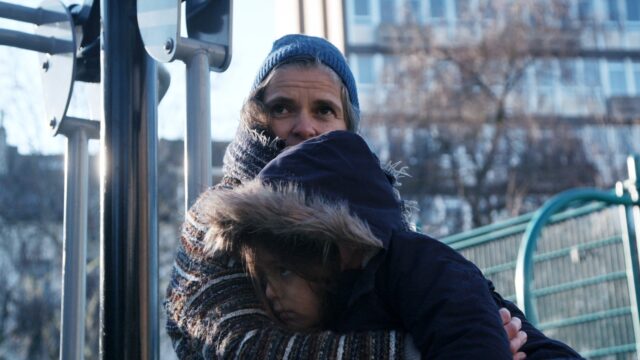
There is a small sandpit inside the Petit école (or ‘little school’) in Brussels. It is an apt metaphor for the school itself. A sandpit has clear boundaries, but within those boundaries there is room for playful freedom – just as in the Petit école, which began life in 2015 and is targeted at children aged 6 to 15 who never went to school before and for whom simply showing up at the right time and doing basic activities with the teachers and other pupils is already a big step towards socialisation.
Many of these pupils come from Syria, we hear. A traumatic past of war and exile, combined with the possible cultural and social differences in the way school is perceived as an institution, prevent many children from entering the Belgian school system. Which is where Marie Pierrard and Juliette Pirlet come in.
The Petit école is the women’s own invention, it appears, and, like the children, also falls outside of the system. Which is both a curse, as they struggle to secure funding, relying partly on private donors, and a blessing, as it frees them from the kinds of regulations and testing requirements that these children are not yet ready for – if indeed, as is remarked at one point, they ever will be.
Still, the school’s raison d’être has to be to prepare these children for entry into the traditional schooling system, as long as they receive some form of official financial support, which they do. But you can feel that Pierrard and Pirlet would rather, while they’re at it, change the whole system as well.
Which makes the sandpit also a metaphor at another level. It seems to be how Pierrard and Pirlet see education for allchildren – not just the refugees who make up the bulk of their pupils. Setting clear boundaries, certainly. But within those boundaries a lot of individual freedom. Looking at what children can do. Instead of, as traditional schools are used to doing with their entry tests (which, of course, were never meant for traumatised refugee children in the first place), looking at how far they are supposedly ‘behind’ – a frustrating, demotivating and even humiliating experience that disregards these children’s knowledge and skills.
For now, Pierrard and Pirlet’s goal is to provide the children with a sense of trust and daily rhythm. And to get trust, you have to give trust. In one striking scene, a young child who is overly energetic and disruptive is taken outside, to a little courtyard, where it can hammer some nails in a board to cool off – with Pierrard holding the nails between her fingers, fully trusting the child to strike the nail and not her. The necessary focus, it appears, being exactly what the child needs to calm down.
Brussels-based director Lydie Wisshaupt-Claudel’s observational documentary is full of such scenes, in which Pierrard and Pirlet interact with the children, carefully guiding them towards some activity or a measure of concentrated effort. These scenes are, of course, endlessly fascinating and there is no reason we will ever see the last of the observational documentaries on school life which, at least since Être et avoir (Nicolas Philibert, 2002), has been a genre staple (last year’s Herr Bachmann and his Class by Maria Speth being another fine example.)
The main difference with those documentaries is that Éclaireuses focuses more on the conversations and discussions Pierrard and Pirlet have with other adults, in which they elaborate on their pedagogical ideas. Here, however, the choice of a purely observational stance runs into problems. Apart for some very basic descriptions (such as ‘a research group’ or ‘open doors for professionals’), it isn’t very clear what the status of these discussions is. Or, for that matter, of the Petit école itself. How successful is this project? How many children do go on and enter the school system? How many give up? What do the parents think? And how experimental is the school, exactly? Are Pierrard and Pirlet making it up as they go along or are they applying existing methods?
To take one example: when two boys fight, instead of trying to stop them, they are led to a corner where they have to follow certain rules, like counting down before they start and stopping when the other one falls – but apart from that, they can still hit and kick each other. The kids seem to enjoy their little kickboxing match, but from a pedagogical point of view, I’m sure there is room for debate. Including whether and how this method is preparing them for life within the traditional school system.
So, what do other professionals think? It seems unlikely they all agree with Pierrard and Pirlet’s approach – there are few fields with such passionate disagreements between well-intentioned professionals as the education system. But even during the aforementioned discussions, the documentary mostly limits itself to what Pierrard and Pirlet have to say, thus avoiding real debate. And of course, none of the other professionals gets to be interviewed on the subject. Because that wouldn’t be observational.
While the observational method fits the interaction between teachers and pupils very well, it becomes more frustrating when the documentary starts adding these institutional and pedagogical layers. Those ask for a more analytical approach, with pros and cons, providing the viewer with more background information and context. Following Jean Vigo’s definition of documentary cinema as a “documented point of view”, we can say the filmmakers fully align their point of view with that of their protagonists. Leaving the viewer little room to question that position and form their own opinion.
As a social and educational mirror, however, Éclaireuses shines a deserved light on two teachers who lovingly, patiently, and professionally take care of children who have fallen through the cracks of the system. At this level the documentary is illuminating and instructive, especially now that a new refugee drama is unfolding in Europe.
Belgium, 2022, 90 minutes
Director Lydie Wisshaupt-Claudel
Production Les Productions du Verger
Producer Joachim Thôme
International sales CBA
Cinematography Colin Lévêque
Editing Méline Van Aelbrouck
Sound Thomas Grimm-Landsberg, Lucas Lebart
With Marie Pierrard, Juliette Pirlet