A fascinating and enthralling film that begins as a story of momentous artistic discovery before spiralling into a heated examination of the power of the cultural establishment. Acclaimed Norwegian filmmaker Nils Gaup’s documentary debut, an International Premiere at Hot Docs, may raise questions and provoke debate but ultimately (and perhaps most importantly) it helps celebrate an artistic talent long thought forgotten, and one that has been hitherto dismissed.
Images of a Nordic Drama (Bilder fra at nordisk drama) traces the determined campaign by art collector Haakon Mehren to champion the work of unknown Norwegian artist Aksel Waldenar Johannessen after finding a cache of paintings in a remote barn. His striking oil paintings depicted prostitutes, drunks and ordinary folk living in poverty, but as it turned out they also ended up irritating the established aesthetics of Norway’s art establishment.
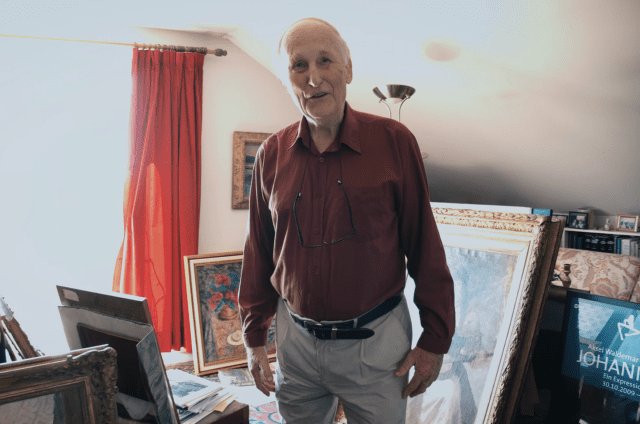
The film opens with ageing Mehren wandering around his living room, packed with books, magazines, posters, folders and artworks. “This is how I live,” he says, the space reflecting an obsession of more than 30 years work. “It’s quite an archive…It will probably end up as garbage when I’m gone. A piece of Norwegian history.”
“Believing that you will find treasure in barns belongs in fairy tales…but the fact is that it changed my life,” he adds.
Controversial Norwegian artist Johannessen was born in 1880, studied at The Royal School Of Drawing and was a member of leading art group The National Movement. He was married and had two children – both Johannessen and his wife Anna worked for The Norwegian Theatre. However, only his closest friends knew that he also was painting. When Johannessen died under tragic circumstances at age 42, his seriously ill wife organised an exhibition of his paintings at Blomqvist, an art gallery in Oslo.
The critics were absolutely ecstatic, especially acclaimed critic Jappe Nilssen who said how “there is a glow and an intensity in these paintings I have hardly ever seen in Nordic painting.” Norway’s pre-eminent painter Edvard Munch agreed, noting how “better paintings are not being made in the Nordic countries nowadays.”
Anna died shortly after the exhibition opened and the Public Guardian took possession of all of the paintings until their offspring were adults. The children were unaware of the success of the exhibitions so when they got the paintings they merely hung some of them at home. And so Johannessen the painter was forgotten.
After finding the paintings in a barn, Haakon Mehren set about restoring the pieces, wanting to exhibit again. “Seventy years after his death and thousands came,” he says of the attendance numbers. He invited Norway’s National Museum wanting to give them half the collection, but the Museum’s director Knut Berg saw it otherwise. “He came to the exhibition acting like a lout,” Mehren says. “[He] shouted and hollered that it was all rubbish.”
Marit Lange, once an Art Historian at National Gallery, is also interviewed in the film and stresses how he thought they were “awful.”
“For the bourgeois art audience these paintings were unpleasant. They are too depressive and gloomy,” said author Arild Bye. “They are…well, frightening.”
In later years new National Museum director Dane Allis Helleland said it was interesting to see increasingly high temperatures around discussions concerning Aksel Waldemar. “I saw two really interesting paintings and I wanted to see some more of his works. Paintings of adequate quality should be included in our collection,” she said. “Mehren has been fantastic by not giving up. 2007 – they were enormously powerful. Not about if [they are] good or bad – it is about treating them seriously.” But internal politics meant that Helleland was destined to leave her , and new director Audun Eckhoff was not inclined to make changes. The Oslo Municipality also chose to turn down the gift of paintings from Mehren, and as the film comes to an end there is an exhibition of Johannessen’s work at New York’s Metropolitan Museum of Art in June 2021.
Nils Gaup’s film makes it clear that the depictions of prostitutes and drunks living in miserable poverty offend the bourgeois aesthetics of Norway’s art establishment and set about challenging the established canon. Certainly the ever-determined art collector Mehren is a polarising figure, but the film ultimately offers a fascinating insight into art world politics and cultural institutions’ ties to big business.
Norway/Germany, 2021, 71mins
Dir/scr: Nils Gaup
Production: Paranord Film
Producer: Linn Henriksen
Cinematography: Andreas Ausland, Martin Edelsteen
Editors: Svein Olav Sandem, Mik Stampe Fogh
Music: Kjetil Bjorkestrand
With: Haakon Mehren, Marit Lange, Øivind Storm Bjerke