

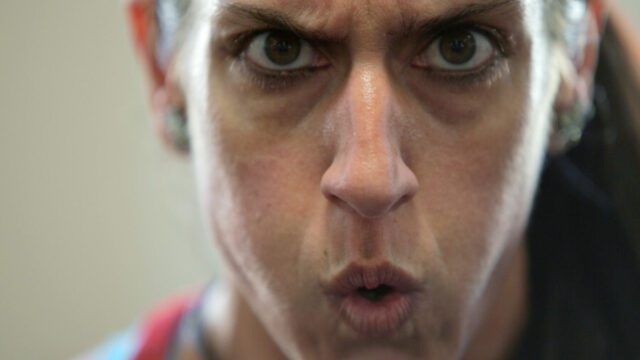
Director Anna Nemes’ fascination with female bodybuilders began over ten years ago when painting was her primary artistic outlet. She was intrigued by their shape, their strength, their quest for perfection. But she wasn’t satisfied merely to surf the internet to find images to use as the basis for her works. She had to meet her subjects, even if the community of female bodybuilders in her native Hungary was tiny.
“I wanted to meet them and to talk to them, to understand the whole phenomenon and make the paintings with this knowledge,” she says. And when she did, “a totally new universe opened up for me.”
She met women who were seeking self-fulfillment through bodily perfection. “But in their case it’s a big sacrifice because in order to achieve that goal, they have to live with the fact that they are so-called freaks in society,” Nemes stresses. “I think society is not really ready for this kind of openness yet. We talk a lot about, ‘you can be whatever you want blah, blah, blah.’ But many times I see that on a different level people still have these conservative ideas.”
When she met her muses in person, Nemes soon realised that only the medium of cinema could do them artistic justice. “Paintings were not enough,” she says. So she embarked on two film projects about female bodybuilders, the fiction feature Gentle which was selected for Sundance 2022 and the documentary Beauty of the Beast, world-premiering at Sheffield.
In Beauty of the Beast we meet four women (unnamed until the final credits) whose lives are defined by their dedication to, and knowledge of, their bodies. At one point, Eszter (who is also recognizable as a key protagonist in the fiction film Gentle) recites a dizzying account of her body’s constituent elements (37.7 litres of fluid in her body, 10.9 kilos of protein in her muscles, 9.2 kilos of skeletal muscle, 3 kilos of muscles on hands, 23.8 kilos of muscles on her trunk etc, finally ending with a mere 0.4 kilos of fat). At another moment we hear the distressed call she puts into director Anna after a terrifying nightmare in which she saw her mother driving away in a car with her head on God’s shoulder. While the other characters seem relatively happy with their lot, Eszter is a fragile soul.
We hear observations throughout the film from the other women, such as the toll that such bodily exertion can have on the face in terms of ageing, but also how the possession of supreme physical strength can be as majestic and as sublime as ownership of the perfect sculpted body.
The final sequence of the film is superb in its depiction of the bodybuilder’s grace, artistry and elation, with a piano rendition of Beethoven’s solemn Allegretto* providing heart-breaking counterpoint to the visuals.
Nemes is just as precise in sculpting a perfectly honed art film from her material. Like Eszter’s body, the 47-minute film doesn’t have an ounce of excess fat. “I wanted it to be focused, cut the bullshit out and just focus…which meant that it had to be shorter and more concentrated. I think many times [when] I watch a documentary it’s 15 or 20 minutes longer than it should be because many people think that they have to do a 72-minute film to be taken seriously. This is just not the reality. You have to decide if you want to make a good film or a bad one, not to make a long film,” Nemes observes.
This was an opinion shared by her co-editor Rudas Marianna who understood implicitly where the director was coming from with the film. “She was amazing…She wasn’t just sitting there like a robot doing what I tell her. She could really follow my ideas. And really understand the goal.”
“I believe documentaries and other films are a medium of art and [each movie is] a unique individual universe,” Nemes explains her filmmaking philosophy. “And I truly believe that they are not an application for storytelling. I really don’t like when people call moviemakers ‘storytellers.’ It’s terrible. I think it’s degrading…if I want to have stories, I read books,” she says.
“A film is a really complex thing. It has rhythm. It has sound, images, everything. I believe that we can tell a lot through just simple images and rhythms and non-verbal stuff. We don’t need to explain everything on a cognitive or intellectual level.”
She further tells how at film workshops people wanted to know where the narrative arc of her film was. “I was like, I don’t have a narrative arc…I don’t care about the narrative arc. It’s other people’s life. It’s not a story.” And if the circumstances of the story deliver one of the bodybuilders to a major competition by the film’s end? “I wanted to honour [that] by showing it…I didn’t use it just to make a narrative arc documentary.”
So is Nemes herself a bodybuilder, I ask, after she points out that her surname actually means ‘noble’. “No, I’m not bodybuilder. I’m skinny, I have the body of a frog,” she laughs, before reflecting further on the aesthetics of her subjects – and their bodies.
“I believe that body building is not different from making art. It’s an art form. It’s like contemporary dancers. They also use their bodies to somehow [express] themselves. This is the same thing. [But] it’s just a long term project in the case of a female bodybuilders, because it [takes] 15 to 20 years to achieve this kind of body.”
*Beethoven 7th Symphony, 2nd Movement





