The prodigious talent of jazz legend Louis Armstrong is beautifully celebrated by filmmaker Sacha Jenkins (director of Wu-Tang Clan: Of Mics and Men) who revisits the music, the man and his legacy, and reappraises the politics of the legendary jazz trumpeter and singer.
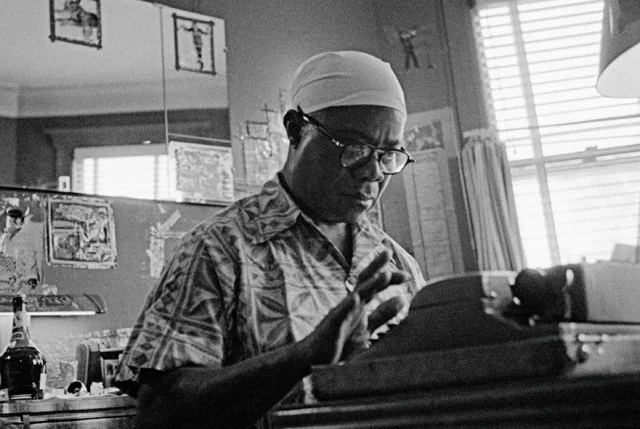
The film – engagingly credited as a ‘Sacha Jenkins Jammie’ – draws on Armstrong’s many hours of meticulously recorded reel-to-reel audio diaries and scrapbooks which go some way to revealing a different side of the man, other than the genial, ever-affable personality that he presented on stage and to the camera.
Though relatively straightforward in structure, Louis Armstrong’s Black & Blues revels in his charm and talent, detailing his tough origins in New Orleans; how he was introduced to music; how he grew to became a major talent celebrated around the world and how he was dismissed by some for seemingly never taking an overt political stance on racism. The film leaves criticism of him until the closing section (and any criticism is nicely redressed) as it chooses to celebrate the talent and complexities of a major talent.
The film opens with television footage of Orson Welles (standing in for usual host David Frost) as he introduces Armstrong to his show as “one of the greatest influencers” who has long been “the number one in his department.”
“There will never be another one like this,” adds Welles as Armstrong starts to perform.
Armstrong’s wife Lucille recalls how happy he was at their house in Queens in New York (adding that he was a “deep person, aware of what happening around the world, but he would never come out in public when asked questions”) where he used to record conversations with friends and family, adding that he spent hours indexing the recordings as well as making up scrapbooks of his career.
The film extensively uses snippets of audio alongside evocative archive footage and clippings to tell his life story, from his early days as a youngster working in the red light area of New Orleans; his time in a Waif’s Orphanage where his musical talent was fostered, and eventually moving to Chicago in 1922 to play with mentor Joe “King” Oliver.
The film astutely details how white managers controlled his career as well as his brushes with gangsters; how he had mixed feelings about his film career (he felt poorly treated in Glory Alley, but fared better in later films such as The Glenn Miller Story, High Society and Hello Dolly), and how he was an enthusiastic marijuana smoker, and even spent nine days in a Los Angeles jail after being arrested.
The film grapples with how Armstrong was perceived by a younger, more radical generation who thought he was overly accommodating to white audiences. Ossie Davis, Amiri Baraka, and Wynton Marsalis each admit to being detractors who turned into admirers.
Actor/director/activist Ossie Davies says that some of his friend would ridicule Armstrong for “doing his thing for the white man” but admits he re-thought his feelings after working in a film with him in 1966. He says: “He did what he did to survive…under all that mouth was a horn that could kill a man.” However, when Armstrong did speak out he was such a celebrity that it made national news. He criticised President Dwight D Eisenhower because of his inaction during the conflict over school desegregation in Little Rock, Arkansas, in 1957, calling him “two-faced” and “gutless”.
The film features archival recordings of contemporaries including Dizzy Gillespie, Count Basie and Artie Shaw, as well as Armstrong’s second wife, pianist Lil Hardin, and his last wife, Lucille, to whom he was married for almost 30 years. Passages from his private correspondences are read by American rapper Nas.
Louis Armstrong’s Black & Blues is a film to be cherished, and warmly and intelligently celebrates not only Armstrong’s talent as a musician but also dwells on his singing, joking and ability to spin a story. His sheer force of personality shines though, revealing a generous and astute man blessed with rare skills. Louis Armstrong Black & Blues perhaps pays him the greatest respect of letting him tell his story in his own words and images.
US, 2022, 104mins
Dir: Sacha Jenkins
Production: Imagine Documentaries, PolyGram Entertainment
Producers: Sara Bernstein, Justin Wilkes, Sacha Jenkins, Julie Anderson
Cinematography: Ed Lachman
Editor: Jason Pollard
Music: Terence Blanchard