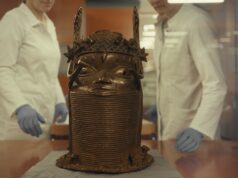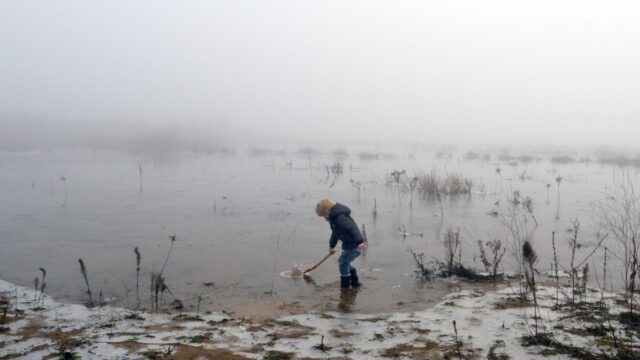
“Sketches that were never meant to appear in a film form the backdrop for texts written a hundred years ago by the Dutch writer Nescio,” is how producer Paul Ruven (Talent United) describes Nescio, the new project by the highly artistic Dutch pairing of Eugenie Jansen and Albert Elings.
“By bringing Nescio’s themes into dialogue with contemporary lives and landscapes, they’ve created a film that is both reflective and immediate: a cinematic essay about shifting realities, generational change and the fragile things that still offer us orientation.”
Using the filmmakers’ own personal archive of home footage the film is “composed of vignettes that meander like a river overflowing its banks, through which Nescio’s vision resonates within the personal present,” reads the film’s synopsis.
It continues: “Nescio’s ‘Little Poet’ finds the road from cradle to grave a meaningless procession. Bavink, the painter, tries in vain to capture the sun reflected on the water and ultimately ends up in an asylum. Japie loves nothing more than sitting by the waterside for hours, drifting into reverie, but eventually steps off the Waal Bridge. What unites them is their inability to realise their ideals and creative ambitions. These characters do not appear literally in the film; rather, they offer a lens through which to view our own time.”
Producer Ruven is equally lyrical in his description of the 90-minute project that will be ready before year-end. “This is a kind of film you probably have not seen before,” he tells Business Doc Europe. “I would definitely NOT call it an experimental film, but rather an investigation, or an exploration of cinematic language, in which the filmmakers use their own archive.”
“Yes, there are storylines. But the story itself is not actually the main thing in this film,” Ruven adds. “And although you may think the film has a loose structure, this is carefully composed. It’s like the way memories surface, never in the right order, and always for a reason you only come to understand later. It’s a film you can let yourself be carried away by, one you experience rather than fully understand.”
He further describes what we will encounter on-screen. “The film consists of many long, atmospheric, poetic observations of landscapes, water, sun, and clouds. These are intertwined with down-to-earth, everyday scenes that have an intimate touch. The person behind the camera stays close to the people on screen, and sometimes interacts with them. Both landscapes and people are observed gently, rarely in close-up, but always with a sense of closeness. Occasionally there are time-lapses, drone shots, whip pans, and double exposures, drawing on every corner of cinematic language.”
Jansen and Elings have long taken a “a unique stance within the landscape of Dutch film culture, often ahead of the pack,” Ruven tells BDE, citing how, back in 2002, “they were among the first in the Netherlands to work with non-professional actors in a feature film that was difficult to classify as either fiction or documentary (Tussenland),” for which they won an IFFR Tiger Award. Before the introduction of the smartphone, they composed a film from (mostly handycam) footage shot by amateurs on the wedding day of the Dutch crown prince (Nader tot Máxima: The Royal Wedding Tapes). He further refers to Jansen’s Above Us All (Generation+2014), in which the camera is turned 360 degrees in every shot.
“With this new film, they take another step forward in their approach to cinematic storytelling,” Ruven underlines of Nescio.
The filmmakers write how, “we are living through a time in which old certainties are rapidly falling away: climate change, collapsing ecosystems and large-scale migration are reshaping our sense of the future. For younger generations especially, this creates a profound awareness of instability and loss, but also an urgent need to imagine other ways of being in the world.”
“By bringing Nescio’s themes into dialogue with contemporary lives and landscapes, we hope to create a film that is both reflective and immediate: a cinematic essay about shifting realities, generational change and the fragile things that still offer us orientation,” they continue. “The film does not seek clear answers. Rather, it tries to stay open to uncertainty, while making visible what remains true, beautiful and sincere.”
Ruven replies: “The strength Albert and Eugenie bring to this film is their compassionate and tender way of looking at the world. It’s their unique and authentic approach to filmmaking. Urgent stories all too often crowd out the important questions everyone must ask themselves at some point in their life: What are we doing here? What are we doing it for? Why does any of this exist at all?”
“It’s a film for everybody open to engaging with the unanswerable questions of life,” the Dutch producer signs off.