

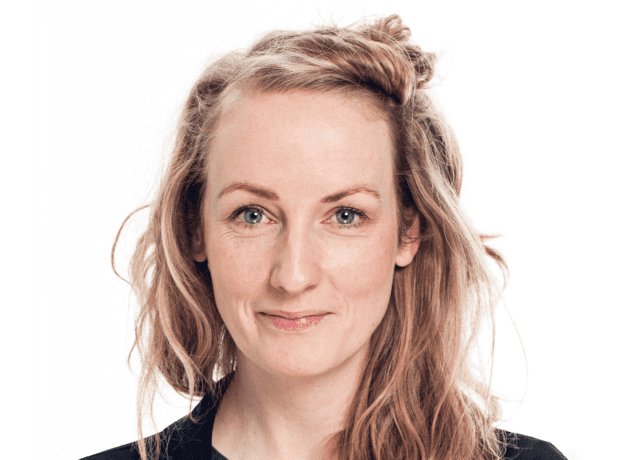
Business Doc Europe sat down with Rut Sigurðardóttir, the Icelandic participant at this year’s IDFAcademy, the Dutch docfest’s workshop and training program for emerging documentary filmmakers and producers.
Sigurðardóttir is currently working on her first documentary feature, titled Skuld and produced by Bíóbúgí in co-production with Freyja Filmwork. During our chat, we spoke about her new project and her approach to non-fiction filmmaking, among other topics.
First, we asked Sigurðardóttir to describe Skuld briefly and touch upon its main themes: “Skuld is a documentary about my partner and myself, a young couple who puts at risk their financial situation and relationship when they start working as independent fishermen on their small fishing boat, called Skuld.”
“It felt like such an absurd situation to be in, having bought this boat and being on it together in the North Atlantic, far from everything. Going from feeling like the king of the harbour one day to despair the next really made me question why we were doing this and why we loved it, and loved hating it. Perhaps the making of the film was an attempt to understand the situation better and to really force myself to look inwards, find meaning and understanding of my own being and vision, seeking an answer to the question: ‘Why the f**k are you doing this, Rut?’”
The picture, now nearing completion, should be ready for a release early next year. When asked what brought her to explore the field of non-fiction filmmaking, Sigurðardóttir gave us a very straightforward answer. “I’m known for having a really bad memory, where I usually can only remember as far as two years back. So I’m going to guess that either I was bored, or this was my way of documenting what I find interesting at each moment, so that I’ll have something to go back to when my memory fails me. But probably I was simply bored…”
She describes her approach to filmmaking as “intuitive” and based on “a trial and error” method, “mixed with a lot of grinding and a dash of megalomania.” “But I like to believe that I value respect and authenticity in my approach to work,” she added.
Speaking about her creative style and why she decided to pick herself and her partner as the documentary’s main subjects, she further explained: “I always believed that I wanted to tell other people’s stories, to bring other people’s narratives and views out to the public. But very soon I realised that, of course, I’m always telling my own personal story, exploring my personal identity and role in this crazy world. [It’s] so obvious when you think about it… my covert narcissism disguised as altruism!”
Commenting on the current climate for docs in Iceland and, more broadly, across the Nordic countries, she said: “Maybe people are becoming more curious about the documentary form in Iceland, more than ever before. It’s not a huge scene, but a growing one. We definitely look at the other Nordic countries for inspiration and as someone we can learn from, that’s probably because of the professionalism and understanding they have in the field.”
Sigurðardóttir seems ready to look beyond her country for her future endeavours: “It’s hard to shake off the obsessions I have for the ocean, fishing, cultural heritage and the [search for] beauty and extraordinary within the ordinary. The latter is a universal theme and I would love to challenge my current belief system somewhere beyond Iceland.”





