

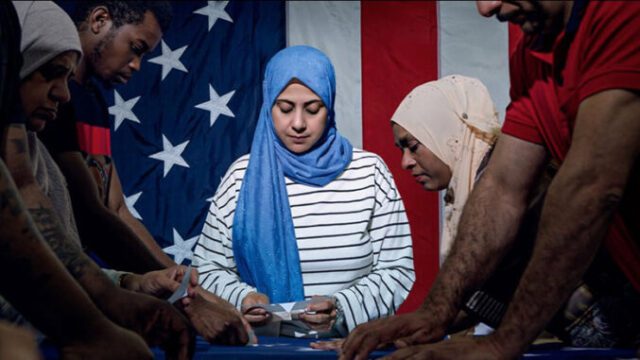
Eder Flag is a US employee-owned company that produces and distributes five million flags per year, as well as the poles needed to hang them on. But this mid-Western blue collar flag factory isn’t populated solely by locally-raised Wisconsin folk, rather by a majority workforce of immigrants and refugees who have chosen America as their new home.
In Cynthia Wade and Sharon Liese’s award-winning short film The Flagmakers we are told the stories of four company employees. Radica, from Serbia is the understanding and thoughtful boss on the shop floor who, at least at the beginning of the film, questions whether the market for flag production can ever be sustained. But that was before the world-changing events since 2020, such as Covid, the emergence of Black Lives Matter and the storming of the Capitol building, all of which in their own way contributed to increased sales.
Ali is a new arrival from Iraq, together with his wife and small kids. He survived the war in Iraq and is now starting work at Eder Flag under the patient tutelage of Radica. He has dreamt of living in America for 12 years and wants to do his job perfectly, buy a car and raise his children well – even after he suffers a vicious and unprovoked attacked by a stranger in a Walmart store.
Sugar Ray is a Black man born and raised in Milwaukee, a loyal employee but critical of the country he is living in. He can easily understand the pride his fellow workers feel in the American flag and their dreams of being whatever they want to be. But Sugar Ray reflects on the status of Black and Brown people, how “when you learn about how this country was built…it doesn’t include you.”
Barb meanwhile is a local white woman with distinct right-of-centre leanings. “If you come to the country legal, that’s fine,” she observes. “My ancestors fought for the flag. [The US is] better than a lot of countries, that’s all I know.” It would be easy to cast Barb in the token role of tub-thumping Trump-voting Republican, but her portrayal is subtler than that. She might seem grouchy but she helps her fellow workers revise for their citizenship examinations. And their appreciation of her is obvious as they line up to embrace her when she is presented a leaving cake.
“We were looking to have a nuanced story, sure,” underlines co-director Liese. “Not spoon-fed, this person is this and they’re gonna change to this. We really were leaning into nuance and to allow our viewers to look at it and make their own decisions. Some people identify with Barb on certain levels and others identify with her on completely different levels. She’s a great character for us.”
That said, it was the recent appropriation of the US flag by the conservative right that drove the filmmakers to tell this story, they explain. “I think for both of us, the genesis of this film emotionally was our recognizing [something] we felt super uncomfortable with. The way in which the flag, the American flag, had been co-opted by a very right wing conservative [base],” says Wade. “A ‘you’re with us or you’re against us’ kind of political affiliation. And certainly here in the United States, if you’re sticking your flag in front of your house, if you’ve got an American flag bumper sticker on the back of your pick-up truck, or literally flying from the back of your pick-up truck, you are signaling, I think, a very narrow conservative intolerance to a more nuanced relationship with the American flag, and maybe even [signaling] a more nuanced and complex relationship to the United States.”
“The factory was a perfect place to then explore those feelings and try to encapsulate [how] there are so many different American experiences in this country. And there are so many different American experiences inside Eder Flag. So it [the factory] became this microcosm of the larger canvas which this messy democracy of a country is,” Wade adds.
How do the filmmakers think buyers of the flag will respond to a documentary that tells them that their cherished purchases were made by immigrants. A telling answer lies in the response of the factory owners, Liese points out, one which also indicates Eder Flag’s tacit approval of their film. “The chairman of the board of the flag factory said that this film could cause them to lose some customers – and that they’re okay with that.”
The Flagmakers is only 35 minutes long, but could easily have been a feature given the avenues the filmmakers explored and the rabbit holes they went down during its development and production, such as the myriad tales of regional and state flags across the US, not to mention the other fascinating individual stories were left on the cutting room floor.
But The Flagmakers still offers so much. Not only do we encounter four stories in which each character undertakes his or her very specific journey, we also observe the complex flag-making processes. Even the business of applying the stars requires 250 turns of the material – 50 stars, five points on each. Some flags are so big the whole shop floor has to turn out to manipulate, sew, fold and pack the material.
Then there was the pandemic, when filming was not permitted, but a period which is nevertheless covered sensitively in the film; the rise of Black Lives Matter, when flags with an altogether different political significance were waved, and the storming of the Capitol building when flagpoles carrying the Stars and Stripes were literally weaponized to bludgeon the police force protecting the building.
“I think that it’s actually harder in many ways to make a short where there’s both complexity of story and layers of characters, but also where there’s room for breath, room for silence and room for reflection,” comments Wade. “It’s a particular kind of Rubik’s Cube. It’s really hard to find that balance in a very short form.”
Which is why the pair were continually compelled to return to the essence of their story, ie the dichotomy whereby the most potent symbol of US identity was being manufactured wholesale by folk born far beyond American borders. It was a pitch that convinced National Geographic to come on board 18 months after production began of the film in 2019.
Given the turbulent political times during which the filmmakers were shooting their doc, were they aware that they were telling a story of such socio- and geo-political significance? Not at all, answers Wade. “I think in the midst of it, you’re just trying to follow the story, you’re just trying to show up,” she says. “I feel like [in] this country, we’ve been frogs in water and the temperature has been rising slowly and you don’t recognize that it’s boiling in the moment.”
The Flagmakers has won three awards since its world-premiere in September at the Camden International Film Festival (US), namely the Audience Award at the Denver International Film Festival, Best Doc Short at the Savannah Film Fest (Georgia) and the Audience Award at Indiana Yes! It also received a Critics’ Choice nomination (Critics’ Choice Documentary Awards 2022.) The film launched on National Geographic December 8 and hits Disney Plus on Dec 21.
What producers of documentary shorts rarely get to experience is having their film optioned for presentation on Broadway. This has been the case on The Flagmakers. “The producer Mark Gordon heard that we were working on the film and wanted to see some early footage and got very excited and said, ‘you know, this would actually make a great theatrical musical, in the vein of something like Come From Away,’ which has been on Broadway for years,” says Wade.
“Obviously a flag factory is very visual, but then just all of these stories from around the world and thinking about all the kinds of styles of music and dance, I was like, oh, I hadn’t ever thought about it as theatrical.”
“A musical seems so obvious,” she concludes.





