

It’s not so often that a short documentary that eschews narration, dialogue and soundtrack, and which a lot of the time is presented in slow motion, arrives at the business end of the annual Oscar jamboree.
But those were the artistic choices made by debutant directors Jack Weisman and Gabriela Osio Vanden for their audacious and highly cinematic Nuisance Bear, which can be viewed on The New Yorker website.
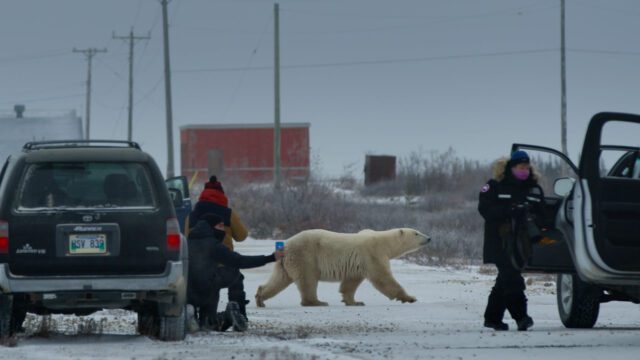
Every year, polar bears numbering from a few dozen to several hundred proceed through Churchill, Manitoba. It is an awesome sight and highly popular therefore with tourists and professional observers alike. In their film, Weisman and Osio Vanden choose to focus on just one of these magnificent beasts as it goes about its business of sauntering, sniffing and curiously checking out the contents of the local waste disposal area.
But don’t expect the dulcet tones of David Attenborough or suchlike to accompany and explain the film’s visuals. For the filmmakers, the howling wind, crashing waves, thudding paws or revving truck engines are enough by way of sonic discourse.
“This particular town has no shortage of television crews, filmmakers, photographers coming to document the story of the bears passing through,” explains co-director Weisman. “They have various angles, you know, a mother and cub story, or hobbyists taking photos of bears in the wilderness, or television crews that are covering the bear management program. In any case, there’s a lot of different versions of the story being told every year. So for us, it felt like there was this natural opportunity to try to tell a story as close to the bears’ perspective as we could. Bears presumably don’t talk, at least not in the way that we do, and they don’t listen to music. And so removing those elements felt like a natural creative limitation.”
Osio Vanden further reflects on their being part of the scrum of onlookers recording what they were seeing. “You know, we were trying to be self-reflective with it as well. By including film crews [in the shots] we’re critiquing ourselves as filmmakers. I think that’s part of the reason why we ended up not having music and narration. We just wanted to avoid being manipulative in any way. And we always knew we wanted more of an observational approach.”
The film opens with a spectacular slo-mo shot of a bear ambling left to right, before a crowd of observers appear in the frame, seemingly close-by with mobile cameras in hand and protected by their open car doors. It all seems quite relaxed and unthreatening until the polar bear is chased away by a truck. The scene challenges the notion that the animal is a terrifying and dangerous predator from whom one should remain at a considerable distance.
“This subpopulation of bears that migrates through Churchill, they’re very used to going there, and so they’re desensitized,” explains Osio Vanden, who tells how some of the bears would regularly come and sniff the truck they were filming from. “So that’s part of what our film is about. It’s just they’re used to the paparazzi, to tourists. They’re used to the smells of food around town. They’re used to seeing people, used to seeing cameras, they’re used to seeing shotguns. They’re used to seeing pick-up trucks. So they’re all familiar [elements] for them. So that’s why this specific group of bears already have a relationship with this place.”
The bears know when a human is a friend or foe as well, as evidenced by their reaction to the specific sound of a Ford F150 truck, the type used by the bear management wardens tasked to chase the animals out of town. “It’s probably not obvious to the viewer, but…as soon as it hears that truck, it dips into the woods. They’re really intelligent,” adds Weisman.
The film has received more than 25 international awards and nominations, and much critical acclaim, since its world premiere at TIFF 2021, but how do the filmmakers reflect on what initially began as a research project. “I’m really excited that we didn’t compromise. We self-funded this project,” says Weisman. “I don’t think we could have ever anticipated what the result would be…Something I’ve taken away from this project is that if you place the camera at the right spot at the right time, the film will always reveal itself. You’re more of a witness than an active creator…It was really beautiful not having those expectations, we just sort of allowed the film to take shape in the way that it needed to.”
“We were okay with this trip potentially just being research,” adds Osio Vanden. “We didn’t put pressure on ourselves to have to come out of it with a film. But while we were there, I think for all of us, when we got that opening shot, that long shot, we realized that we had a film. That’s a concrete way to communicate how the film told us what it was gonna be.”
“And we need to show thanks to The New Yorker,” Weisman further underlines. “Of course, they recognized the film at TIFF and they’ve waited over a year to release it and allowed us to go on this festival run, and have been as supportive as they can during this [Oscar] campaign.”
For Weisman this may also be a very busy campaign, given how he is executive producer on the Feature Doc shortlisted The Territory by Alex Pritz with whom he grew up in Ithaca, NY, together with the film’s producer Will N Miller. “We started making short films together when we were about 12. So to have our first films accepted and recognized in this way at the same time, is just like a dream come true,” he says.
Another pleasing dimension to the whole story is that, while Weisman and Osio Vanden knew one another before they started production on Nuisance Bear, Churchill is where the pair got it together romantically. That said, they don’t want to be joined at the hip in their future endeavours, they say. “We’re partners in film and in life, and I think this project was really demanding on us as filmmakers, but also on our relationship too,” explains Weisman. “We don’t want to just be known as two co-dependent directors. We both have different sensibilities. And I think that it’s good that we explore other projects separate from each other, and then, like, collaborate on particular projects in different capacities too.”
Osio Vanden concurs, but reminds Business Doc Europe of the romantic lure of the Arctic and its furry inhabitants. “Churchill is really where we fell in love and where we solidified our relationship,” she says. “So this bear story’s been part of our relationship.”





