There is a structural tension in the concept behind In Ukraine by Tomasz Wolski (1970, 2021) and first-time feature director Piotr Pawlus. Their film is a world premiere in Berlinale Forum.
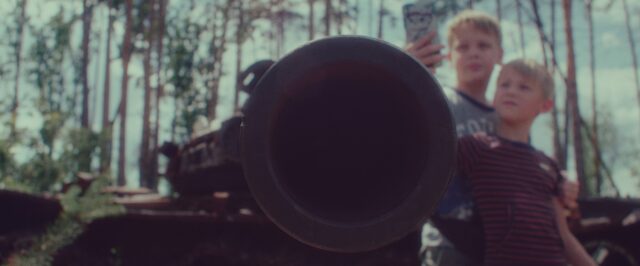
By combining static, predominantly wide framing with long takes, Pawlus and Wolski provide the viewer with the time and space to let their eyes wander over the images of war-torn Ukraine. Staying mostly outside the war zone, In Ukraine gives an impression of everyday life for Ukrainians living in areas damaged by Russian aggression but not under direct attack at the time of filming. We see people repairing buildings, manning roadblocks, distributing food, but also simply walking down the street, driving a car, crossing a river. There are children playing among the rubble, and people taking selfies with destroyed Russian tanks. There is life.
We have seen this basic concept in other documentaries about beleaguered Ukraine, such as A House Made of Splinters (Simon Lereng Wilmont, 2022) and Mariupolis 2 (Mantas Kvedaravičius, 2022). Like Pawlus and Wolski, those filmmakers wanted to show everyday life behind the news footage, away from the fighting. How does a school function just a few kilometres from the frontline, like in A House Made of Splinters? And how does daily life go on when you are surrounded on all sides by bombing and nightly fires, as in Mariupolis 2?
This is a clear and obvious function of documentary in times of war. To take the long road, to show what happens after (and before) all the attacks, the bombardments, the ruins, the fires, the running, the screaming, the dead and the wounded have been shared on the world’s news channels.
Usually, these documentaries (like the two mentioned above) also show a more personal side to ‘life during wartime’. But In Ukraine takes a somewhat different approach. It’s true that, in the film, we also see civilian and military Ukrainians going about their daily business, and in the process we learn about their hardships and their often remarkable resilience. But while their camera sometimes moves in closer, as filmmakers, Pawlus and Wolski remain at a distance.
We never see the filmmakers. Because of the static framing, we almost never sense their presence, as we would with handheld shots. We do not hear their voices, as there are no interviews. There is no voice-over, and there are no explanatory texts. There is little dialogue. And there is no music.
When I once asked David Cronenberg about this, who – in a very different genre – also tends to keep his camera at a distance and his shots relatively long, he referred to his interest in lepidopterology (the study of moths and butterflies). And one can indeed recognize in his films the inquisitive stance of the scientific observer, like an ethnographic researcher. Or, in the case of Cronenberg, like a surgeon performing an autopsy – every detail is studied with great attention and commitment, but the individual personality of the body in question tends to fade into the background.
There is, of course, a moral component to this tension. By taking a more detached, less personal approach, the focus shifts from individual Ukrainians to a more sociological view. This has its advantages. It gives the viewer space to breathe and time to reflect. But the sense of distance also feels impersonal. As if the people in the frame are subject to the concept. Some scenes, to me, naturally raise questions, which are not asked – they couldn’t be, because the concept doesn’t allow for them. Or for any kind of visible connection between the filmmakers and the filmed, for that matter. These moments, when the concept seems to overrule connection, feel wrong.
In a similar sense, the undeniable beauty of the framing also clashes uncomfortably with the reality of the situation. It’s a familiar tension in art: the beauty of horror, the aestheticisation of violence – which alienates us from reality while at the same time, through its aesthetic appeal, actually allowing us to approach that by which we are instinctively repelled.
It is exactly in this sense that I believe the central tension of In Ukraine, created by distanced observation collective suffering which also , of course, consists of individual suffering, ultimately does more good than harm. There are good arguments to be made for not overwhelming the viewer with tragedy. And instead to give the viewer room to pause and think. To contemplate. The Russian invasion has been going on for a year now and does not seem to be ending any time soon. However uncomfortable it may feel, it is time to acknowledge that also under these conditions, everyday life has no choice but to continue. And, just as for the Ukrainians whom we see walking past destroyed buildings with seeming indifference, the real uncomfortable truth is that these images of destruction will be with us for some time to come. We might as well, in some ways, get used to them.
In their directors’ statement, Wolski and Pawlus say that, ‘through a simple concept that relies on anticipated shots shot with a static camera, we are looking at the collective.’ It is indeed what they have done. And uncomfortable though that may be at times, there is much to be said for this approach.
Poland/Germany, 2023, 82 minutes
Director Piotr Pawlus, Tomasz Wolski
Production Kijora Film
Producer Anna Gawlita
International sales Taskovski Films
Script Piotr Pawlus, Tomasz Wolski
Cinematography Piotr Pawlus
Editing Tomasz Wolski
Sound design Igor Kazmirchuk
Sound Piotr Pawlus, Tomasz Wolski