

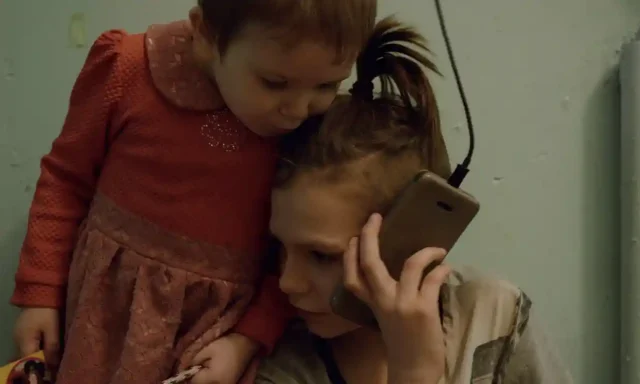
Danish director Simon Lereng Wilmont freely admits when his film A House Made Of Splinters premiered in Sundance last January he had no idea that only a few weeks later the Russians would invade Ukraine.
The heart-rending documentary charts the experiences of kids temporarily removed from their parents in an orphanage in eastern Ukraine.
“I think it took both me and a lot of my Ukrainian colleagues by surprise,” Wilmont says of President Putin’s “special operation” in Ukraine which saw tanks and troops cross the border on February 24. After all, Putin had made these kinds of threats before and had even previously mustered forces on the Ukrainian borders – but he had always eventually pulled back.
“I remember being in Kyiv five days before the new invasion happened. I was sitting with one of my colleagues and we were laughing at another of my colleagues because he was saying that this time Putin really means business…we were drinking red wine, laughing and maybe even making a little bit of fun of him – and then, five days later, the terrible thing happened.”
A House Made Of Splinters [sold by Cinephil] won the Directing Award: World Cinema Documentary in Sundance. However, Wilmont spent little time basking in the success. He and his colleagues immediately started “trying to figure out if anything could be done for the people that we had gotten so close to.”
The filmmakers had hired a local psychologist with a specialism in children and trauma to look after the kids once the filming of the documentary was completed. She was at the shelter on the morning of February 24 and quickly contacted Wilmont and his team to let them know that the kids were safe. Many had already been put on a train that was taking them westward – and out of harm’s way.
Along with assistant director Azad Safarov and Lena Rozvadovska, founder of the charity The Voices Of Children, Wilmont began organising fundraising screenings both of A House Made Of Splinters and his previous doc The Distant Barking Of Dogs (2017), about the experiences of a 10-year-old boy during the war in Donbas.
“Throughout the year, and especially at the beginning, we have had a lot of charity screenings where all the profits go to Voices of Children,” the director notes. “It’s an organisation that I really trust. I know the people that run it. They are doing an amazing job.”
At first, the money was being used “just getting the basics – food, blankets, a place to live, heating.” The charity was also looking to provide psychological help for the kids. “There were hot lines so wherever you were in Ukraine, you could call in and have psychological help.”
Wilmont sighs. “It was a huge job, first of all gathering the funds but at the same time also trying to figure out what was the most crucial need.”
The director noticed that responses to the film changed after the invasion. “There is no doubt that audiences around the world put it in [the] context of the war,” he says.
Spectators were desperate to do something to help. However, there was a period early in the war when the Voices of Children website was compromised and supporters were warned not to click on it.
“I think actually it was the Russian trolls,” Wilmont suggests of the online sabotage. “You have to remember it was a relatively small NGO. In the beginning, they were a bit vulnerable. But very quickly they got some super amazing tech guys to look at this. I think it got solved within a day or two. There has been no problem ever since.”
The film focuses on the experiences of three of the children passing through the orphanage: girls Eva and Sasha, and the boy Kolya. They’ve had mixed fortunes since the war began.
Eva’s grandmother, who took her in and adopted her, had already passed away from Covid. However, her grandfather has taken over her guardianship.
The woman intended to become Sasha’s foster mum suddenly “got cold feet”. That meant that Sasha is now back in an orphanage, albeit one in the EU. Kolya is in the same establishment.
“From what we hear of Sasha and Kolya, they are both doing really great in Europe.” Wilmont says. Sasha’s new passion is gymnastics, at which she thrives.
Wilmont adds, though, that Kolya hasn’t been able to speak to his siblings with whom he was in contact regularly before the war started.
It’s almost a year since Wilmont completed the documentary but he hasn’t been able to move properly onto new films. He and his producer Monica Hellstrøm (who was previously at Final Cut For Real but has now set up her own company) are at the very early stages of developing a film in Moldova but there is unfinished business with A House Made Of Splinters.
“It has been quite the work trying to get the film out there and building the platform for the film from where we can make sure we keep the focus on the vulnerable kids that are in this horrible situation right now in Ukraine,” he says.
Wilmont admits that he sometimes feels guilty has hasn’t been to help his subjects yet further. “I keep on wanting to do more but it is difficult to find out what is the right thing to do.”
The director recently returned to Ukraine for a special screening of the documentary in Kyiv. “We wanted to get hold of the political establishment,” he explains. “We think within the film there are so many great ideas of how to build up this part of children’s services for when they [the Ukrainians] finally kick out the Russians.”
One senior government figure was in attendance. “The ombudswoman for children’s rights was at the screening. She saw it and came over afterwards. She was in tears and asked if she was allowed to show it at a closed screening to [President] Zelenskyy.”
As for being back in Ukraine, the director says that was “like coming home in a way, meeting all of my good friends and some of the characters from the film. Kyiv was relatively calm. Yeah, there is a war going on and you can see it in everyday life…but when I was there, people were still drinking coffee at the small cafes outside. It was beautiful, amazing to be back!”
Now, the awards race is underway. Animated Danish doc Flee, also produced by Final Cut For Real, was an Oscar nominee last year but Wilmont believes it will be an uphill struggle to emulate its success.
“We are a little bit a dark horse,” the director says, pointing to the limited resources available for the Oscar campaign. However, the film was recently nominated for an Independent Spirit award as well as for a European Film Award. Such acknowledgements suggest that A House Made Of Splinters must be in with at least an outside chance of Oscar glory…





