

The stories behind some of the great Formula One rivalries have been brilliantly told on celluloid over the past years. Asif Kapadia’s ground breaking Senna concerned the eponymous hero’s fractious on and off track relationship with the French driver Alain Prost, while the high octane 1970s rivalry between James Hunt and Niki Lauda is explored in the fictionalized biopic Rush, directed by Ron Howard.
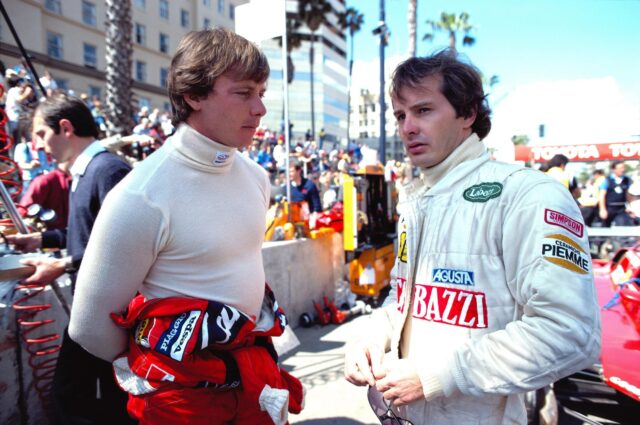
A story that few people are aware of (although it is one told and retold by F1 aficionados) is that of Canadian wunderkind Gilles Villeneuve and the brilliant French driver Didier Pironi, whose intense rivalry came to a head during the F1 World Championship of 1982. Such was the intensity of their combat, and the emotions that it sparked, before the year was out one of the protagonists would end up dead and the other would suffer terrible career-ending injuries, only to die five years later, once again looking to satisfy his need for speed.
Torqil Jones’ Villeneuve Pironi, which is selected for the Glasgow Film Festival and which premieres on Sky on March 19, tells this remarkable story.
Arguably the key characters in Villeneuve Pironi are Joann and Catherine, the respective wives of the two drivers, who talk movingly, lovingly and at times with great bitterness about that time in their lives four decades ago. Both had two children, and all four offspring also give testimony within the film. (One of these, Jacques Villeneuve, who suffered greatly from his father’s emotional absence, went onto to become F1 world champion in 1997.)
“The way both women spoke about the story, it felt so different to how sports documentaries and how motor sport documentaries have been portrayed in the past,” says director Jones. “It’s a female take on what is a very macho sport. As soon as those interviews were conducted I was very clear in my mind that the first voice you should hear in the film should be Joann’s. The second voice should be Catherine. And they should be the last voices you hear. They should really be telling this story, rather than it being led by male racers or by male journalists, or even by Gilles and Didier themselves. The story should be told from this female perspective.”
“Because that’s what really what the story is,” Jones underlines. “What it’s like to be with someone like Villeneuve or Pironi [during] this incredibly intense period of life, when they’re at the top of the sport competing. But then when something like the 1982 season happens – and then 1987, for Pironi – it’s like, how do you live with the consequences of that?”
At the beginning of the film, Joann tells how it is a story of a deep betrayal, referring to Pironi’s alleged ignoring of Ferrari team orders to remain behind Villeneuve during the 1982 San Marino Grand Prix. Instead he overtook his teammate and won the race. This enraged Villeneuve to the extent that he “declared war” on his former friend. As racing great Sir Jackie Stewart comments in the film, “in motor racing, emotion is dangerous.”
Two weeks later during practice for the Belgian Grand Prix, when obsessed by the times being posted by Pironi, Villeneuve lost control of his car and was killed. Later that season, Pironi suffered an identical crash in the rain soaked forest circuit of Hockenheim, which ended his career. As Ferrari mechanic Pietro Corradini observes, “destiny led them to have the same accident.”
The film is dealing with a time, in the late 70s through to the early 80s, when safety didn’t seem to be of much concern to the F1 authorities. “Pretty much, there was a driver dying once a season. During that period it was incredibly dangerous, which was kind of fascinating to really delve into, how the drivers felt about and articulated that, as well as the families. One of the fascinating archive finds during the process was this clip of Gilles Villeneuve saying ‘I’m not gonna die in a race car…I don’t believe that I’m gonna die.’ Which, again, just shows how this kind of passion he had overcame everything else.”
Villeneuve Pironi is made by Noah Media Group, the company Jones co-founded with CEO John McKenna and filmmaker/broadcaster Gabriel Clarke. Early on in the production the company got Australian F1 driver Mark Webber on board as exec director. He was a person who could open doors to F1 royalty.
“We’ve done quite a lot of work for him [Webber] in the past and he was brilliant. The reason why Alain Prost, Bernie Eccleston, Sir Jackie Stewart are in the film is because Mark was the one who reached out, and he was able to vouch for us that we would be telling the story in the right way. Getting that kind of A-list stardust was really important to elevate the story.”
Right now, Formula One is an enormous international brand with a reach to billions of devotees worldwide, and documentaries such as Villeneuve Pironi and Senna serve to feed an insatiable desire for more history, wider context and amazing stories from the sport’s rich and dramatic past. What’s more, F1 makes for great documentary.
“The natural draw from a filmmaking story perspective is you’ve got immediate jeopardy, immediate drama, high risk. You’ve got death, you’ve got accidents. You’ve got these fascinating characters who are so focused on their own mission which means they achieve these incredible things,” says Jones.
“But it also has an effect on the people around them, which is what this story is about,” he continues. “You have these two men who are so passionate about this one thing that to be in the moment with them, the sensation is incredible….but the negative side of it is you get collateral damage. You have these accidents, you have these crashes. You have these lifetime effects that really hit home in terms of the families. There’s this real kind of light and darkness to these stories which you don’t get in other sports.”
Villeneuve Pironi screens at the Glasgow Film Festival and premieres on Sky March 19





