

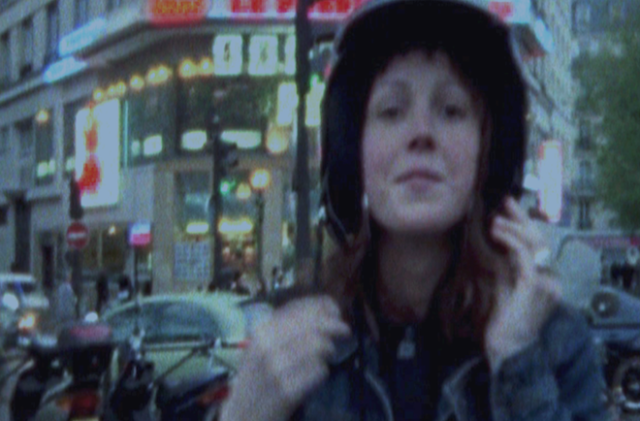
Hypermoon, the third part of Mia Engberg’s Belleville trilogy, was made at a time when the director had no idea how long she was likely to live following a bleak, and unexpected, medical diagnosis.
She decided to make a final film with a black screen and voices as she believed it would be the last film she would ever make. “I organized myself as if I was not going to live,” says Engberg. “But then I survived, so I just added more and more images and music and layers to the film.”
The images in Hypermoon are both myriad and at times metaphorical, and sourced from a range of media (Super 8, mobile, archive) depicting time past and time present, and time as experienced when the medication kicks in. At moments in the film we see a human form floating in the ether, suspended between life and death, and we are told how subatomic articles still communicate across vast spaces when separated, as lovers may do, Engberg suggests in interview. “If you have ever been very, very close to someone, this connection will never fully disappear.”
Decades ago she lived with a man called Vince in Paris. They were beautiful and in love but while she followed a path towards filmmaking, he turned to crime and ended up in jail. After her diagnosis he gets in touch, unaware of her illness, to say that he has unearthed some of her old footage. As they resume a telephone correspondence we see them together on celluloid, happy and young and beautiful in Paris. We know inherently that they are not destined to meet again as their lives now follow different trajectories, but like the particles they remain in some way conjoined.
In the film we also follow Engberg’s long intensive treatment and hear how, high on morphine, she feels a kinship with the trees that wave to her outside her window. She references two other women with whom she has formed a spiritual triumvirate, her grandmother Aina who married a sailor, lost a child and died of cancer at an age similar to Mia’s now, and the immensely skilled and capable cosmonaut Valentina Tereshkova.
Engberg further explains the process of making the film. “I always start to edit a film at the same time I start to make a film,” she says. “So the first layer was obviously my own story. But after a while I thought that this would be so fucking boring. Who wants to listen to this grim, dark story about illness and death and hospitals?”
“And so I felt an urge, also for my own sake, to do something with more life and happiness,” Engberg continues. “So that’s when I added more layers. Layers about time, and about my time in Paris with this love of my youth. And also my son. I added layers all the time to add dynamics.”
“And astronauts,” she adds. “There’s a little voice in the film, and that is kind of me when I was a child imagining travelling in space. I asked Google, who was the first woman in space? And I never heard of her before.” In the film we see YouTube footage of Valentina Tereshkova in a field in Kazakhstan in 1963, surrounded by kind and curious villagers, after she successfully re-entered the Earth’s atmosphere following a technical malfunction, displaying a proficiency not dissimilar to that of Sandra Bullock in Gravity.
Why do we remember the name of the first dog in space – Laika – but not Valentina’s, I ask. “I know, it’s amazing,” agrees Engberg.
While memories are fleeting, and time is ephemeral, there is one thing that can create permanence, and that is the recorded image (especially if it is digitized). This is something to celebrate, Engberg argues.
“I’ve been making films for 25 years. I mean, I’ve been making so many films, short films, and long films, I’m producing film and I’m teaching film. And since I thought that this might be my last film, it’s also a celebration of cinema, and especially documentary film itself,” she says. “A celebration of all the images that we make and that we see and that we exchange with each other. If you’re a filmmaker, you tend to have a kind of an archive when you get older. I also used some my own footage from my youth, and so it’s also like a celebration of the image in a way.”
At one point in Hypermoon, Vince remembers how he would upbraid his Swedish girlfriend about her intentions and motivations as a filmmaker. Wasn’t he, and the life they were leading in Paris, simply data to be stored in the memory banks and used for artistic or commercial exploitation further down the line? It’s not a conclusion that Engberg entirely disagrees with.
“We were very wild kids when we were living in Paris, but I had the possibilities to go to film school and become a filmmaker – and he went to prison. So the wild years for me became material that I could use in my films but the wild years for him, he had to pay a higher price,” she answers.
“I think also it’s a question about class, because I’m middle-class and he’s not,” she continues candidly, widening her answer. “Someone once said to me in a kind of cynical way, that the definition of documentary film is the middle class looking at the underclass. I know that’s very hard, very rough. But I had the possibility to [make] films about our experiences, and he couldn’t… I think every filmmaker or artist or documentary maker has this little feeling of using your own experiences and other people’s experiences. In a way, you’re a bit of a parasite. I did it with respect and everything, but that’s what you do if you’re an artist. You use your life in a way.”





