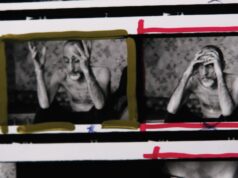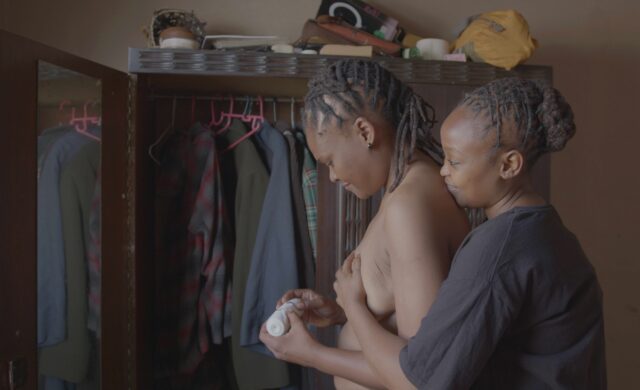
Sharon-Rose Khumalo is a South African beauty queen, born and raised as a girl. She was planning on getting married and having children when, at the age of 21, she found out after a visit to the doctor that she had the genetic make-up of a male. This discovery turned her life upside down.
Dimakatso Sebidi, meanwhile, is a male-presenting intersex activist.
These two extraordinary characters, both attractive, charismatic and funny, are the protagonists of Who I Am Not, the debut feature doc from Romanian-born Tünde Skovrán. The film is sold by Cat & Docs and screening at CPH:DOX, SSXW and BFI Flare following its world premiere in Thessaloniki.
When she was performing at the Hungarian Theatre of Cluj, Skovrán always found herself drawn to “stories that challenge the social norms.”
“As an actor, my body is my instrument. I was trying to find a story that has to do with the body, our relationship with the body…and what happens when you lose your body,” she says.
The director had originally gone to South Africa in 2018 to find out more about a leading South African middle distance runner who competes as a woman and is intersex. While there, she met Sharon-Rose and Dimakatso. Both were part of the activist organisation Intersex South Africa (ISSA).
Skovrán had read widely on her subject and felt she was very prepared. “I was surprised by the fact that highly educated friends, the people closest to me, still have an issue understanding what is the difference between intersex and transgender,” she acknowledges that not everybody in her circle shared her depth of knowledge.
It is estimated that there are 150 million intersex people in the world. “But they’re not speaking up. Some people only learn they are intersex when they are adults and their identity is already formed…”
In the documentary, Skovrán was determined to “familiarise people with their experiences” and “with the normality of being intersex.”
When she arrived in South Africa, one of the first things the director did was to go out on the streets to ask people how they knew they were male or female. She quickly realised that this simple inquiry can raise other deeper and more universal questions about gender and identity.
Skovrán films some very intimate moments in her subjects’ lives. For example, Sharon-Rose is shown ice skating with a potential new boyfriend. The camera captures the moment that she tells him, no, she can’t have children. He very quickly makes his apologies and says goodbye. It is obvious that he doesn’t want to be around her any more.
Equally fraught are the scenes when Dimakatso [who identifies as ‘they’] discusses decisions their father took regarding medical operations that took place years before.
“I got very close to Dimakatso’s father as well…I knew the family history before we filmed those scenes. Definitely, as a documentary filmmaker, you have the instinct to moderate but those are the moments when you have to tell yourself, ‘no, I can’t interfere,’” the director says of the encounters between Dimakatso and their father. “As an actor, I am always observed. Now, this was my possibility to observe.”
Both protagonists come up against prejudice in their everyday lives. At employment interviews, potential employers who learn that Dimakatso is intersex find reasons to withhold job offers.
“Obviously, we followed them [Sharon-Rose and Dimakatso] for a very long time. It has been five years of following. These are not isolated situations,” the director says of these very frank sequences. “They got very used to the camera…and we tried to get access to all the people who surrounded them. We followed them everywhere.”
Who I Am Not started as a “passion project” which Skovrán and cinematographer Dániel Szantdner worked on without outside backing. Andrei Zincă, with whom Skovrán had worked before, eventually came on board as the main producer.
Oscar winner Patricia Arquette (Boyhood, Lost Highway) also joined as an executive producer. “I knew that Patricia was an LGBTQ ally and that she speaks always for the rights of this community so I contacted her. I presented her the story, the topic back in 2018 and she was fascinated by the passion and the whole idea that I had,” the director says of Arquette, who has championed the project from the outset.
She also enlisted award-winning Canadian co-producer, Paul Cadieux (who also worked on The Triplets Of Belleville).
“I never stopped acting but obviously making this documentary was my priority over the past five years,” Skovrán reflects on her move behind the camera. On one level, the pandemic helped. She wasn’t being offered other projects and could concentrate on Why I Am Not. “Despite Covid, I travelled to South Africa and we filmed quite a lot during the pandemic,” she recalls.
This was her debut as director and she was learning on the job. She pays tribute to rough cut workshop dok.incubator for the help it gave her in completing the film. “They really elevated our project…I am super grateful.”
This month, the film is screening in four different festivals. Skovrán’s whistlestop itinerary is taking her from Greece to Texas to Denmark to London. The interest in the film reflects the relative lack of documentaries on intersex themes.
“There are other documentaries made on the topic but very, very few – especially creative documentaries,” the director stresses. “It’s not only documentaries. There are very few fiction films made on the topic as well. When I made the research, I was really stunned that this important topic wasn’t really explored yet. The confusion and the lack of knowledge about the issue is because not too many resources are out there. I am very proud that we are going to be changing this a little…”