From taking on rogue multinational food companies in Bananas!* (2009) to tackling the “disease” of car dependency in Bikes vs Cars (2015), Swedish documentary maker Fredrik Gertten has consistently exposed corporate skullduggery in his work.
His new film Breaking Social (a world premiere in CPH:DOX’s F:act Award section) takes on corrupt fraudsters and kleptocrats around the world – everybody from the billionaire American businessman who play less tax than the toilet cleaners in their offices to the officials in Afghanistan who rely on bribes to oil the wheels of government.
“There is a link between all these films. In some ways, they try to explain a global pattern,” Gertten reflects. “That means you basically can tell the story from any place.”
One of the characters referred to at length in Breaking Social is Daphne Caruana Galizia, the courageous Maltese investigative journalist who was murdered in 2017 while exploring the Malta Government’s plans to sell EU passports.
From his own experiences being hounded and sued by big business after making Bananas!*, Gertten knew “how lonely you feel when you are under attack. I decided from then on to try always to be out there for other journalists under attack.” He had therefore followed and supported Daphne. Her son Matthew, also an investigative journalist and who runs the foundation formed in her memory, features in Breaking Social, as do fellow Maltese journalists Joanna Demarco and Caroline Muscat.
“Malta is this kind of microcosm of corruption. I reached out to people there…I wanted people who had a strong case but who are not victims; they’re still fighting, they’re not giving up,” the director says of his Maltese protagonists.
In the UK, Gertten was already in touch with Sven Hughes, a British former military specialist who had gone on to work for the patent company of Cambridge Analytica – and had played a part in rigging elections in the Caribbean. Hughes is now an author. The Swedish director films him fishing in a lake in Surrey – a strangely peaceful setting for the disturbing stories he tells about his former paymasters.
There are several Chilean interviewees in Breaking Social. Gertten has a long and deep relationship with the country. He was there in the late 1980s as a journalist, covering the referendum against the country’s dictator, Pinochet. He speaks Spanish and has often shown his films and done workshops in Chile. Part of his 2019 film Push, about the global housing crisis, was shot there.
In the US, Gertten meets Chris Smalls, famous for setting up a union at Amazon. He encounters West Virginia school teachers who are so poorly paid they can’t afford their health insurance and have to work second jobs. He speaks to New York-based social activist Rob Robinson, once homeless himself, and learns from him how easy it is now to end up on the streets.
Wherever he goes in Breaking Social, Gertten discovers that when humans are faced with corruption and exploitation, they will almost always react by protesting.
“The idea [behind the film] was that all frustrations and all uprisings, good or bad, around the planet, have the same source, the same anger. It comes from almost this childhood feeling of ‘this is unfair, this is not OK,’ because it goes against the morals of what we are taught. We are taught by our parents and our schools to behave in a certain way,” Gertten says. “It is still the same frustration about the elites running away with the gold.”
Everyone shown in the film is “resisting in some way.” Some are academics or journalists, for example New York Times journalist Peter Goodman who wrote the recent book, ‘Davos Man: How Billionaires Devoured The World,’ and Dutch historian, Rutger Bergman, author of ‘Utopia For Realists’ (2017).
Gertten did some of his research for the film through the Pushback podcast that he hosts with Leilani Farha, the former UN Special Rapporteur on adequate housing who featured in his film Push.
“There’s no big masterplan. I am not a big intellectual. I take it step by step and try to find stuff,” Gertten explains his method.
Robert Saviano, the Italian journalist celebrated for exposing the financial web of the Mafia, had also featured in Push. Now, Gertten wanted to tell the “Saviano story in a bigger take, so I had been looking for people who can speak about corruption, tax avoidance and so on.”
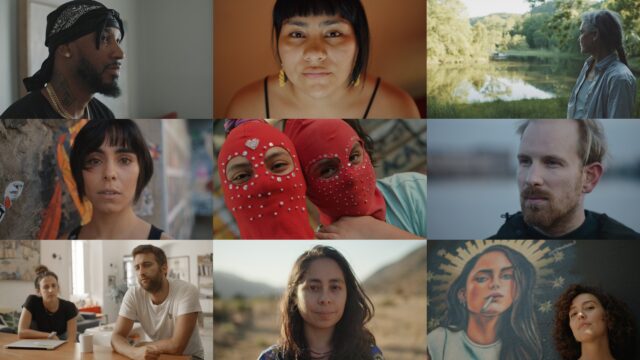
The Swedish director knew from the outset that he also wanted “a lot of faces” in the documentary. The subjects didn’t have to be angry activists, debating or chanting or arguing. He included artists and dancers as well. For example, Melissa Briones, a modern dancer in Chile, uses movement as her means of protest.
“I had been looking at a lot of flash mobs, when the street is changing. Dance was certainly something I wanted to try.” There is one extraordinary scene in which Gertten films protesters led by Briones and a band breaking into dance on a metro train.
Plenty of other books and documentaries have exposed the vulgar behaviour of rich individuals with their “golden toilets and big yachts.”
“That’s fine but it somehow takes the focus away from the power they have,” Gertten suggests. He wanted his film to look at the baleful effect their behaviour has on the society around him. In this, he was helped by Sarah Chayes, author of ‘Thieves Of State’ and ‘On Corruption In America,’ who had studied the subject in forensic fashion.
“If we are going to fight kleptocracy, we need to see how it works,” the director says. “We can’t just go for individuals…we need to talk about the bigger structures.”
Gertten insists that nothing in the film is “super radical…it is mostly common sense.” His hope is that the film will be used to “create a better conversation.”
Breaking Social was produced by Margarete Jangård and made through WG Film. It will be released in Sweden by Triart and has also been picked up by multiple other distributors including the Netherlands (Cinema Delicatessen) and Canada (Level Films).