

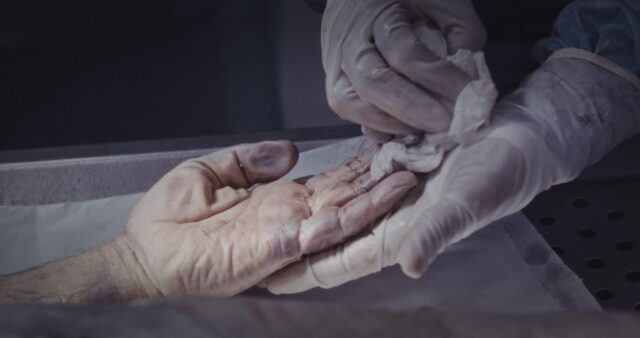
Cristina Cattaneo, the heroine of Pure Unknown by Valentina Cicogna and Mattia Colombo, is extraordinary. As one of Italy’s foremost forensic pathologists, she has dedicated her life to identifying the anonymous dead, whom she calls the Pure Unknowns. These have, in the main, come from the margins of society; the homeless, sex workers, runaway teenagers. Latterly, they are refugees and migrants. The majority will have left behind families who are desperate to know their fate of their loved ones, make sense of their own sense of loss, and to find closure.
As we see in Cicogna and Mattia Colombo’s very moving film, the pathologist’s work extends far beyond the morgue. She is also a lecturer, a fundraiser, a caregiver and an advocate (as well as a dog lover). We see her conducting post-mortems, teaching at medical school, and lobbying continuously for funds, much of the time her serious face illuminated by a computer screen which delivers rejection after rejection.
But all the time Cattaneo remains true to her guiding principle, that the right to an identity must be accorded to everyone who has passed away, irrespective of age, status or nationality.
At one point Cattaneo explains to a potential donor that a cranial DNA extraction costs €250. When a migrant boat carrying more than 1000 refugees sinks in the Mediterranean (there were 28 survivors), Cattaneo’s appeal for €80,000 to extract DNA from 320 reclaimed bodies falls on very deaf ears.
Nor is the Catholic Church particularly willing to part with funds. In one beautiful but telling sequence, the bones of Sant’Ambrogio (Saint Ambrose) are unveiled and decorated in priceless jewels by clerics and nuns alike, just as an anonymous cadaver is examined by Cattaneo and her students who are working with next to no financial resources. Ironically Sant’Ambrogio is referred to among theologians as a Doctor of the Church.
The film progresses towards two powerful and dramatic sequences, the first being Cattaneo’s response to a TV appeal to help find a missing Albanian girl (Mbaresa Kumbria) who was kidnapped and forced to work as a sex slave in Italy. The girl’s profile matches a body that Cattaneo had examined in the past, so now she must conduct further tests to help close the case and enable the girl’s desperate family to find closure.
In another sequence, she is given the opportunity to appeal directly and passionately to the European Parliament for law change that will guarantee the right to identity for everyone who dies within European borders. For this to happen, a European database needs to be created, Cattaneo argues, which can cross-reference the data relating to the Pure Unknowns with the data of missing people collected in the European countries where the reports are filed. To date, such legislation remains far from the European Parliament’s statute book.
Co-director Valentina Cicogna got to know of Cattaneo when she was researching a fiction film that required an autopsy sequence. She read the forensic pathologist’s writings on the Pure Unknowns and was immediately captivated, as was her partner Mattia Colombo. “He immediately saw the [potential] film,” Cicogna says of Colombo.
Cattaneo is a private person, however, and wary of media who, according to Cicogna, sometimes “pretend to see the truth,” especially vis-à-vis such a public figure.
When the filmmakers eventually approached her it was just before the horrendous disaster of April 18 2015 when 1000+ passengers and crew perished in an unnamed boat which went down in the Mediterranean. Cattaneo immediately understood where the sympathies of Cicogna and Colombo lay, and the depth of their commitment to the cause of the migrants, but nevertheless it wasn’t until years later that she allowed them to start shooting their film in earnest.
“After two years of being tested by Cristina, to see if we were patient enough, [and] with the ethical values that she likes, then she let us start shooting,” Cicogna confirms. But even then, they could only film her students. The filmmakers had to wait a further two years before they could work directly with Cattaneo, when she felt ready to have her every move recorded.
Cicogna credits the post-production workshop DOK.Incubator for the encouragement they gave the filmmakers to stay with their story and apply the layers necessary to reflect the complexity of their subject. She explains how the film’s early lectures serve to provide audiences with the vocabulary (or the “tools”) needed to fully comprehend the doc’s later developments.
She and partner Colombo were further prepared to wait as long as necessary for a critical case (that of Albanian Mbaresa Kumbria) to really underline the essence, the necessity and the enormous emotional impact of Cattaneo’s work.
The disparate elements within the film are handled with great sensitivity, like pieces of a delicate puzzle, and serve to reflect the fragmented structure of the forensic work that Cattaneo undertakes on a daily basis. This even applies to the complex scene concerning the relics of the saint, in terms of what we see and which interpretation we decide to apply.
“We didn’t choose to say it so clearly. We were trying to really make the audience super active watching the film and let them be free to build a story inside their mind, to create the right link. Just giving a clue, just giving an ingredient,” says Cicogna. “Cristina deals, in her job, with fragments of life and she has to put them together. And this is exactly what Mattia suggested, to treat the film like the job of Cristina. To give tools, give clues. And let the audience do the rest.”
After meeting their subject in 2015, four years of waiting for permissions to film and then shooting during Covid, the film now world premieres in Visions du Réel (April 22) before what should be a successful festival run and a full-on impact campaign designed to change hearts and minds in Brussels – and effect change in European law. Ahead of all this, however, director Colombo reflects on the woman at the heart of his and partner Cicogna’s film.
“I’m so honoured to be a friend of Cristina,” he says. “I remember when I read her books and when I first met her, I completely fell in love with her and her mission, and her ethical approach to her work, to her life and to the lives of others. In this film we wanted to show the human being behind the fundraiser and behind the medical examiner, but through her great work, through her important mission.”
Sales for Pure Unknown are handles by Deckert Distribution.





