

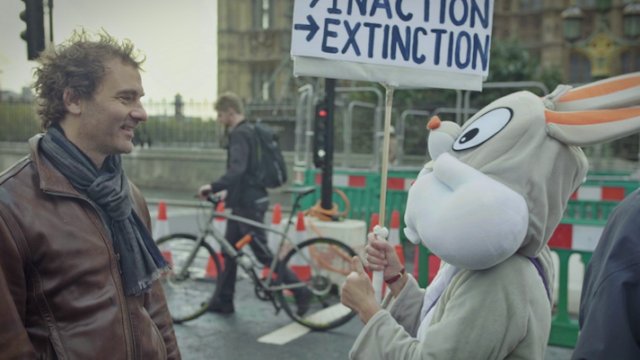
Josh Appignanesi is very good at playing that kind of feckless but loveable dilettante whose priorities (which amount to himself and his career) are placed centre stage as greater crises, whether global or domestic, play out across the planet or on the home front. It’s a role that he performed memorably in his last documentary Husband, where his wife’s literary excursion to New York becomes secondary to his decision to accompany her on it.
But of course, it’s all somewhat of a front. That is his “shtick,” as he puts it, to construct a documentary narrative around somebody who is completely self-obsessed, somebody whose opinions you’re not likely to seek out, only for him to come good at the end and finally occupy a position a little less centre-stage and vainglorious.
Funnily enough, in the case of My Extinction, the place he ends up is very much stage left, within the heart of the radical Writers Rebel and Extinction Rebellion movements.
The premise of the documentary is simple. As for most people (although to a large extent Josh, as a successful filmmaker married to an arguably more successful writer and philosopher, is not like ‘most people’), the climate crisis is a matter for concern, but doing something about it can be a bit time-consuming. Who wants to chain themselves to a fence or glue themselves to a pavement? And let’s face it, who doesn’t enjoy a bit of unexpected warm weather every now and then?
But one day Josh finds himself watching Greta on telly, and is moved by her. What’s more, the daily news seems to be filled with increasing numbers of environmental catastrophes – bushfires in Australia, crumbling glaciers in the Antarctic, floods, droughts and refugee migrants. And Josh has small kids himself who may very well want to have kids themselves one day. While he may be (at least as presented in his docs) an ineffectual and self-absorbed dad, he is nevertheless a very loving one too.
As he says to his wife Devorah, albeit with a dose of irony and understatement, “When they’re old enough to say, ‘what the fuck did you do?’ I just want to be able to say, ‘I was there. Here’s some photographic evidence.’ I’m just selfishly thinking, I just don’t want them to hate me as we all drown.”
So Josh takes his first faltering steps towards active protest, and joins the outspoken and surprisingly radical Writers Rebel group of climate activists. No, he will not get himself arrested under any circumstances, and yes, the dangling carrot of a ludicrously well paid petroleum gig threatens to derail his new militancy, but Josh remains on course, and proves to be an articulate and engaged soldier within what seems set to be a long battle against climate change, and those who have a vested interest in denying its existence.
Appignanesi happily admits how it was losing out on a very well paid car advertisement pre-pandemic which opened the door for his engagement with new radicalism. “Maybe if I’d been, as I say at the end of the film, busy with big commissions on film projects and big commercials and all the other stuff I do, then maybe I would’ve not really had time to worry about this,” he says. “But, you know, that isn’t what happened.”
Instead, amidst his feelings of career angst, failure and dread, he was offered extra time and head space to take a closer look at the world beyond him, how it was becoming increasingly endangered and how the future lives of his kids were looking potentially bleaker. “In that moment [of career disappointment]… a void opens where, if it can be admitted to, change can start to percolate.”
Which is the message that he underlines in the film, to galvanise like-minded people who should be scared shitless by the prospect of climate change to, in some way, shift their mindset and actually do something to combat it. “I expect that most people watching this film are all already going be switched onto climate in some way. They’re not going to be deniers…but they could be doing more basically.”
The doc shows a lot of non-violent protest on the streets, sometimes against a carnival backdrop, and at other times when the law steps in. The film culminates in the joyous September 2020 protest outside 55 Tufton Street in London, home to the controversial Global Warming Policy Foundation, by Writers Rebel and featuring public declarations from the likes of journalist and activist George Monbiot, writers Zadie Smith and Simon Schama, and actors Mark Rylance and Juliet Stevenson. Some GWPF members have been accused of practising and promoting climate change denial.
Climate change is a serious business, but that doesn’t mean you can’t employ a bit of levity when making a film about it, Appignanesi argues, as we see in his journey from incredulousness to full-on wise-cracking commitment to the cause, and all the stages in-between. A standing joke in the film is how none of the writers are prepared to go the whole hog and get themselves arrested. They are much too busy for that. We are even presented a cameo by the megaphone-wielding anti-natalist conspiracy theorist Danny Shine, who thinks humans should just stop reproducing altogether. The wonderful irony is that Danny has three children himself.
But in among the laughs, there is a serious point to be addressed. “Yes, I guess with this film, the idea was there are no climate documentaries that are funny. There are no climate documentaries I’ve seen that have intimacy beyond the usual intimacy of, here are some climate activists and we’re up close to them. We feel their feelings as they go through this hardcore climate activism. That’s great. And that needs to be there,” says the director.
“But there is the other kind of intimacy, the everyday one that people watching the film are maybe more familiar with, which is like, ‘I have a family and I have kids.’ Or ‘I have a mum with asthma’…or all the ways in which climate is very clearly there in our lives. And those discussions [about climate] are being had, but they’re being had behind closed doors. If people could see that other people were having them more, then they’d feel more able to have them. Those were two registers that I wanted to hit.”
Appignanesi feels, furthermore, that these registers must be applied across all media, that the issue of climate change should be elevated out of the realm of the doc. “A romcom can as subtly reflect that we are in an emergency,” he says.
The film receives its world premiere June 29 ahead of its UK release by Dartmouth Films. Appignanesi will be heavily supporting the impact strategy of bringing a “persuadable” friend, “somebody who is worried about the climate, but never does anything.”
“Bring your dad who’s doesn’t know what to do and so therefore doesn’t do anything and drives an SUV. It’s agnostic who you are, but just bring someone along. And then, if you watch this film with someone, it will be more powerful because you’ll have that conversation,” he says.
And what of the director himself? How is his ego bearing up at the end of this intense film process? “I’m still an egotistical, self-absorbed filmmaker with my own kind of worries and sense of failure and dread, but I think that is actually essential for change…but hopefully by the end you’ll think, well, he may actually still be that guy, but at least he’s doing something,” Appignanesi signs off.





