

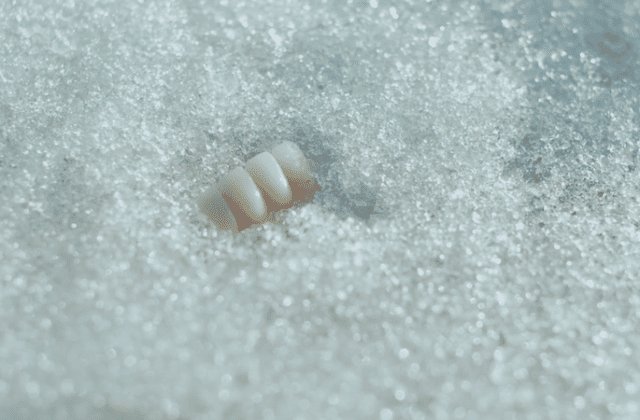
Oh dear…the things that politicians say…the promises they make…
In 2012 Georgia’s ruling ENM party promised voters in the western part of the country dental care in order to gain their much-needed votes. Dentures were on offer, as well as other much-needed oral treatment. President Saakashvili wanted to ‘make Georgia smile’ again. “We’ll fill, cap and polish their teeth so that they are always in a good mood, and smiling,” he says in archive from the time.
The problem was that the ENM party lost, and for the winning Georgian Dream political party, there were much more important issues to tend to than the electorate’s missing teeth.
When Tbilisi-based director Luka Beradze heard about this “absurd and surrealist” story, he knew he had to go the region and tell it, just as the 2020 elections were in full swing. And he found the perfect place to do so, chronicling the lives of folk with no teeth in the intriguingly titled village of No Name.
As it turns out, the residents of No Name are stoical and relatively cheery. Having no teeth hasn’t stopped them from smiling, even if those smiles are often with closed lips. One woman jokes of former President Saakashvili’s motives, how “he was overwhelmed with kisses from toothless women and that’s why he started the program to give them teeth.” A man who only had to have one tooth removed gently chides his wife whose mouth was rendered empty of teeth. Another woman had a whopping 15 teeth removed in one sitting, but remains sanguine about the experience.
Director Beradze identifies a particular naivety in the villagers’ trust in politicians and the departments of state. “The approach of the people mostly in the eastern parts of the world, who have this totalitarian past, is very common. And it’s very understandable how the people do not really acknowledge their rights,” he says, noting how the people still put their trust in a government they feel “is doing everything for them.”
That trust is self-evidently misplaced. “Politicians have been coming and going in this area all the time, and they keep making all kinds of promises. The campaign about teeth is only one of many promises that were made. Other promises include gas and electricity,” Beradze adds in his notes for the film. “I went to the Ministry of Health to look into the exact figure of people who were affected, but they refused to give me this kind of information. They didn’t even have a concrete number themselves.”
One participant in the film observes wryly of how the region’s toothless residents were even “unable to eat the food they had so little of.”
Yet as we see, life in No Name continues. People fall in love and get married. Folks die and are buried. And during an election campaign, they politely listen to politicians saying whatever is needed to get themselves elected.
“They can joke and reflect upon hardships almost like looking at things from a distance, not only when it comes to their teeth, but also a lot of other things,” Beradze stresses of the villagers in his notes. “They are used to living in harsh conditions without losing their sense of humor.”
In a late sequence Beradze trains his camera on the media, on what he terms a “yellow journalist” (a practitioner of sensationalism over fact) who, when filming an item, meets unexpected resistance when she tries to offer dental support to a woman who decides she doesn’t need it. It transpired that, in the case of this particular woman, the 2012 election pledge was actually met, and she was given new dentures. At which point the journalist’s false bonhomie comes to an end. The story is dead in the water, the elderly subject in question is of no further relevance and an unsavoury row ensues between the reporter and her crew as to how they all ended up wasting their time at this house.
“This whole chaos was in front of us,” comments Beradze of a scene which, for him, illustrates a wider point, “how nobody really cares about these people – media, politicians, everyone. It was somehow, for me, a symbolic element that connected everything.”
It is equally symbolic how the villagers vote by number for the numerous parties standing for office. As we see emblazoned on the election posters, the Georgian Dream candidates demand response to the number 41, while the previous incumbents (the ENM party) are assigned the number 5.
And if you are looking for further symbolism, then there’s the curious name of the village itself. No Name may serve to underline a certain anonymity in the eyes of the authorities, but it indicates a place of mystery and romance for Beradze. “I realized that there’s a lot to tell in a village with the name of No Name. It was a very symbolic meaning for me,” he says.
He adds: “The mood and atmosphere are so dreamy there. You can see the details of No Name that feel like [are] coming from an archaic world. I wanted to feel these kinds of emotions from the film. The moment of balance. The moment of mosaic. Lies, politicians, the dreamy place, everything together weaves into an existential reflection.”
Smiling Georgia world premieres July 4 as a Special Screening at Karlovy Vary.





