Swedish Gunilla G. Bresky is one of the stalwarts of the Nordic documentary scene. She has made a dozen films over the last 20 years and has won festival awards for documentaries such as Blood Road, I Stop Time and Night Witches.
In 2017, Bresky directed Son Of The Sun, about musician and artist, Nils-Aslak Valkeapää, a hugely important figure in Sámi culture. That project laid the groundwork for her new feature doc, We Are Still Here, a world premiere in the Best Nordic Documentary competition at the Nordisk Panorama this week. The film is produced by Norwegian Aleksander Olai Korsnes of Rein Film.
The Norwegian/Swedish film tells the story of a group of Sámi artists who formed a collective in the late 1970s and became involved in protests against the building of a massive hydroelectric dam which threatened to obliterate their community.
“I live in the north of Sweden. My world is the north,” Bresky declares. “Sweden, Norway, Finland, Russia…in all those countries, you have the Sámi people. For many years, I’ve made different kinds of projects and programmes about Sámi people. This time, I found this house empty and abandoned. I started to look for the story of the people who lived there – and I had to make the film!”
The house was the base of the so-called ‘Máze Group,’ eight young, idealistic Sámi artists and activists whose work in the 1970s celebrated their cultural identity. “What they did is fantastic. It really changed a lot of things in the Sámi world.”
In the documentary, the artists, now very much older, are shown talking directly to camera. Their gaze is piercing. Their testimony, especially about the neglect and cruelty they experienced as kids, is often devastating. Bresky uses often very poignant archive material and elegiac music to accompany their reminiscences.
“I am a documentary filmmaker. I am not a reporter,” the director states of her lyrical approach. “The form is very important to me – how to tell the story, not only the story. I cannot tell the story, I cannot make the film, unless I find the proper way of doing it. If you see my films, you will see every one is unique in the way of telling the story.”
Prior to becoming a documentary maker, Bresky worked for many years in Swedish radio. That gave her the opportunity to make “thousands of programmes” and to experiment with every different kind off narrative style.
Another benefit of the director’s radio days was the experience it gave her in researching her stories. “I am rather good,” she says about her ability to ferret out facts find rare material.
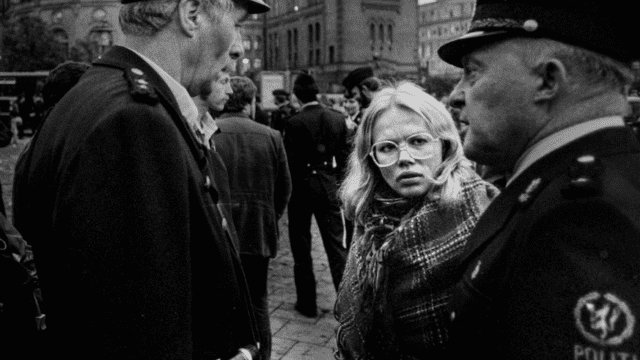
The Méze Group’s protests against the Alta Dam were covered at the time by NRK, the Norwegian broadcasting company. However, Bresky was disappointed by the shabby quality of the footage. This was bad TV journalism. She knew, though, that contemporary photographers had also been chronicling the Alta Conflict. “In the 70s, many people were radical and supported the Sámi people’s protests. I found this fantastic treasure of really good documentary stills.”
It is a point of principle for Bresky to ensure her films are accessible to the audience. She wants spectators to feel intimately involved. “That is why the artists are looking into the camera. They are not looking at me as a reporter. I want to create the direct contact [between the audience and the film’s subjects].”
The Sámi artists knew Bresky’s work. They respected the fact she had already made a film about Nils-Aslak Valkeapää, They therefore trusted her and were ready to share their innermost confidences. “They didn’t hesitate, not all. We have many things in common. The big challenge for me was that I had to make the film in Sámi language.”
Her Norwegian producer Aleksander Olai Korsnes of Rein Film helped secure funding – but some of this was conditional on the documentary being made in Sámi. It’s not a language the director speaks.
How did Bresky get around what looks from the outside like a daunting hurdle?
“I’ve made 12 films…and only one was in the Swedish language. I’ve made Finnish films, Russian language, Norwegian, English language,” she dismisses the idea she is constrained by having to work only in her mother tongue.
In this case, her strategy was to spend as much time with her subjects as possible before shooting began. “I have very deep contact with the people.” She talked to them in her language and listened to their often heart-rending stories about their childhoods.
This meant she knew what they were going to say once the camera started rolling. She had an assistant who checked that the interviewees were saying on camera what was expected.
The director talks of the “spirit of the north.” Those who live far away from the big cities in Norway, Sweden and Finland are a long way removed from the seats of political power where decisions are made which may have huge impacts on their lives. They are effectively disenfranchised.
“So much of our lives, our histories, were never told,” Bresky says of how those in the north were marginalised in the cultural sphere as well as the political one. She may not be Sámi herself but feels a very strong sense of identification with the people. “The government tries to take the language, the culture, away from them, but still we have so many things in common.”
The director acknowledges “there are people in the Sámi community who think I shouldn’t have done this [make the film]. But I had Sámi cameramen, Sámi assistants. And they all supported me because they believed I could do this because of my background – my deep knowledge about Sámi history, Sámi philosophy and Sámi culture.” She adds that her family have lived in the north for many generations and that she believes she has Sámi roots. “Their culture and heritage is also mine. They live here [in the north] in the cold and the dark, the light, the horror and the beauty.”
Bresky’s films don’t come easily. We Are Still Here was made over a period of five or six years. “It’s like I am composing, like music…I cannot compromise. That makes it very difficult sometimes. Making documentary, the budget always is limited. But then you have to have good friends and contacts.”
The director is planning special screenings of the new documentary in small Sámi communities. “I think I bring a part of Sámi culture, history and heritage and give it to the Sámi people,” she reflects on one of the main goals in making the documentary.