Ragnar Kjartansson is Iceland’s very own chameleon-like artist and provocateur. He is a flamboyant figure who dabbles in every medium imaginable. To his fans, who include leading critics and curators, he’s a near genius.
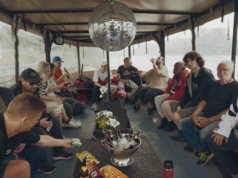
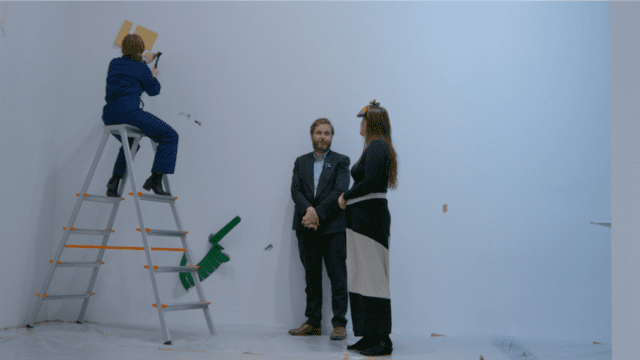
In late 2021, he came up with the idea of recreating American soap opera Santa Barbara in Vladimir Putin’s Russia as a “living sculpture.” The Russians love the show and he had got permission from its creators to put on his exhibition at a former power station in Moscow which had been re-designated as GES-2 House of Culture, and rebuilt by architect Renzo Piano.
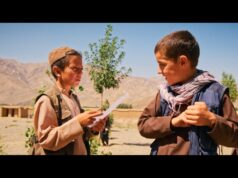
Icelandic filmmaker Gaukur Úlfarsson was along for the ride. His documentary Soviet Barbara, the Story of Ragnar Kjartansson in Moscow, is screening in Nordic Competition in the Nordisk Panorama this week having received rave reviews at Hot Docs earlier in the year.
The director and artist are kindred spirits, and it’s hardly a surprise that they know each other. “I don’t know if you know, but Reykjavik is a pretty small city – if you can call it a city. We are approximately the same age. He [Kjartansson] dabbled in the music scene for a bit, as did I. We are around the same group of people,” Úlfarsson explains his links with his subject. They’ve known each other for “quite a while” without being close friends.
“I would say that he [Kjartansson] is somebody who can easily fit into any conversation. He is so intelligent that you can talk about, say, Russian literature with him…then he can talk to you about punk rock. And then he can talk to you about Miley Cyrus. He’s an extremely intelligent man and an extremely fun guy to be around.”
The artist and the filmmaker have had near identical upbringings. They both come from bohemian families. Their parents are socialists who are heavily involved in culture and politics.
The two acquaintances were speaking about something “completely different” when Kjartansson mentioned in passing his exhibition in Moscow. Úlfarsson realised this could make a fascinating subject for a film. “That’s when I decided to ask if he would be interested in me doing a documentary.” The artist immediately agreed.” We were very honoured he let us into his life in this chapter,” the director says.
This would have been a strange and very intriguing film anyway, but Úlfarsson had inadvertently arrived in Russia just as Vladimir Putin was planning his invasion of Ukraine.
“As you can see in the movie, things get really heavy pretty fast.” The exhibition was supported by an oligarch who was close to Putin. Nonetheless, when the artist invited Maria Alyokhin, “Masha” from protest punk group Pussy Riot, to have a look around the museum, he was courting trouble with the authorities. After all, Putin is no fan of Pussy Riot – and those the President dislikes have an uncanny knack of ending up behind bars or worse.
“We started protecting everything really, really well,” the director remembers how he went to extreme lengths to ensure his footage wasn’t destroyed, confiscated or stolen. He talks of “tucking it away” and of making copies – and then copies of the copies.
“It took me a lot of time to get across the border,” Úlfarsson describes his extreme nervousness when he was leaving Russia. “I thought, OK, here we go, here we go – they are going to detain me. I am not going to make it home for Christmas and they are going to take all the footage. These are the things you feel.”
The director can’t help but acknowledge his deep ambivalence about Russia. It’s an oppressive Kafkaesque country but he feels a deep affection for the place. Masha from Pussy Riot is exactly the same. She now has an Icelandic passport. She has suffered captivity and extreme intimidation in Russia – and yet she pines for her homeland too. “She hates Russia and at the same time she loves Russia. Of course she does. It’s a strange feeling.”
This wasn’t a difficult documentary to put together. Even before the invasion of Ukraine, Úlfarsson was sure he had “more than enough material for a great documentary.” But then geo-politics intervened and the film began to develop different layers – and to become much more disturbing.
“Putin didn’t just invade Ukraine. He also invaded this documentary. He invaded everything!”
Partly because of the shifting sands on which it was being constructed, the film keeps on changing style and identity. It has fly-on-the-wall verité-style moments. It has history. It has talking heads. It has elements of the traditional portrait of an artist. “It is all blended into one documentary.”
World sales on the doc are handled by OFViTiNN in Reykjavik. The film has just been released in Icelandic cinemas. “We do not have any [other] distributors yet. We are just looking for the right people because this is not for everyone,” the director says of the patient approach the filmmakers are taking to the film’s international roll-out. “We need the right kind of distributor. We are just looking and working for the perfect one to arrive…I just want as many people as possible to see it.”
In the meantime, Úlfarsson is teaming up with another near legendary figure in Icelandic culture for his next project. Sigurjón Sighvatsson will produce his next doc, Bitcoin Bandits, a cautionary tale about petty Icelandic criminals robbing a crypto currency firm. This is at the financing stage and will move into pre-production soon.
“I have been doing some form of art all of my life. I always thought I was going to be a musician. That was my dream. Then I discovered this form of artwork which is TV, documentaries, movies, music videos, but I also like to go back to writing and I like to go back to music…I get to be creative and I enjoy it,” Úlfarsson reflects on the many different creative fields in which he continues to work and excel.