As a “very precocious” child, Sheila Nevins used to read both translations of Victor Hugo’s Les Miserables and Robin Hood adventures. She and her sister were “required” by their mother to wade their way through the classics, but what she really enjoyed were books about dinosaurs and fairy tales.
“It was so long ago!” the legendary US documentary producer exclaims as she remembers her literary tastes as a girl. Books were freely available, a fundamental part of her everyday life.
At the age of 84, Nevins, who has produced dozens of award-winning docs at HBO and MTV, has now directed a film – and its subject matter is the reading habits and opportunities for children today. This turns out to be an explosive topic. As The ABCs of Book Banning reveals in its opening credits, over 2000 books have been removed from school districts in the US. These books are labelled ‘restricted, challenged or banned” and are not available to millions of students in “up to 37 States.’
In other words, US educators seem to be following the lead of the Third Reich in proscribing literature they don’t like. Books being banned range from studies of black history to kids’ tales about gay penguins, from James Baldwin and Margaret Atwood fiction to graphic novels like Art Spiegelman’s Maus, about The Holocaust.
Many, including Nevins, are outraged that children are being denied access to such work. Her film begins and ends with footage of the heroic Grace Linn, the 100-year-old widow of a Second World War soldier, who regards Florida’s removal of books from school shelves as a direct attack on her constitutional rights and those of her fellow citizens. As Grace points out very forcefully, the freedom to read is protected by the First Amendment.
In the documentary, Grace is shown walking up a massive flight of stairs en route to giving her testimony. She is an old, frail woman. The steps are like Everest to her – but she is determined to get to the top.
Nevins knew exactly how Grace felt. “Being an older woman and always being helped out of a chair when I don’t want it or being given a seat when I don’t want it, I learned from Grace. She was really the inspiration for this documentary…when I saw Grace as an activist at 100, now 101, holding onto the rail goddamit, but walking up those stairs…she gives you courage! And when you meet her, it’s like getting an injection of life.”
The filmmaker also confides that Grace made her feel “a little embarrassed at my own inactivity as a person who uses film to make a difference.”
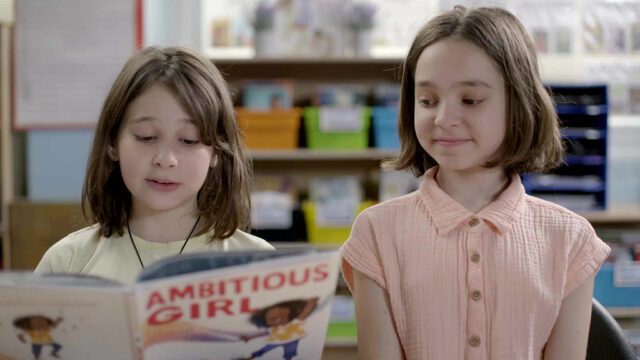
Between the scenes featuring Grace that bookend the documentary, we hear the kids themselves. Some are as young as 8 or 9 but they are amazingly perceptive. “If you try to ban this book, it’s like you’re banishing Jewishness,” one child says of Maus being taken off the shelves.
Nevins believes that interviewing the youngsters “brought out the children in us…it’s a very strange reaction you have when you enter a child’s world. You’re no longer an adult looking in. You’re not their teacher. You’re not their mother. You’re there because you really want to know what they think and you’re not going to blame them for what they say.”
The filmmakers had no idea what the kids would say. When one girl referred to LGBTQ, Nevins was startled that someone so young knew all these words.
As for the transition to directing, Nevins didn’t find it a stretch. “Interestingly enough, it was really no different from anything I’ve done before,” she states. In her opinion, a good producer is a good director – and vice-versa.
And, no, Nevins had little interest in speaking to those behind the banning of the books. She wasn’t trying to make one of those traditional docs that offers everybody’s opinion in equal balance. She was determined to foreground the victims – the children whose reading opportunities were being so brutally restricted. “I know what the left thinks, I know what the right thinks, I don’t know what the kid thinks,” she sums up why the children are placed fully in the frame.
The film has just arrived on the Paramount+ platform. In New York, where Nevins is based, viewers are surprised by what it reveals. The book-banning is not part of their world. “But when you show it in the south, in Florida or in Iowa, they nod up and down. So the reaction has been very, very different.”
Ask Nevins how she sees the current landscape for theatrical documentary and she acknowledges that audiences may be turning away from the big screen.
“The shape of the way we view things at home has changed the very nature of watching,” Nevins reflects. “When I began in this business, your television was 11 or 12 inches…now I can go into someone’s house and they have a 65-inch screen…it seems like the home has become a better place for docus. I hate to say that because I love to see docus in the theatre.”
The veteran producer also has her reservations about the awards process. “Look, I love to win,” she declares of the annual race for gongs. “[But] I do think it has become too important. It has created an annual money stream for publicity which is good for the publicists, but not necessary to the theme of the film.”
Returning to the subject of her documentary, Nevins suggests that books “are the key to freedom. When you take books away, you take away the next generation’s freedom and its generosity of spirit.”
Having finally made her directorial debut, will she be making more movies? Nevins parries the question. “I don’t know I have the energy to do the things I did 10 or 15 years ago. I am human and I have failure built into my biological self,” she says, but then adds: “if I meet Grace again and she has another deal going, I might climb the stairs with her. I don’t know.”
Nevins is “fascinated” by aging. “It’s nature knocking on your door.” In her mid 80s, she still regularly visits her psychiatrist. “What do you talk to your psychiatrist about? The unfairness of life and the fact that you’re a little speck of light and you’re going to vanish.”
And, yes, her psychiatrist has seen the film. “She loved it! I cried [at the positive reaction] because the film means a great deal to me – and that children are allowed to read the books written for them. It’s like food. How do you know what you like if you don’t taste it? Hitler banned books way before the star [for Jews]. Banning books is the beginning of the ending of freedom.”