

The CPH:DOX Industry programme is once again vast in scope in 2024. Forty-six projects are offered up for the great and the good of the finance, sales, distribution, TV, streamer, festival and interactive sectors, while this year’s conference wrestles with the thorny issues of climate and the re-building of narratives within a time of global uncertainty. Not to mention a CPH:LAB programme and symposium that “encourages creative risk taking, celebrates raw talent, facilitates collaboration across borders and business sectors and supports visionaries to push the existing boundaries of documentary filmmaking.”
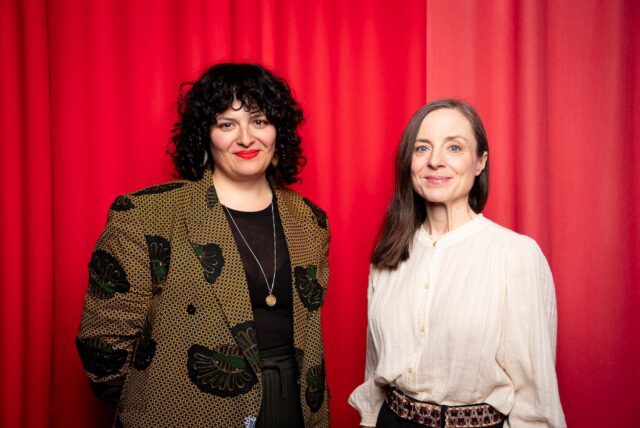
Kicking off with CPH:FORUM, given that there are a plethora of events throughout the doc calendar presenting and promoting hundreds of new projects every year, BDE asks new Head of Industry Mara Gourd-Mercado and MD Katrine Kiilgaard what are the key criteria that CPH:DOX applies to its project selection to attract and retain top [commissioning and buyer] talent?
‘For us, artistic quality and relevance, but also marketability and the potential of international markets for that film are really important. Those are criteria that we look at,’ replies Gourd-Mercado. “We also make sure that those are projects that haven’t been presented at other festivals or markets. We want to make sure that the projects we select are fresh and ones that industry professionals in the room are discovering for the first time.”
“It’s that kind of magic formula that ties it all together that we’re looking for, something that will interest the industry, that will garner attention and that will potentially go and get those partners and get these projects made,” she further stresses.
For MD Kiilgaard the high number of projects is a result of the range of styles, media, topics and interests represented by the pitching filmmakers and demanded by the professional audience they are looking to entice. “[There is] a very wide spectrum of what a documentary can be, from the very artistic, to the experimental to the more factual or investigative journalism. So to be able to show an array of all of the different genres that we feel that we are dealing with in this organization, it takes a [large] selection to cover it all. Besides covering that, we also want a diverse representation of countries.”
This year, filmmakers such as Rintu Thomas and Sushmit Ghosh (‘Writing With Fire’), Sky Hopinka (‘Kicking the Clouds’), Talal Derki (‘Of Fathers and Sons’), Lindsey Dryden (‘Trans in America’), Mila Aung-Thwin (‘Midwives’), Rachel Leah Jones and Philippe Bellaiche (‘Advocat’), Mads Brügger (‘Cold Case Hammarskjöld’) are presenting in Copenhagen, as well as producers like Signe Byrge Sørensen (‘Flee’), Kat Mansoor (‘Cow’), Mandy Chang (‘Welcome to Chechnya’), Sidsel Lønvig Siersted (‘Apolonia, Apolonia’), Diane Becker (‘Navalny’), among many others.
Kiilgaard adds: “I think it’s a truth that we all know is out there, that there are a lot of projects in the market and also more than the market has money to take in, so to speak. So of course there’s a great deal of responsibility to try and find those projects that we really think we can make a difference for. Can we help this project? Are we able, with the decision makers showing up at our event, to do something particular for this project? Are they coming to us at the right moment where we will be able to help them in some direction with completion and further distribution in mind? So I think it’s something that we try to work with in the best possible way…not wasting theirs or anyone else’s time relating to them.”
CPH:CONFERENCE RE-BUILDING NARRATIVES
The 5-day CPH:CONFERENCE, which kicks off March 18 and is presented in collaboration with Documentary Campus, presents an “exciting array of talks featuring visionary thinkers delving into contemporary themes in documentary filmmaking.” Two of these themes in 2024 are the re-building of narratives within a time of global uncertainty and climate.
Built on the “three pillars” of Society, Art and Science, the Re-building Narratives programme is curated by filmmaker Nanna Rebekka (Art); creative director, commissioner and entrepreneur Derren Lawford (Society) and Peabody- and Emmy-winning documentarian Katerina Cizek (Science).
“I think that when we thought about the theme of re-building narrative, which is the red tape for the afternoons, we were looking at how narratives can be many different things,” says Gourd-Mercado. “It can be of course the narrative of a film. It can also be the narrative that we put forward as a documentary industry, as a documentary community. And it was important for us to delve into what does it mean moving forward?”
“We analysed what happened during the pandemic. It was very difficult years and we’re still kind of rebuilding from all of that,” she continues. “And for us it was like, if we deconstruct a system, how do we rebuild it and what’s the narrative behind it? And also woven into that is the notion of narrative sovereignty, which means many different things to different people. Who tells the story, and who finances the different stories, and how does that influence the actual film and the stories that you’re going to see on screen? For us, that theme of rebuilding narrative was all encompassing and it was as much talking about financing and how are we building the industry of the future as much as the themes in the films, as much as how we see documentary as a cinematographic art form.”
CPH:CONFERENCE CLIMATE
During CPH:CONFERENCE The Climate Story Lab Nordic will curate a day of conversations about climate storytelling and strategic audience engagement (March 22). “I think that the filmmaking community at large, but specifically the documentary filmmaking community, is trying to find a way to awaken people and to make them really realize what is the urgency,” Gourd-Mercado underlines. “How do we use the documentary language to convey a message when there is a fatigue? I think that when we talk about the climate emergency and the environment, when you look at the numbers from different surveys across the world, you see that there is that kind of, ‘oh, I’ve heard so much about it, I’m done’ response. So how do we have an impact as a filmmaking community? I think that the Climate Story Lab Nordic is really interesting because it will analyse that.”
MD Kiilgaard stresses how the festival went eco “way before Creative Europe started having a specific demand for us to become greener.” This involved adopting train travel over flights, and in the main simply traveling far less. Plus publishing as much online over via print. “2024 will serve as a baseline benchmark for us to be certified within the next year,” she said.
The unavoidable reality is that people want to gather, she further underlines, but people are become more choosy as to where they are prepared to travel to. “I love that we are back together in physical closeness – it seems to be an inherent part of how we do our business, but which I think as a collective we need to look at that over time. Are there alternatives to this or how can this be done in a better way, which is maybe not getting fully back online, but how can we organize ourselves so that we don’t travel too much? And I think that there’s also a feeling that people are more picky about where they travel to than before, that they’re no longer traveling to everything.”
Another core element of the 2024 Conference is the DISCO network Declaration of Independence on March 18 during which founder members Ambulante, AFLAMUNA, DocsMX, Doc Society, DocSP, Docubox, In-Docs, and India Docs will be presenting and workshopping the Independence Project, which will work “to articulate the unique importance of independent documentaries to culture, society and democracy.”
CPH:LAB
To some, the notion of an ‘out there’ immersive/interactive platform (in the form of the festival’s CPH:LAB and Symposium) seems at odds with the flat-screen 90-minute doc screening model that we have become used to at festivals. Not so for Kiilgaard and Gourd-Mercado.
“When you talk about immersive and interactive filmmaking, I think that the most innovative and boundary pushing people working in XR and VR and immersive come from documentary,” Gourd-Mercado underlines. “I think that we’ve been able to create a circle of virtue where every single component speaks to each another… It goes back to what Katrine was saying, how can we be useful to those projects? I think that if we didn’t see a usefulness to it, we wouldn’t continue. But we do see that usefulness and we do see that the projects that go through our lab and that go through the one-to-one meetings, they come back to us or to other festivals or other exhibitions as finished projects. And I think that that’s the really important part, the circulation of projects and the finding their audiences.”
Kiilgaard channels her inner hippy by way of response. “The fact is that these media are coming to us, and as good old Marshall McLuhan said, ‘the medium is the message,’ and we’d better be there to take some ownership of how it is formed and what it can be used for,” she points out. “And I think artists are necessary in this process to take ownership of what these technologies can also be used for, so that’s what we are trying with the Lab and also with the nurturing of new storytelling within new forms of media.”





