

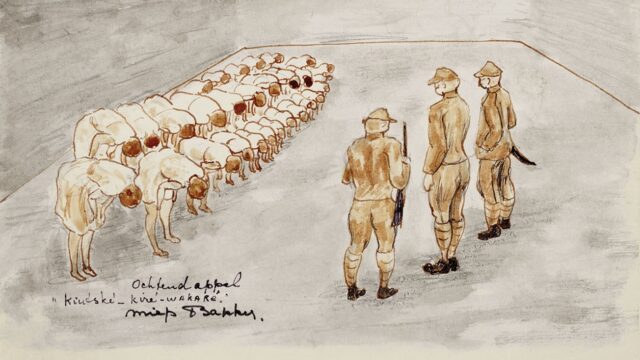
The Dutch women had to bow every time they passed their captors they thought looked like “tiny Martians” with bayonets. They were sometimes beaten. There were deaths from starvation. At roll call every morning, even the youngest kids had to keep silent.
Pieter van Huystee tells a largely untold story in his new feature documentary When I Close My Eyes (which world premiered in Movies That Matter) – that of the Dutch women and children interned in Japanese prison camps in Indonesia during the Second World War. His mother and grandmother were among the captives enduring tough and traumatic experiences.
The film is being presented in the Hague this evening [Mon 25 March] during the Dutch Movies Matter Night. Van Huystee, along with one of the women from the camps, will be discussing issues raised by the documentary with presenter Mirthe Frese and clinical psychologist/psychotherapist Inez Schelfhout.
When he was a young kid, van Huystee often to use to visit his grandparents who were then living in France. He knew that they had been in the Dutch East Indies during the war but little suspected quite what his grandmother had endured.
It was not just his grandmother. The other women’s voices have rarely been heard either. After the war, no-one seemed to want to listen to the stories of their suffering. It somehow seemed small-scale next to the calamities of the Holocaust. Van Huystee was determined, though, to give these invisible women a voice and a presence. He was startled to discover how many other people had relatives who had been in these camps. No proper documentaries had been made about the camps – and he decided to dive in.
“But then I saw there was no archive material, only a few minutes, but those few minutes were from after the camps were liberated,” he says of what looked like being a major stumbling block for the project.
How could he tell this story without images? This seemed like a hurdle that would be impossible to overcome.
As it turned out, there were hundreds of drawings hidden in archives that the captives themselves had made of the camp.
“They are like diaries. They are not only about suffering but about daily life [in the camps],” the filmmaker notes of these images, almost all of which were created by the women in captivity. The filmmakers also used animation to bring the camp experiences to life. The director pays tribute to his young collaborator Lenna Bartens and to animator Hanneke van der Liden for helping him evolve a storytelling style that “had the approach of two generations.”
Once he started work, van Huystee (one of the Netherlands’ most distinguished documentary producers) was determined to move as quickly as possible. The surviving women from the camps were now very old. Some are already in their 90s and weren’t likely to be around for very much longer. The director began to shoot the interviews before the budget for the film had been put together.
Van Huystee wanted to tell the stories of the women’s suffering in the camps in a direct and simple fashion. “I am not a history type who wants to stick years, months, facts [into the film],” he explains why avoided an overly academic approach.
The director used a mirror system which meant that the subjects looked directly into the lens. “With the mirror, they see me around the corner. I wanted to bring the simple feeling [to viewers] that you are sitting at the kitchen table and they are telling you [their story].”
One rule he set himself was that he could only talk to women who had been in the camps. “Actually, it was not my plan to bring myself into the film. I thought why should I bother an audience with my own stories,” the director recalls.
Others advised him that he had to acknowledge that his own mother and grandmother had been in the camps. “I said this ego way of filmmaking is so European… I don’t want to put myself in the spotlight. But then the idea came about my sister [Karen],”
Karen features in the film, providing some of the “essential information” her brother needed to “drive the story.” He also asked her to describe the face of their mother.
Van Huystee’s subjects have lived with their memories of the camps for over 70 years. Some have coped by not dwelling too much on their misfortunes. Some have turned to poetry or art. Even so, they have often felt ignored.
“People didn’t listen to their stories. They were not acknowledged,” the director notes. However, he believes they are now benefiting from a renewed interest in the injustices they experienced.
“All their families are starting to get interested in their stories. There is a growing awareness of the colonial background; of slavery, of stolen art.”
Curiously, the women who have been reluctant for so long to tell their own sons and daughters about what they endured are now confiding in younger relatives.
“Old women who were in the camps, they skip one generation and talk with their grandchildren,” van Huystee notes. “I dived into that, [asking] what is this?”
The director concluded that the women simply couldn’t tell their children about the “awful things” they experienced. “It is a matter of love…or shame.”
“Therapy is a word that scares people off. It can feel like an uncontrolled diving into…” the director continues of why many have such suspicion of the so-called talking cure, of Freud and of psychoanalysis. However, he also points out the benefits of sharing difficult experiences. “It comforts you and gives you a tool to start a discussion.”
When I Close My Eyes will be released in 26 cinemas in the Netherlands later this week. (Mokum is handling the theatrical release). Van Huystee has been invited to Q&As at many of the venues. A TV broadcast on NTR will follow in August.





