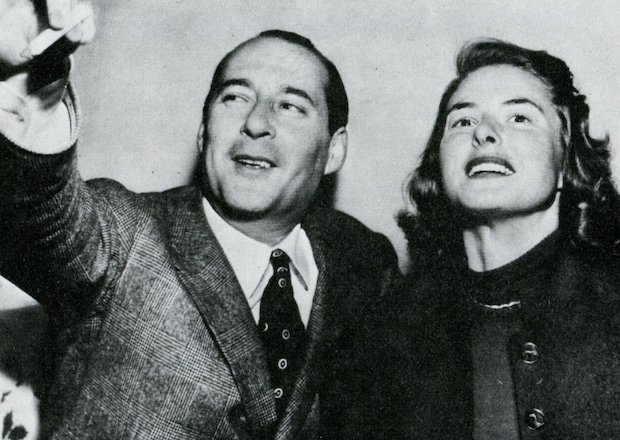
“The Rossellini Method is a biography about one of the most important film directors of all time, known and appreciated all over the world,” producer/director Raffaela Brunetti underlines to Business Doc Europe of her feature doc about Roberto Rossellini, the father of Italian neo-realism. She is co-directing with Ilaria de Laurentis, Andrea Paola Massara.
“But, in reality, few people really know him, Brunetti continues. “This film is an opportunity for the audience to learn more. Moreover, the film tells his life story in a compelling and exciting way. It is not just the life of an artist, but that of a man who came close to failure and was able to start again. Rossellini can inspire audiences, and not only through his films.”
The film’s synopsis reads how Rossellini is in the middle of an existential crisis. He is married to Hollywood star Ingrid Bergman, but the films he makes with her are a flop. While Bergman returns to Hollywood, Rossellini answers an invitation from Indian Prime Minister Nehru to document the progress of the newly independent nation. India marks the rebirth of Rossellini. He falls in love with his young screenwriter Sonali and produces a film and a documentary series for Italian and French TV. What’s more, after he discovers the new small-screen medium, there is no going back. Rossellini will no longer make films for the cinema. “This is his latest revolution. An untold story.”
The feature doc project is selected for DocsBarcelona Industry Public Pitch, where Brunetti will be looking for a major distributor who can provide additional financial support and coordinate the release across several outlets, she says, adding that she is also looking for possible sales to TV channels and is open to the possibility of a third co-producer.
The film is a co-production with ZDF/ARTE, “so it already has its own high-profile television destination,” she adds. “We hope to expand the television audience in Europe and beyond. Being a biography about a film director, it is natural for us to think about a theatrical release on the big screen. We think there could be a lot of interest, in that sense. For the cinema-loving public, it would be a special occasion.”
“We are aiming for a world premiere at major film festivals, in some dedicated section: such as Classics at the Cannes Film Festival and the similar section at the Venice Film Festival.”
Why three directors, and what are the skillsets of each? “The challenge of this film is to construct an exciting story using only archives. To do this, a team with different and very competent professionals was needed,” responds Brunetti. “We are all authors of the film, but each has their own specific set of skills: Ilaria [de Laurentis] directed a documentary and is also an experienced editor, with a passion for archives and their creative reuse. Andrea [Paola Massara] is a screenwriter who comes from fiction cinema and can give narrative strength and intensity to the story. As for me, I have the director’s eye and give additional value to the style, rhythm and power of the images. I am also the producer of the film and founder of B&B Company, and [have] built a strong experience on the needs of broadcasters and their audiences.”
Brunetti further explains the appeal, both of Rossellini and her film portrait of him, and stresses how AI will play a significant role in the production.
“The documentary presents Rossellini from an original point of view, debunking the clichés surrounding the myth and freeing him from those labels in which he himself felt caged during his lifetime. It develops on two parallel tracks: on the one hand, archival materials evoke [his] public image, his visual, his direct and documentary testimony through television interviews, radio debates and public lectures, hundreds of hours of rare or little-known footage found in Italy, India, France, Spain and the United States.”
“Our aim is [also] to make an emotionally engaging ‘self-portrait’ of Rossellini based on a vast amount of rare or unseen archive material and excerpts from his films. The narrative will be guided by Rossellini’s voiceover in his own words, transformed into his spoken voice thanks to advanced voice-cloning software, allowing the spectator to listen to a sort of confession, offering a unique experience, a journey into the great director’s thoughts and the man’s complex personality,” she says.
In order to take the audience even further into “an intimate and visionary dimension,” the film will also reconstruct the voices of his former wife Ingrid Bergman, of director Jean Renoir, a friend to both, of François Truffaut (a great admirer of Rossellini), and of cinematographer Aldo Tonti, who accompanied him on the Indian adventure.
“Solid contacts with Rossellini’s descendants allow exclusive access to the family photos and home movies and to a private collection of unpublished writings and letters of great interest, useful in the construction of his narrative voice,” Brunetti tells BDE.
“The family’s trust in the production allows us to make the film in the best conditions, including the necessary authorization to reconstruct Rossellini’s voice through artificial intelligence,” she underlines, adding that, “the year 2025 will be an important anniversary for Roberto Rossellini’s cinema, the celebration of 80 years since the release of his Rome Open City and of Italy’s liberation from Nazi fascism.”