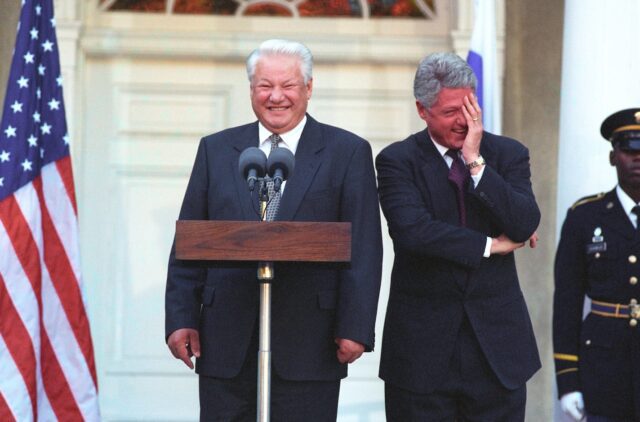
One Inch Eastward is the second film in a trilogy about the Washington/Moscow relationship. The first dealt with how Gorbachev, Reagan and George Bush Sr ended the Cold War. The third will study Putin’s relationships with George W Bush Jr and Barack Obama.
“It became clear while making the Gorbachev film that the 90’s were actually crucial to what is happening today, and it’s a period that is only now beginning to be studied,” Brendan Culleton explains to Business Doc Europe. “One of the reasons for this is that the archives for the time are being declassified in chunks, shedding fascinating new light on what was said behind closed doors.”
The team is undertaking “PhD”-level research, going back to original documents and at the same time “hunting down the film archives, so we generally have a lot of the archives gathered before we start the edit. Then we begin cutting this down. It’s a long process, but it needs to be a process, you certainly don’t know all the answers when you begin,” says Culleton, who is a historian and information scientist by training, as well as having a master’s degree in screenwriting.
“We were […] drawn in to these stories by our love of the archives, then we became fascinated by what they revealed to our filmmakers’ eye, often things historians haven’t noticed, because they tend to read texts,” he adds. “They don’t consider film archives as part of the historical record. But we like to look at Gorbachev’s eyes as he speaks, see what his gestures and body language tells us about what he is really thinking.”
The feeling will be that of an observational doc, eschewing voice-over and narration, using intertitles and captions to give key info such as time and place, while the declassified documents will be incorporated as graphics, “allowing the audience to see what was said when the cameras were turned off.”
“This kind of observational archive film works very well when there is a clear chronological timeframe,” says Culleton. “The narrative is created by director Irina Maldea, who curates the material and guides the audience through her choices. It’s obvious really, using visual language to create the ultimate cinematic experience, and make the audience part of events.”
Much of the budget can be raised in Ireland, with Screen Ireland and the tax shelter accounting for approximately 50% of the budget says Culleton, whose Akajava Films has a development agreement with Bulgarian co-producer Smarty Pants Shooter, the co-producers on Moscow Nights. The team are in discussions with other potential partners who can access their national funds, broadcasters and tax shelters. “There will be TV presales (YLE is already on board) and we’ll complete the funding with either Eurimages or Creative Europe’s TV and Online Content action,” says Culleton.
At DocsBarcelona the producer is looking to meet producers from Arte partner countries, “as Arte Geie is an obvious investor and we have talked to them. I’m interested too in letting festivals know about the film,” he says. “A large part of the benefit of these pitching fora is getting the project out and about. There are fewer and fewer commissioning editors at these events, it’s now often about raising your profile.”
Culleton will also be keeping an eye out for projects that he can join as a co-producer. “Ireland is a great partner for docs, as our national funder Screen Ireland now can give funding of up to €275,000 for a doc. Our tax shelter can get you 32% of the Irish spend. We also have a big cultural fund for TV productions. This all needs to be spent in Ireland, with a strong Irish creative element, but the subject can be international,” he underlines.
He further explains the qualities of director Irina Maldea. “What she is brilliant at is imparting the human aspect to a story, which creates the empathy needed by the audience. She is great at crafting intricate stories in a subtle manner, she creates several layers of meaning, it’s such a joy to watch her cuts several times: her work is very powerful.”
“I think it’s also important that she comes from behind the Iron Curtain [Romania], growing up under communism, and then living in the west,” he adds. “This gives her a different perspective on the last 30 years from the standard viewpoint that Western Europeans still tend to believe in.”
The producer signs off by putting the era of immediate post-Cold War politics into perspective as a period when lasting accord between the superpowers seemed possible.
“People have been called naive for talking about a ‘lost peace’, the idea that the present crisis in Europe could have been avoided by adopting more of the Gorbachev philosophy of negotiated solutions that take the concerns of both sides into account,” he says.
“In answer to this I quote JFK’s magnificent Peace Speech in 1963: ‘Let us examine our attitude toward peace itself. Too many of us think it is impossible…But that is a dangerous, defeatist belief. It leads to the conclusion that war is inevitable – that mankind is doomed – that we are gripped by forces we cannot control. We need not accept that view. Our problems are manmade – therefore, they can be solved by man. And man can be as big as he wants.’”