Poland, December 1981, the period of martial law. Soldiers are on the streets. Everything from eggs to shoes to soap is in short supply. Solidarity union leader Lech Walesa is being demonised by the Communist leaders as an enemy of the state. This is the period that Tomasz Wolski examines in his new archive-based documentary, A Year in the Life of the Country, a world premiere at the Krakow Film Festival on 30 May.
In Wolski’s 2021 film 1970 the director looked back on a year in which protests broke out in several Polish cities. He had audio-recordings of the Communist leaders trying to manage the crisis but he didn’t have visual material. He therefore used stop-motion animated dolls.
Shortage of film wasn’t a problem with the new doc. The martial law era was exhaustively recorded. That was one of the attractions. He knew he would have plenty of raw material to edit from.
“Also a reason to make this film was that I knew at that time Poland was some kind of caricature of a country,” Wolski reflects on the turbulence of the era. “The government was in a position where they thought they knew everything, but they did not care about what the people actually wanted.”
This was a period of extreme propaganda. The government pretended that everything was fine when, in fact, there was hunger and chaos. Wolski saw the grotesque humour in the situation. “I thought it was good footage to make some kind of comedy even…”
Not that there is anything comic about the brutal way the military suppressed protests. Toward the end of the documentary, we see characters being beaten up and run over.
“There are two faces of this regime. One is funny. I would call them [the government] amateurs. They didn’t know how to rule this country, how to take care of it, and so they made a lot of mistakes. It makes for a lot of comic situations. At the same time, they tried to scare people. There were threats all the time. That was another face, the brutal face, of communism….some might say it is the real side, the brutal side.”
A lot of the material included in the film is from Polish television. Wolski also took film from The Institute of National Remembrance, the state body in charge of archives and education. Some footage came from international sources and some from the Polish opposition of the period. Video Studio Gdańsk, formed in 1981, had begun filming street demonstrations and meetings in the city.
Wolski himself was only four years old when martial law was imposed. Ask how he feels about General Jaruzelski, the Polish military figure who imposed martial law and tried to lead the country and Wolski admits he had “no special feelings.”
“I was never afraid of this person.”
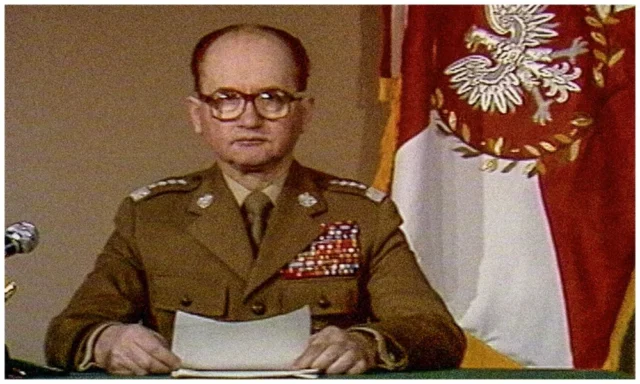
The documentary includes film of the General fluffing his lines as he tries to speak to the nation. He’s a sweaty unconvincing figure in big spectacles. The footage of his speech is very well-known but Wolski has discovered the little seen outtakes when he blundered. “Nobody knew about it. It’s only a small part…in the middle [of the broadcast], this mistake, it makes him human.”
Jaruzelski was the villain of the piece. Walesa was the hero. Today, though, the shipyard union leader who went on to become President of his country and to win the Nobel Prize is a divisive figure.
“I met him actually. I was wanting to make an archive film about him. When I was editing this film, I found so much footage with him. He was such a strong person, so charismatic at that time,” Wolski notes of the period when Walesa was the “face of Solidarity.”
“You can clearly see in the film why people followed him. You can see how they welcomed him after he got out of the prison. It was like a rock star came to town! He was brilliant.”
The director adds that he would have “loved it” if Walesa had stopped his activities in the early 1990s after the fall of communism, “because [then] he would be an iconic figure and everyone would love him.”
What actually happened is that Walesa remained active in politics and then risked tarnishing his reputation in the period when Poland was trying to adjust to democracy.
A Year in the Life of the Country is edited in rapid-fire fashion. Wolski wanted the rhythm of the documentary to match the chaos in the country at the time. He throws together colour and black and white. He decided to ”make it fast and then at the end to slow down to show [the] brutality.”
“The film is not from the political side,” Wolski insists. Walesa may feature prominently but he is not the main character. The documentary is as much about the women queuing for food and protesting about shortages as it is about him. As the director notes, there are already a lot of films about the Solidarity leaders but not so many “about the ordinary people.”
The director was startled by some of the material he discovered in the archive. For example, he was surprised that May Day celebrations still went on at exactly the same time as the protests. This highlighted just how divided the country had become. He was also very struck by footage of women protesters who want more food for their kids. “You can see clearly on their face that they are hungry, angry and they are fighting for something better. I was like, wow…somehow you cannot imagine that people were really fighting for food.”
As he prepares for the premiere of A Year in the Life of the Country, Wolski is already pressing ahead with two new documentaries. The Big Chief is about Leopold Trepper, the Polish Jew who became an anti-Nazi master spy but who suffered from anti-Semitic prejudice in Poland after the Second World War. The second project (Torun Trial) looks at the case against the killers of Jerzy Popiełuszko, the Roman Catholic priest brutally murdered in the 1980s by state agents because of his links to Solidarity. Both projects are being made through Kijora Film.