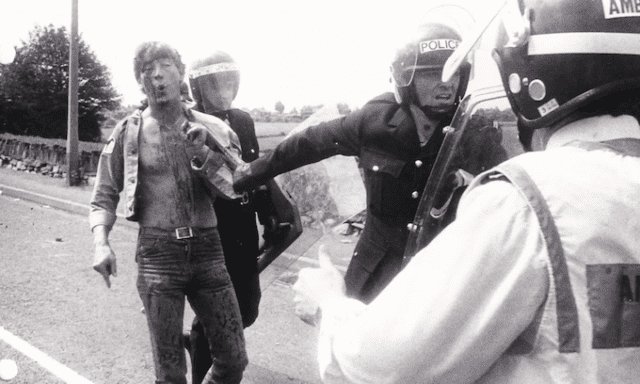
Nobody died at Orgreave (in South Yorkshire) 40 years ago, which may have been a miracle. It also explains why successive governments have stubbornly refused properly to address the police brutality that took place that day in June 1984 during the violent confrontation with striking mine workers.
Strike: An Uncivil War, directed by Daniel Gordon, tells the story behind the “battle of Orgreave.” It also reveals just how the Thatcher government ripped the heart out of Britain’s mining communities during the year-long miners’ strike (March 1984-March 1985).
The film received its world premiere at Sheffield DocFest on Sunday 16 June. The June 17 screening (12:30, Showroom – Channel 5 Screen 2, Sheffield) will be followed by Q&A with the director. Rainmaker Content is handling international sales, and the film will be released in UK cinemas by Tull Stories.
“It’s a film I’ve wanted to make since it feels like forever,” Gordon says of the new documentary. He regards it as a “prequel” to his award-winning 2014 film, Hillsborough, examining events behind the disaster at the 1989 FA Cup semi-final between Liverpool and Nottingham Forest when overcrowding and crushing led to 97 deaths and hundreds of injuries. That also happened in South Yorkshire, in Sheffield. One common factor between both Orgreave and Hillsborough was the police’s attempt to cover up its own role in the calamitous happenings.
“There are so many similarities – the same police forces and the same kind of victimisation of the victims,” Gordon reflects.
For Gordon, this story has a personal resonance. His grandparents were immigrants who fled to the UK from Austria after the Anschluss in 1938. His mum grew up in a mining village in South Yorkshire. During the freezing winter of 1947, the family was impoverished.
“My grandmother didn’t have any coal to get them [the family] through [the cold]. She happened to mention this in the village store. The next morning, she found that the whole coal cupboard had been filled overnight by someone. It was never revealed who did it.”
Gordon tells this story to illustrate the strength and decency of the mining communities. Working in the pits may have been brutal and dangerous but everyone stood up for everyone else.
Many of the director’s interviewees, former mineworkers and their families, break down on camera as they look back at the summer of 1984.
“That was what they were fighting to save [during the strike],” Gordon says. “It did surprise me how emotional people were getting on the one hand. On the other hand, it wasn’t [surprising], knowing what they’d lost and reflecting on it – and also it was quite clear a few of them hadn’t talked about the emotional effect this had had on their lives. It was only really in the interviews they were beginning to understand all of that.”
In many former mining towns, poverty and drug abuse are now rife. The old community ties have long since been destroyed. “Irrespective of your political viewpoint, you see the results that happened,” Gordon says of the social devastation caused by the closure of the mines. France and Germany closed down much of its coal industry too, but there was an attempt in those countries to re-skill the workforce and preserve the communities.
Gordon made sure to interview police officers and mine workers who crossed the picket lines. He wanted all shades of opinion to be represented in his film, even those he disagreed with.
“I just felt that I don’t need to agree with you to get your point of view. I felt it was really important that everyone’s points of view are taken [into consideration]…there is no point in showing a film purely from one side. It was the same with the policemen. A number of the policemen were reticent to speak, but the two policemen in the film are key to understanding what was going on.”
Miners’ wives also feature prominently. “It was one of the few positives of the whole strike that women found their true role. It had been a masculine-dominated community but they [women] found their voice during the strike,” the director suggests. “They just had this resilience and togetherness.”
Nonetheless, as the film shows, families broke up because of the strike. Fathers refused to speak ever again to sons who crossed the picket lines. There were suicides. Marriages broke up.
It was obvious that Thatcher was determined to avenge the humiliation the government had received at the hands of the trade unions in the 1970s.
During the research for the documentary, Gordon discovered the story of the ‘manual,’ the secret document that effectively gave the police the right to behave like a paramilitary force. “The rank and file don’t know anything. The ‘manual’ is only seen by officers. It’s the chief constables and assistant chief constables who know about this.”
Financially, the film was a struggle to pull together but Gordon was able eventually to secure support from Embankment Films as well as the BFI Doc Society Fund.
The film ends on a poignant note with the miners returning to Orgreave four decades after the strike.
“I live in Sheffield so I know where Orgreave is…it was difficult to picture Orgreave as it was. {Now] you walk around it and you just see Mrs Thatcher’s dream. Everybody has got a house, they’ve got a car. They’re mortgaged up to the hilt. They’ve got the car on the never-never [hire purchase]…everyone is working all hours to try to pay off everything,” Gordon sums up the town as it is today.
Gordon and archive producer Stephen Slater went “far and wide” sourcing as much archive material as possible. “We were using local archives, national archives. We were very lucky that one miner shot a load of video on a VHS camcorder. The NUM [National Union Of Mineworkers] were shooting a lot of stuff themselves.”
The director tried to make contact with Arthur Scargill, the firebrand NUM leader during the strike who is now in his mid-80s. Scargill, though, has long been distrustful of the mainstream media.
“He has done nothing [with the media] for many, many years. This year, he has done a number of talks for miners at safe places….we approached him a number of times but there was just never even an answer. I don’t think he is interested, And, also in the end, I felt this is about the people. It’s not about leadership. It’s not about politicians. It’s about the people that were there.”
Strike: An Uncivil War is one of a number of films and series that have been made during the 40th anniversary of the miners’ strike. Gordon isn’t bothered to have so much company.
“For me, the more films that are out there, the better in terms of adding to people’s understanding of the events and issues. From my perspective on my films, I just want them to be the definitive version…I want this to be the definitive miners’ film,” Gordon says.
“Obviously this is going out in cinemas which is fantastic, In cinemas, you are completely absorbed. You’re not going to be looking at your phone. You’re not going to be looking at the ‘next’ button on your remote control. That’s what I try to do, make this as absorbing as possible. It’s a brutal watch at times but I think this does what few TV docs are able to do [and] really leave you with a lasting impression of moments…we take our time to try to make it an immersive experience, so you really feel it, you’re with the characters and you understand what they’re up against,” Gordon ends.