

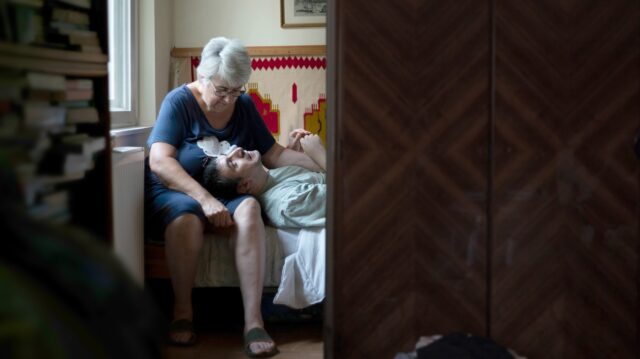
If sixty-five-year-old Hungarian Magdi were to pass away, her severely disabled son Feri (39) would be left to the mercy of state institutes whose reputations are notorious. In these establishments, patients are regularly “tortured, tied down, starved and neglected,” we are told in Anna Rubi’s Your Life Without Me, world-premiering August 17 at Sarajevo FF Competition, and therefore the construction of humane care homes must be made a priority.
Of course Magdi is not alone in her plight. Other mothers have the same fears for the future, and also undergo the daily processes of caregiving which can have huge psychological consequences both on them and their other children.
Back in 2018, debutant director Rubi was working for the human rights NGO HCLU (Hungarian Civil Liberties Union) which had taken up the women’s cause, having filed a lawsuit against the Hungarian state in 2017. Despite having signed up to the European Convention on Human Rights nearly two decades before (and therefore subject to the jurisdiction of the European Court of Human Rights), Hungary had always claimed that its economy could not bear the cost of the construction and maintenance of small-scale care homes.
This situation is patently unfair, inhumane and unconstitutional, the women argue. While the construction of football stadiums such as Budapest’s Puskás Aréna seems to continue unabated, investment in care centres for the disabled was deemed financially impossible.
“We joined the UN declaration that should make it the government’s duty to build these care homes and treat everyone with disability as a full person who could have his or her own choices,” director Rubi tells BDE. “So now they are bound by several laws and agreements – and still it’s not happening. And I think what makes this lawsuit even more absurd is that this group of women is suing the government to obey its own laws, and they [the state] have been fighting back for several years.”
In Your Life Without Me, we observe these women as they seek justice and recompense, all the time led by the indefatigable Magdi. We see them at home, meeting up together in cafes both joyfully and tearfully, and in the courtroom where, as plaintiffs, they argue their case against the Hungarian state. During the film’s 72-minute duration there are ecstatic high points and painful lows, but each time an obstacle is placed in their path, the women pick themselves up, dust themselves down, and get on with it. These are women who have had to put up with much toil and suffering, after all.
In one heart-breaking sequence the women, many of whom are single mothers after their husbands left the troubled households, talk about the emotional toll on the siblings. “They’re born into this,” one woman laments. “This never makes it to the courtroom. The judges should follow us for a day.”
Throughout, Magdi is at the heart of the film, the loving matriarch and leader of the women. She is a woman who curses as much as she laughs, all the time informing the group of developments and keeping up morale among its members.
“I’m not sure if I could find another person in all of Hungary who is like that, who’s really coming from the edge and can still step up. She has this strength, but at the same time is also really human, warm and funny, with a great sense of humour,” director Rubi agrees.
Magdi provided, in great part, the motivation for the director to keep going. “At the beginning I was, like, I’m not sure if I can make a film, but I have to. I have this person here. I have this law suit here. This is such a unique story. It’s my duty to communicate it to an audience,” she says, adding, “Yeah, in a way the story chose me.”
Placing Magdi centre-frame also enabled Rubi to streamline the film’s structure. “I decided to go with one lead character and then more of a small support group and the lawsuit. But in itself it was dramaturgically a very complex situation,” Rubi says. “Because there’s so much injustice, and so much in there that we don’t think about. For example, what is happening to the healthy siblings and how home-caring affects them from the very beginning, and the lack of any kind of systematic support, because at the end they will inherit that responsibility. And this is very heavy.”
“Every time there was a verdict, it was such a declaration on what the state believes in as a value, and generally what it believes about people, about human beings, that it really shook the entire film crew,” adds Rubi. “We were often, I’m not saying crying – because we had to shoot – but there were tears of sadness and joy.”
The film is sold internationally by CAT&Docs and will screen on the RTL+ screening platform in Hungary and its neighbouring countries. “It’s a big deal because they only pick one documentary every year. And this winter is going to be ours. So we have quite a big outreach in Hungary, which I’m really happy about and aligns with our impact plans as well.”
Rubi plans to arrange screenings across Hungary to “isolated affected groups” and, together with RTL+, organise an “education and communication sensitizing campaign” on dealing with people with disabilities. “The bigger picture would be that at some point we would love to do a screening either for the European parliament or for the involved committees who are inspecting Hungary in relation to disability equality situations and rights violations, because Hungary is currently under inspection.”
The filmmakers are also hoping to support a fundraising effort for the construction of a private care home in Budapest, which will benefit disabled patients and their families alike.
“They are isolated, they’ve been living a tough life, most of them alone,” Rubi underlines of her admiration for the women who are charged both with the responsibility of care and a deep desire to change the system.
“Despite taking care of their children 24/7 alone, often in financial insecurity, these women managed to find each other and form a community,” she continues. “At first, what brought them together was the common fight. But then really deep friendships were formed. And this community is growing. And this is unusual. It’s absolutely unique that it happens to such isolated, marginalized individuals, something I’ve never seen in Hungary. And I think what this community can give you is that you’re not alone, but you’re all together sharing the same experience.”
“It is an inspiration,” Rubi signs off.





