

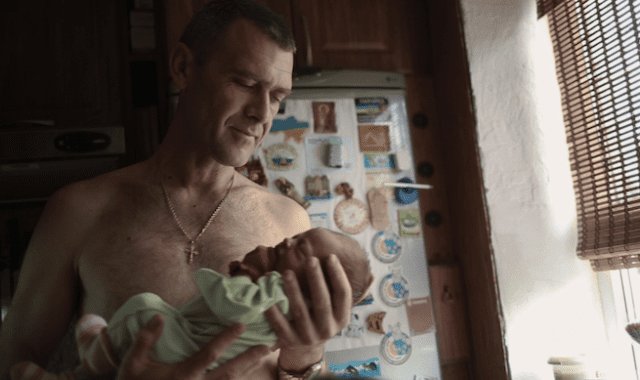
45-year-old Ukrainian Serhiy Zinchuk is the husband of Nadiia and the father of three boys, Nikita, Artem and Sasha, aged three to eleven. He has been serving on the Eastern front for three years, helping to repel the Russian army (even before the full-scale invasion of February 2022) and commanding his soldiers, some of whom he had to remove in “buckets” from the battlefield and trenches.
When Serhiy comes back to Kyiv, his boys are three years older but still desperate to welcome home and love their dad, and to impress him. He may initially return their love and affection, but his mind has undergone a seismic shift after three years at war.
At the same time, director Lesia Diak tells how she was in a relationship with a soldier who regularly went off to war. Each time she said goodbye, she felt desperate, but when they went away together on a holiday, “there was no embrace, no hand-holding; just stone-like facial expressions behind which the veteran was recovering his ability to be close.” With nobody to offer emotional support, Diak was left to process her thoughts and feelings alone. The relationship came to an end.
We observe commander Serhiy as he interacts with his family. The boys gambol and fight. He plays with them or admonishes them in turn. He seems to cook a lot, especially after his wife Nadiia falls pregnant. Nevertheless she is critical of Serhiy, and smiles in the household seem a rarity. The film is as much a portrait of a marriage, or of parenting, as life away from war.
But it turns into something quite different when it is just Serhiy and Lesia within the frame, as he reflects on his life as a soldier. His was a brutal experience characterised by the shitting and pissing of pants, and vomiting blood out of fear. He saw desperate romances and marriages which would only last a matter of months after the couple returned home from the frontline. He talks of a “self-rejection” in which he craves pity and love but at the same time rejects them.
At which point Lesia reflects on her own experiences. Whether to mask his discomfort or to don the role of director Serhiy seems to turn the camera on her, or she offers the camera to him to do so. He questions her interpretation of her boyfriend’s silences and remoteness, offering his own analysis. “Have you ever thought that he might want to be alone?” he asks of the director’s ex. The frontline is frenetic, and space was always something to be craved, Serhiy further observes. Back home, sometimes there’s no room “even for the people you love,” he concedes.
He is engaging, clever, wise and at times cynical, and looks a little like an older Morrissey, but he is willing to have his life chronicled, even up to the birth of his daughter, at which point the family dynamic changes radically, and very sadly…
Director Lesia offers her own account of their one-to-one exchanges. “At some point he [Serhiy] didn’t feel comfortable watching me holding the camera and not having eye contact all the time. He was in that state of mind when – I dunno if it’s a correct English word – he was cracking almost with tears. And I asked him if it’ll be more comfortable for him if he holds the camera and we resume talking. So I believe that in this moment of extreme vulnerability, it was probably the best [thing] that I could do as a filmmaker. Then it was also more simple for him to talk about my issues, my problems, than to open up about his problems.”
Diak is reluctant to use the term post-traumatic stress disorder in relation to Serhiy, even if it seems a reasonable layman analysis. “He didn’t actually go to the psychiatrist and he didn’t receive an official diagnosis,” she says. “So I am not quite comfortable with using this term. Speaking about the movie, I can say that the psychological difficulties he’s going through are related to the burden he’s carrying [due] to war trauma and war memories. All these events are haunting him, especially the loss of his comrades.”
The director never knew her subject before the ongoing war which began in 2014, but she has seen videos and photos of the younger Serhiy. “I can just say as an observer…he was this beautiful man who was smiling a lot, who had a lot of dreams and hopes [and with] all the characteristics that a person between 30 and 40 years old has at this age. I believe [he was] eager to conquer the world, but I also know that he didn’t have the easiest background. Before the war, there were times when he couldn’t find the best job he wanted, but that’s the challenge everybody is facing.”
Diak doesn’t expect that her film will have any impact “on international politics and on the destiny of Ukraine as a whole,” nor that it will either “stop the war [or] motivate the countries which are constantly creating hindrances for the weapon supply to Ukraine to simplify their inner processes.”* But she is keen to help victims of trauma join and share their experiences to help alleviate its effects. “If there will be someone who could help me to make this impact campaign broader, then of course I will embrace the opportunity. But now I’m just telling you…I’m capable of doing this in Ukraine,” she underlines.
The film is absorbing in telling a powerful story of trauma from the perspectives of the director and her subject, from which a fascinating dialectic emerges. What’s more, it is likely to go on to other festivals after its Sarajevo world premiere, which is not necessarily the future trajectory of all Ukrainian documentaries, despite their relevance and merits. How does Diak assess the current international climate for docs from her country?
“The market is overwhelmed with Ukrainian films. It is not good or bad, it is what it is,’ she answers. “But I don’t want to feel that I am competing with other colleagues who make films about Ukraine. I would like to think that we are creating such movies with a common purpose.”
“If I think of Dad’s Lullaby in a broader cultural context, I believe it has a chance to be noticed because it is centred on a very complex male character and it deals with the long term consequences of war. If I put it in other words, the experience of war affects a person’s basic need to be in a close relationship, to love and to feel loved. If this need is not met the person is confined to loneliness. I believe there was no deep exploration of this in Ukrainian cinema yet, but I may be mistaken,” Diak ends.
Dad’s Lullaby world premieres at Sarajevo FF on August 18.
*Additional interview excerpts and notes courtesy of Dimitra Kouzi.





