

In After the Storm, one of the Docu Talents from the East projects to be presented 18 August during Sarajevo FF’s Cinelink Industry Days, we meet Arūnas and Paulius, two Lithuanian fishermen and amber searchers from different generations but united by their quest to find the precious resin within the cold Baltic waters.
“Discovering amber is like holding 60 million years in the palm of your hand, a magical and magnetic experience, as if gazing through a window to a lost world,” the film synopsis reads. “Both amber and the film become fragments of time, linking the past and present of the characters with the history of the region and its people.”
Producer Valdemar Albert Lovci (from production company Ketvirta Versija) explains the appeal of the project to investors and audience alike.
“Amber has a strong imprint on European history, yet the way it is collected is mainly unknown to the masses. In Lithuania, people wait for a storm to find amber on the shore and use ways [to harvest it] that have stayed the same for thousands of years. This is a practice of great cultural relevance but also spellbinding atmospheres,” he says.
“There is something moving and poetic in this endless waiting and searching by the sea. The film director Francesco Rufini looks at the amber from an anthropological perspective. He’s interested in the stories of people who work with it – their struggles, their everyday lives and dreams – but also the rich culture and history of the region. Moreover, in times of global warming, relentless and unsustainable exploitation of natural resources, After the Storm tells a story that connects us with nature and our planet, in which people are patiently waiting to take what is offered to them instead of taking it by force.”
The film will be director Francesco Rufini’s debut feature effort.
“Until now, working with Francesco has been a fantastic experience. As a professional of cinema and an anthropologist by education, he has very strong skills that are, for me, the most important for any documentarist. He always searches for deeper layers of the story, he is always seeking for a more natural connection with the heroes of his films and he’s interested in the overall history of the topic,” Lovci points out.
“In the case of After the Storm, for the last 3 to 4 years he was going to the Lithuanian seaside to be with the fishermen, not only as a filmmaker but as a person who wants to learn the craft and observe the community. He went with them on fishing expeditions, he searched amber with them during the storms, and in a way, he became part of their small community. At the same time, he never distracted himself from the idea of the film. He checked almost all of the Lithuanian archives that are somehow connected to amber, and he read through various articles and various perceptions of amber – from Asian buyers to people who use it for healing powers, from fishermen to scientists. This broad spectre led me to believe that, at least in some part, he cracked the magical and mysterious power of amber, which has been captivating people’s attention for the last 60,000 years.”
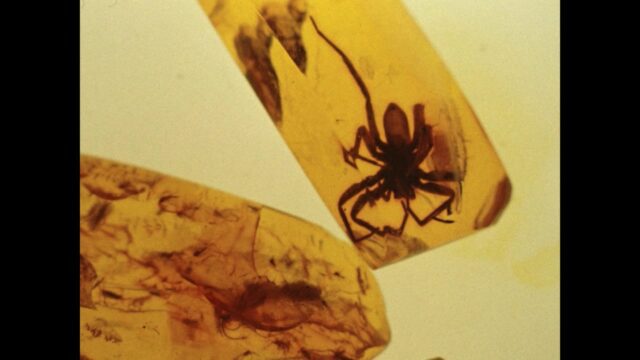
Lovci further underlines how director Rufini sets out to create a visual analogy between amber and the medium of documentary itself. “Amber, as a documentary, is like a door to another world, a testimony from the past. In a way, the subjects of a film are similarly ‘trapped’ inside the medium like insects inside amber pieces. Therefore, the director attempts to reflect this analogy in the cinematography by drawing a visual parallelism between amber and video as both traces of the past and ways to ‘capture’ time. He selected old Soviet lenses from analogue cameras mounted on a digital body and other optical devices like split crystal filters, dioptres and extreme bokeh to create an imperfect ‘amber look’ for the film. This artistic choice connects to amber’s imperfections which are part of its beauty.”
“The idea is that watching the film would remind the audience of the act of looking into a piece of amber. Amber – similarly to film -is like a fragment of time and for many amber catchers is connected to the memories of the day it was found. The dreams and memories of the characters are presented creatively using glimpses of the beautiful archive footage of the region. The use of archives shows the connection of people with their past and local heritage and communicates nostalgia for what is lost and beyond reach. Finally, great music and sound design are fundamental to achieving the immersive experience we are aiming for. Sound will be crucial as amber will sing like a mermaid to our characters, constantly drawing them to itself, and becoming the musical leitmotiv of our film.”
Sarajevo 2024 will mark the project’s first presentation to a jury of experts, and the filmmakers are keen to receive expert feedback and opinions, as well as advice on future steps to take.
“Moreover, we are searching for a possible co-producer to finish the film, as we haven’t locked a company for picture and/or sound post-production,” Lovci adds. “We also wish to find some new connections in the field of distribution or sales with whom we could start working after Sarajevo.”
The final cut of the film should be ready around January 2025, and Lovci is hopeful to supervise its world premiere during the spring of the same year.





