The sheer and awful brutality of war is examined in sprawling artistic fashion by filmmaker Amos Gitai in the simply (and appropriately) titled Why War, using as its spine an exchange of letters between Albert Einstein and Sigmund Freud which dwelled on violence in the name of religion, race and nationality, but which also takes in art, music, performance and literature. The whole is based on Gitai’s notion of embracing the filmmaker or the artist as a healer.
To a large extent Gitai avoids using the expected iconography and imagery of the horrors of war and destruction (in a similar fashion to his films Kippur, Kadosh, House and Rabin the Last Day), but instead lets debate and emotional (and artistic) response to war take the lead.
As Gitai says in the director’s notes: “Today you just have to turn on the television to be overwhelmed by the shocking images of Israeli women and men taken violently by Hamas from their homes or a music party into captivity, by the continuous destruction of Palestinian lives in Gaza. It is an iconography that precisely amplifies war.”
His film opens in Israel, with a gentle tracking shot through a monument to hostages outside Tel Aviv Museum of Art, passing by a yoga class before heading into a dark tunnel and emerging into footage of Roman legions (with images of fire and sword) attacking Jerusalem. He then cuts to actress Irène Jacob coming out of a lift and entering a hotel room, mulling over how it feels to watch war on TV. “What is the effect on me?”
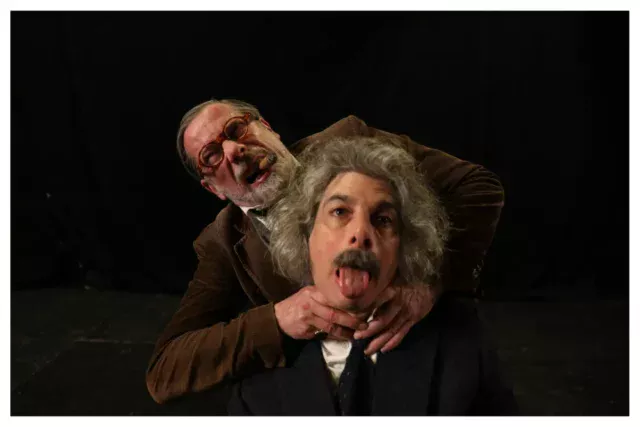
Footage of Freud and Einstein (respectively played by Mathieu Amari and Micha Lescot) punctuates the film. In 1932, Albert Einstein was invited by the League of Nations to address a letter on any subject to any person. He chose to correspond with Sigmund Freud about avoiding war, with Gitai arguing that to this day the correspondence about war between these two great thinkers proves to be more relevant than ever.
He adds: “The exchange of letters between Albert Einstein and Sigmund Freud defined the modern discourse on mass human violence that occurs in the name of religion, race and nationality. The cinema I make is inspired by the reality and the context in which we live.”
It is a film determined to pose questions rather than offer answers, embracing art and performance as a way of subtly creating debate, with the lack of images of death and destruction heightening the impact rather than reducing it. The search for an explanation for the savagery of wars that inhabit our world feels like a never-ending one. There can be moments when the artifice of performance from the actors distracts from the text, but the power and depth of the narrative sines through.
The end of the film features a performance by the Wiener Hammertoe and soprano Magdalena Halsted, as they perform on stage in front of footage shot from a helicopter flying over tanks and devastated buildings. It looks like clichéd Vietnam war footage, but is possibly material that Gitai shot himself with a Super 8 camera when he was part of a helicopter rescue crew during the 1973 Yom Kippur War.
The film’s literary sources also include Virginia Woolf’s The Three Guineas; Susan Sontag’s Regarding the Pain of Others, and Gitai’s own The War of the Sons of Light against the Sons of Darkness, itself inspired by Joseph Flavius’s The Jewish War, but the heart of the film is the correspondence between Albert Einstein and Sigmund Freud. As Freud wrote to Einstein, concluding his letter: “In the meantime, we can say to ourselves: everything that works for the development of culture also works against war”.
France-Switzerland, 2024, 87mins
Dir/scar: Amos Gitai
Production: Agav Films, Elefant Films
International sales: Agav Films
Producers: Laurent Truchot, Alexandre Iordachescu
Cinematography: Eric Gautier
Editor: Yuval Orr
Music: Alexey Kochetkov
With: Irène Jacob, Mathieu Amari, Micha Lescot, Jérôme Kircher, Yaël Abecassis, Keren Morr