

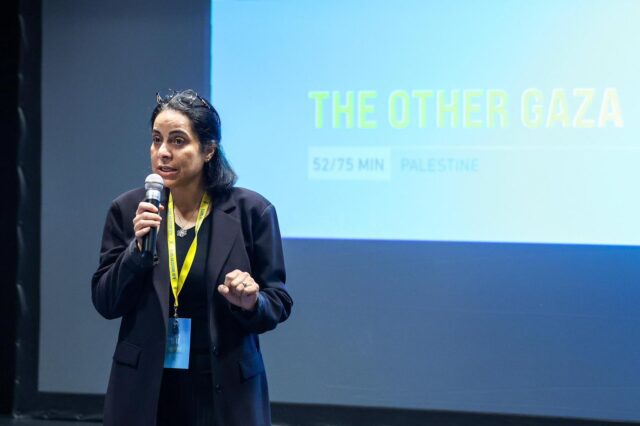
Swedish-based Palestinian filmmaker Wafa Jamil finds it difficult to express the emotional toll of her separation from her family in Palestine, the ongoing bombardment of Gaza and the concerns she feels for her daughter’s future. So she deflects the question, stressing instead why investors should back her film, The Other Gaza, which she pitched at AJD Industry Days.
“Because it’s a good film,” she says. “It’s not only about me as a film director, a producer also, working on this film. It’s about how occupation affects our relationships and connection to family.”
Jamil lives in Stockholm, while her family resides in Gaza. In Sweden, she longs for “the laughter, tears, and unbridled creativity that shape a meaningful life amidst the turmoil,” the film notes underline. Her film is an “autobiographical, intimate, and family-focused story that ponders the dilemma of constantly yearning for a place where one can no longer live.”
During the current war, Jamil feels terrified that something might happen to her family. Whenever they have internet access, they video call to assure each other they are still alive. These calls are filmed as a diary during the war. She hopes to return to Gaza to film them.
When, almost 30 years ago, Jamil left home to be a student in Ramallah “on the other side of Palestine,” she was subsequently not allowed to make the 50-minute journey back to see her family, she says. “I left my family when I was 18 years old. And then when I came back to them, I was a mom,” she says.
“They didn’t have the chance to be at my wedding party [or] to see my daughter born,” she laments. “[Nor] also for my daughter to feel that she has a family. I mean I have a big family, but even some of my nieces, nephews, I [remember] when they were really little. Then when I saw them, I didn’t recognize them even though they are my siblings’ kids. Even if I see them on Facebook, it’s not like reality.”
“The occupation affected every small detail within family life,” she adds. “It’s not just, as we always say, a conflict – it’s occupation.”
In 2018 Jamil received Israeli permission to visit her family following the death of her sister, Kifah. The film’s synopsis reads how, “after nearly two decades, she was shocked by the harsh conditions of life in Gaza, yet proud of their [her family’s]attempts to create normal lives under inhumane conditions, with 17 years of blockade and five wars.”
The reunion was bittersweet, at times joyous, she says. That said, Jamil found it very painful to look at the footage she had shot in Gaza, which emphasised even more the sense of ‘family’ which, she feels, doesn’t feature as prominently in Europe, specifically in Sweden where she made her new home.
“We, in the Arab world, we build up family ‘parcels’ and this is how we create our kids. Of course I’m independent partly living in Europe for a couple of years. Part of my brain, it’s independent and I want my independence. But on the other hand, when I feel weak or I want to be secure to hug my family, I want this also to be existing in my life. And that’s also the heritage I want to give my daughter,” she says.
When Covid hit in 2020, Jamil could not help but see the irony. “Everyone said, ‘I didn’t meet my family for one month. I didn’t see my family for one week, two weeks, one year.’ Well, I just didn’t see my family for 18 years. Eighteen years,” she emphasises.
The Arabic, Swedish-language film has a mooted completed date of January 2026. Financial supporters so far include The Arab Cultural House, The Palestinian Cultural Fund – Ministry of Culture, the Association Amicizia Sardegna Palestine, The Swedish Arts Grants Committee and FILMPOOL NORD.
In Sarajevo, FILMPOOL NORD Commissioning Editor Katja Härkönen and Swedish co-producer Ulf Boström added their support for the project via video.
Ulf Boström commented: “The first time I met Wafa one year ago. I was so taken by her story. Wafa is displaced. She was plucked up from Palestine and dropped down in Stockholm for another life. How can she explain her love for Gaza to her daughter Leah, a happy-go-lucky kid, born and raised in Stockholm? Wafa has a passion I have rarely met. She taught me so much about how deep roots go, and how one place can be at the same time heaven and hell. She possesses a story that the world needs to hear.”At the end of the pitch, Jamil invoked her physical senses to describe the homeland that she misses so much.
“For me home is the essence of orange blossom and the taste of summer water melon, which became the symbol of Palestine,” she signed off.





