

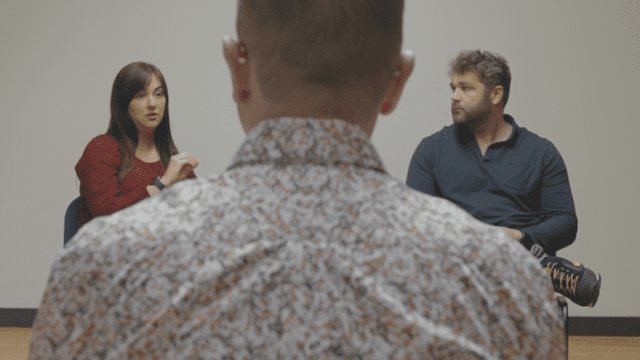
Kerry and Kenny have suffered more than most throughout their lives, both before and after their marriage. He suffered terrible PTSD after serving as a sniper in Afghanistan, while she was sexually abused as a very young girl. They fell madly in love when in their early 20s but each remained silent about the pain they were suffering inside, at least until the birth of their son when deep fissures began to open up within their relationship.
Kerry was abused by the older brother of a friend, even before she was ten. This was simply something that adults did to children, she long assumed, and conversations with girlfriends confirmed this assumption. She became rebellious and defiant as a teenager, and was consumed by self-loathing. At the age of 15, with five pounds in her pocket, she decided to get as far away from her home in Scotland as possible, and took a 19-hour bus journey to Cornwall in the far south-west of the UK.
She started to perform in a lap-dancing bar which seemed a relief, given how the lights were so bright she didn’t feel like she was being watched. But one night she felt unbelievably sad at what she was doing, and returned home.
Kenny was 16 when he joined the army. His misfortune was to be an excellent marksman on whom his unit came to rely heavily. But the toll of being licensed to kill bore heavily on him. “How many families have I devastated?” he asks in the film.
“He was trained as a child soldier,” says director Amy Hardie of Kenny. “The UK is one of the few countries that still trains child soldiers. There aren’t many left in Europe, but the UK still actively pursues recruitment in impoverished areas for 16-year-olds. For Kenny, in some ways that was very good because it gave him a route out of a home life that he didn’t like. And it gave him a route towards increasing his skills and his feeling of potency. But it didn’t give him the kind of emotional growth that a loving family would’ve done. And so it didn’t give him the kind of resilience that he would’ve needed to cope with the responsibility of becoming a sniper by the age of 19, and having responsibility for the safety of his fellow soldiers.”
When he met Kerry, he couldn’t even admit to being in the army, telling her instead that he was a deep-sea fireman. She remained equally non-communicative about her painful past.
After their son was born, he became suicidal and would strike out at night in his sleep, until he was reassured that the person beside him was his wife and not an assailant. When he’d look at dog walkers out of his window in the Scottish countryside, he was convinced that they were Taliban assassins. Fireworks or a screaming child would set off a form of shell-shock whereby he would enter a frozen state, suffering “the screams” in his head. His wife had to remove all the knives from the house.
“They’re both incredibly bright but they were both incredibly angry. They were feeling broken by the world, and they took refuge in each other,” says Hardie of her subjects. “But when that first baby came along, that was like a firework that just set everything off. Everything that they had hoped to hide, the secrets that they’d hoped to keep down in their marriage that wouldn’t emerge, just all came bursting out. And Kenny’s PTSD from his military service came out and he had to become very heavily medicated. So Kerry found herself living with someone who was sleeping 19 hours a day, who was attacking her in the night, who didn’t know what was real, and who couldn’t really be a responsible father.”
As Kenny says in the film: “I knew all this would stop if I was just dead.”
At this point, it may have been the wisest, even the most logical, option for them to go their separate ways – many people would have taken that course of action. But not Kerry. She decided to do something about it. For her, breaking up was too easy a solution. Kenny was the man she fell in love with, and continued to love, despite his erratic, sometimes terrifying, behaviour.
So she turned to the full-time study of psychology, and little by little she persuaded a reluctant Kenny that therapy might just be the way forward. He began to attend sessions with the ground-breaking Rock2Recovery military rehabilitation service.
When compressed into a single sentence, what I have just written all sounds so easy, but the process of therapy was arduous, at times harrowing for both Kenny and Kerry as their pain was so deep-rooted.
But so was their love for one another. And both are/were very smart and, ultimately, very determined. What’s more, they had offspring to rear and to nurture, and they were determined to create a safe and loving environment in which to do that, something neither of them ever had. So the pair begin to undergo a profound transformation, in which they began to grasp the importance of survival and co-existence…
“Kenny and Kerry don’t take prisoners. They don’t take anything for granted. They rely on their own responses to things. And so they’ll try anything. They’re open-minded. And if it doesn’t quite work for them, they move on swiftly. And I think that’s really important. Everyone’s journey is different. It’s worth trying anything, and it’s worth leaving [things] behind.”
For Hardie the core scene of the film is when Kerry decides she is not prepared to walk away from Kenny. “She recognises his need. She recognizes that it mirrors her own, and she doesn’t know what to do. So she does something that nobody in her family or community has ever done. She goes back to school, she gets her highers (higher qualifications), she gets a place in the university to do a psychology degree. She eats that degree. She eats every single word with such appetite. She’s so hungry for it, and she learns extraordinary things. Her perspective is widened massively.”
“For me, it was very moving when she said ‘I realise that suffering is not a given. I realise that anxiety doesn’t have to be a lifelong condition. I realise that you can change feelings with thought.’”
This is exemplified in the film as Kenny starts to learn again how to empathise with a son who wants nothing more than to love and be loved by his dad. A therapist asks him to imagine life through his son’s eyes on a Christmas morning. Kenny agrees, but unfortunately what he sees is his bitter, angry self staring back at him. The experience is, for Kenny, both seismic and ultimately life-changing, and a key that unlocks a happier future between father and son.
Back in 2009 Hardie directed her remarkable The Edge of Dreaming in which a last-resort visit to a shaman reverses her descent towards possible death after the diagnosis of a serious lung condition, potentially cancerous. Prior to this, she had been told in a dream that she would never reach her 49th birthday. But she does, and the last scene of the film features the most joyous and defiant of 49th birthday parties.
Kenny and Kerry watched the film and were deeply moved, and were left in no doubt either of Hardie’s qualities as a filmmaker or her intentions for the new film she wished to make.
“Watching my film allowed them to see that I had been through a real crisis, and what mattered to me was my family and my health, and that I really wanted to exist in the world – and that it wasn’t easy. It wasn’t simple. It wasn’t something I could rely on. I think that gave us a fellow feeling. And the process of filming itself develops trust,” she says. “They began to see that they could be creative collaborators in the film. They understood that in a way, they are as much in charge of the story as I am.”
Hardie and producer Sonja Henrici (Sonja Henrici Creates) chose to world-premiere the film at the inaugural Dokumentale festival because of its emphasis on Impact. The director explains her future outreach intentions.
“We’re talking to Child Light at the moment, which is a child abuse institute, about doing a think tank, bringing various charities together to see if the film can help them in any way,” says Hardie. “We are working with the NHS to use the film to train psychologists, because one of the feedbacks we got in our test screening was that psychiatrists and psychologists would benefit enormously from seeing this film, because you’re seeing the impact of abuse and you’re seeing the impact of PTSD over time and within a family setting.”
The film will also be a core component within a new ‘Aftershock’ module at the Edinburgh Features Institute, part of Edinburgh University. “We’ll be looking at the role of the engaged observer. The people who come on that course will often be psychologists, doctors, people who work in government and policy. And I’m excited to see the film being used to understand the human dimension within a condition like PTSD,” Hardie signs off.





