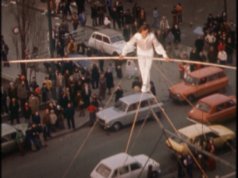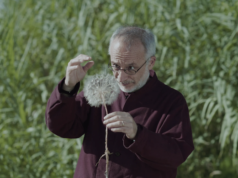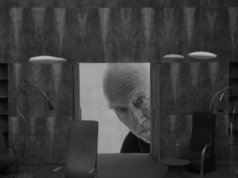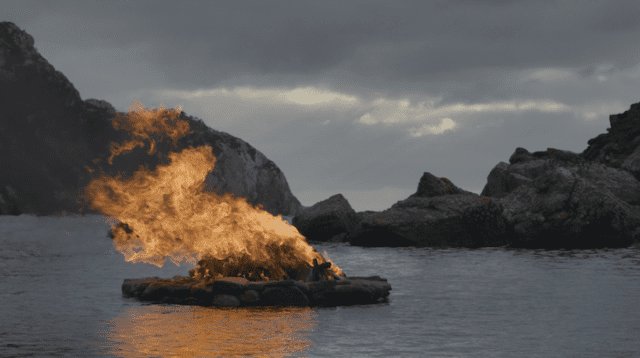
Thomas Riedelsheimer’s Tracing Light opens with a quote from Albert Einstein: “the most beautiful thing we can experience is mystery. It is the inspiration at the heart of true art and science.”
The director explains that he first had the idea for the film when he read a book about Einstein and Picasso as contemporaries. “The author had a little fictional idea about them meeting. They both, at the same time, introduced abstraction in thinking. I thought, well, that’s a clever idea, to combine science and art.”
Another inspiration was the near perfect light reflections he noticed in his bathroom one day.
The film, opening DOK Leipzig 2024 (28 Oct-3 Nov), looks at light from the twin perspectives of art and quantum physics. There are some very challenging ideas about photons, particles and waves floating around here but, as Riedelsheimer told Business Doc Europe in an illuminating interview, you don’t need to be an expert to appreciate and enjoy what the documentary has to offer. In fact, even the top scientists themselves are still in the dark about precisely how light works.
“I’m not trained in science, and science for sure was not my favourite thing in school,” admits the German filmmaker (whose previous credits include movies about artist Andy Goldsworthy and musician Evelyn Glennie). “But as a documentary filmmaker, you watch reality, you record reality – you are able to do that. Understanding that you are able to do that because you are there, and [that] you are part of everything that happens at that very instant, made me interested in these ideas of quantum physics.”
During editing, the director held a series of test screenings. Audiences were split in their reactions. Some were daunted by the science but others were enraptured by its enigmatic beauty. “I tried to find a way to say that light is much more than beautiful sunsets,” the director reflects. “It’s a philosophy. It is something that tells us that we will not be able to understand everything going on – [that] there’s a layer of reality beyond our normal reality that is very hard for us to access and understand. I find that immensely interesting and also, in a way, humbling.”
As a filmmaker, Riedelsheimer works with light as a matter of course. It’s his craft. Nonetheless, as one of his interviewers observes, a point always comes when language fails and you can’t quite explain what you are doing when you try to capture light.
“Finding images that have this kind of fluidity and metaphors in them help you to talk about a subject like this,” the director explains why pictures tell the story of light better than words.
During the three years he has spent on the project, Riedelsheimer has come across “things that you take for granted” that turn out to have far more complex origins than he had imagined. For example, if you create a pinhole, you can create an image.
“In a way, we all know that but, in a way, what it means is that our way of seeing is taking place in a black box.”
The film features physicists and artists from Scotland, England and Germany. Locations range from the rainy, windswept and ruggedly beautiful terrain of Harris and North Uist [Scottish islands] to the brilliantly white interiors of the Max Planck Institute in Erlangen, where artists share their ideas about light with leading scientists.
“The white was obviously, from the technical point of view, the most difficult thing to do, especially in the colour correction afterwards,” Riedelsheimer remembers.
Looking over his earlier work, the director believes he has always been obsessed with natural phenomena. “If you think about it, [with] a film my art tool is light, sound and time. I did a film about time with Andy Goldsworthy and I did a film about sound [with Evelyn Glennie]. In Tracing Light, you will find all these links to filmmaking, cinema and how we perceive things – and that is through light…if you sit in a cinema and you look at a screen, you think it’s a two dimensional image but if you put your hand up and you see the images on your hand or if you put smoke up and you see the images in the whole room, then you think about how this image works,” Riedelsheimer describes the rapidly changing properties of light. “I am just stunned by the topic, the vastness of what light can mean and be…all these little things make me just aware that the world is a place of wonder.”
The Munich-based director has a long association with Scotland. Tracing Light is one of a number of documentaries that have taken him to the country. He has Scottish-based producer Sonja Henrici (former Co-Director/Exec Producer of Scottish Documentary Institute) as his partner on the project. He is also working again with regular collaborator Leslie Hills (Skyline Productions), who is based in Edinburgh.
“First of all, I love Scotland and the people there,” Riedelsheimer declares. “I love to be there. The people have a strong connection to nature. They are modest. They are generous when it comes to [allowing] even trespassing [on] their land.” He further rhapsodies about the landscapes and the ‘fast changing weather.”
Artist Andy Goldsworthy (with whom he has worked several times, starting with Rivers and Tides in 2001) is based in Dumfriesshire in southern Scotland. Tracing Light took Riedelsheimer back to the country.
“I came to Scotland because I found Daniele Faccio from Glasgow University,” he says of the brilliant academic and Professor in Quantum Technologies who explains his philosophy of light. “I found him through a connection in Munich. We set up a zoom. I thought this guy is fantastic. Where is he based? Oh, Glasgow!”
Winter on the island of Harris, where he was filming with artist Julie Brook, was cold and windy but that didn’t put him off in the slightest. “I love these kinds of challenges,” he enthuses. He concedes that Scottish midges can be “really nasty” but not even they can dampen his enthusiasm for the Scots.
Screen Scotland is one of the backers of the film through its film development and production fund. The German release is set for January via Piffl Media (who’ve also released much of his previous work). “They will start with 40 copies, they’ve said,” Riedelsheimer notes of the company’s confidence in the upcoming launch.