When he was younger, Daniel Abma always dreamed of becoming a school teacher. The director (whose latest feature The Family Approach premieres in German Competition at DOK Leipzig) even went as far as to study primary school teaching. But when it came to the crunch and he was due to start working, he couldn’t go through with it.
“It was the big responsibility that kept me away from doing the job. Being responsible for a full class of school kids every day from 9 till 5, I couldn’t imagine doing it when I was so young,” the director, who was then living in the Netherlands, remembers. “There was a huge lack of teachers. They were begging me to start working, but somehow I couldn’t do it.”
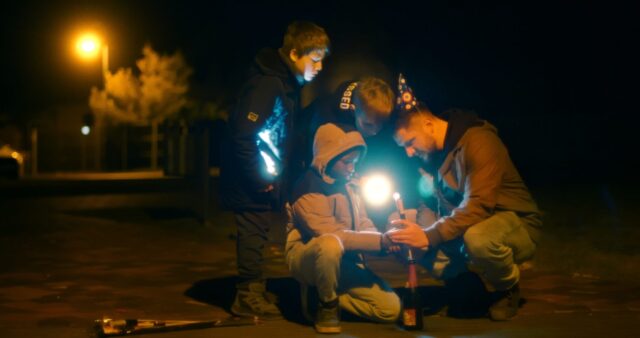
Since then, Abma has had huge respect for those who don the roles of teachers or social workers – and who are prepared to assume the responsibility that he found so daunting as a younger man. This is one reason why he embarked on The Family Approach. The documentary is set in a children’s residential home in a beautiful forest and lakeside location somewhere in Germany. It follows a number of kids living there. They all have one thing in common – they yearn to go home. For whatever reason, their mums and dads aren’t able to cope with them. It’s therefore left to the caregivers to look after them. At times, these youth caregivers take on the role of surrogate parents. They are devoted to the children and always try their hardest to improve their lives.
“Now I am a filmmaker, I can contribute something to the cause by showing them my respect by making a portrait of the important work they do,” Abma says of his subjects.
The spark behind the project was lit in 2017 when Abma read a newspaper article highlighting the chronic lack of youth workers and teachers in Germany.
“Then it was clear. One and one is two…this should be a film,” the director explains. He sees the new venture as a companion piece to his earlier doc, Beyond Wriezen (2012), about young prisoners just released from jail. Many of these prisoners became parents. Now, their kids, who are 11 or 12, are often living in the care system, just like the children we see in The Family Approach.
In the new documentary, the biological parents continually turn up late for their meetings with their kids or aren’t available to take them out. The kids are invariably crestfallen. They feel as if they have been abandoned. Abma points out that the film’s focus is on the care workers, not the parents. There isn’t the scope to explore the parents’ past and what has made them so unreliable at a time when their children need them the most. By the same token, the filmmakers were determined not to “blame” the parents. The care workers do their utmost to work sympathetically with the parents. They know that doing so is in the best interests of the children.
The filmmakers worked very hard over “several years” to establish trust with both the caregivers, parents and the kids. “The biggest part of the research was just living there, having breakfast with them, bringing them to school. I was really part of the family. That [feeling] became stronger over the making of the film.”
Abma’s director of photography Johannes Praus likes to shoot as close to his subjects as he can – and not to rely on zoom lenses. “But because the relationship was built already, we could be there without disturbing them,” Abma reflects on the extraordinary intimacy the film achieves. He adds that in the meetings between psychologists, care workers and children, the talks were “so intensive, the topics talked about were so important, that the protagonists were really focused on that. We were more of less like a fly on the wall.”
The director and his team shot a lot of footage. He can’t specify how much but, at a guess, reckons it will have been close to 100 hours.
There are some delightful moments along the way. For example, one kid is shown early on visiting a farm and looking on in rapture as a baby ostrich emerges from its egg.
“That was an amazing day! Once a year, each child can decide a day with his [or her] individual caregiver. We were driving with one of the boys and we passed this farm where gigantic birds were walking around.” The boy immediately exclaimed that he wanted to go there for his special day.
“It is all about family and birth. It is a very symbolic metaphorical scene,” Abma says of that magical sequence in the farm with the baby ostriches.
Abma has known most of the kids who feature in the film for six or seven years. Given that they are now 14, this represents almost half of their lives. So, yes, he is very close to them, and he remains in contact with them. He is still invited to the home for Christmas dinner every year and feels himself to be part of the family.
The main producer is Britta Strampe, with whom Abma earlier worked on a short film about female firefighters in the Berlin area. “That was a test case for both us. It worked really well and so we said let’s go for a feature film. She came in at an early stage and really contributed a lot. She immediately recognised the potential of the topic and had great ideas in terms of the film’s target groups, and it was her idea to create an impact campaign that we are preparing now, to be launched around the time of the cinema release in Germany.”
The Family Approach was a relatively straightforward film to fund. By the time Abma and his team started applying for finance, they already had several years of research behind them and they were able to convince potential supporters of the importance of the subject.
“Due to this long and intensive research and hard work, we really were able to present a very stable, solid and convincing package with which to apply for financing. So it was very hard work to come until there, [but] then happily all went very smooth,” he says.
The hope now is that the film may inspire a new generation of would-be care givers and teachers. As Abma shows on screen, this is tough but immensely rewarding work.
The filmmaker himself may have resisted becoming a primary school teacher all those years ago but he now teaches documentary to first year students at Film University Babelsberg KONRAD WOLF. “I love it. I really love it,” he enthuses. “With my students, I want to create a room where they can develop. This could be one of the parallels with the educators [in the documentary]. They want to create a safe space, a place where it is like a family where children can grow up ‘normally.’ For my students, I always want to offer them a place where they can dive into documentary, have their first experience, and where it is not a problem to make errors…I like to create a very open atmosphere where they can develop and grow.”
The Family Approach was made through Bandenfilm in co-production with ARTE & RBB, funded by Die Beauftragte der Bundesregierung für Kultur und Medien (BKM), Deutscher Filmförderfonds (DFFF), Filmförderungsanstalt (FFA), Medienboard Berlin-Brandenburg (MBB). The German release of the film is handled by Camino Filmverleih. It will be in cinemas early next year.