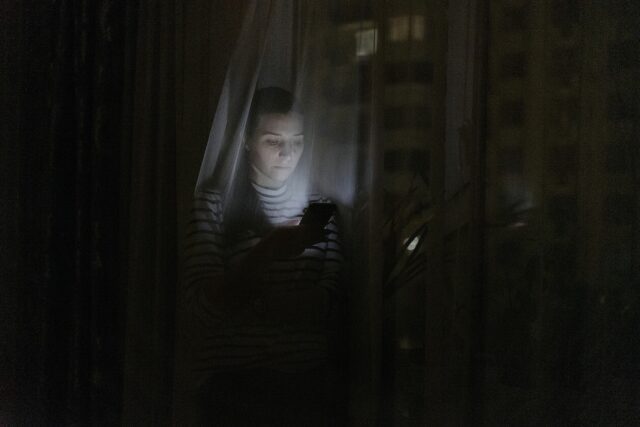
“The war crimes of Bucha mark a point in European history that shows us what happens when the European architecture of freedom is trampled underfoot by an expansive war of aggression,” co-director Marcus Lenz told Business Doc Europe before his DOK Preview Germany presentation of Lights (WT), co-directed by Mila Teshaieva.
The pair’s When Spring Came to Bucha was received to great acclaim after its world premiere at IDFA 2022, later picking up the Audience Award at Hot Docs 2023, among other prizes.
Lights begins where When Spring Came to Bucha left off, and follows a set of characters, post-liberation, dealing with personal and ethical dilemmas in the years after the full-scale invasion. “Navigating through a polyphony of conflicts, trauma, and hopes, the film tells the story of the transformation of the nation shaped by war,” the logline reads.
“For over 2.5 years we observed how this war changes people, while they are forced to live in a world that has to defend itself against the violence of others,” Lenz tells BDE. “This experience also changes the way people live together within the attacked society. A sense of injustice on various levels is spreading inside the nation. What future will these people have, what future will this society get?”
“The personal stories of our protagonists talk about the often-overlooked struggle that comes when the active fighting phase is moving away,” he adds. “In Bucha we can simultaneously observe a society after the end of an occupation and the present of life in times of war.”
Lenz further describes his and Teshaievas’ working relationship, and highlights his co-director’s particular qualities. “Mila and I co-directed Lights as a Ukrainian/German team. This made it possible to have a point of view that is very close to the characters, but still allows for a certain distance. What sounds like a contradiction has a certain quality for us.”
“Mila has an almost unbelievable feel for people and at the same time a very unique artistic vision. Working with her is a very unique experience. It’s almost like not making a movie about our characters, but sharing an experience with them. People open up to our gaze and allow us to capture intimate moments with our camera.”
The style of the film is very much determined by the circumstances of making it. “We aimed to stay simple and direct,” Lenz underlines. “You don’t ask people in a war zone to wait for your technique to be prepared or to do anything for a camera.”
“The film is shot almost exclusively with a focal length that corresponds to the natural section of the human field of vision,” he adds. “So if we wanted to tell in an intimate style, our protagonists had to “allow” this closeness, we had to be allowed to be “in” the situation. You don’t look up at something from a safe distance, but enter into it, share an experience. Perhaps this stylistic simplicity is part of what some viewers describe as ‘honesty.’”
The project already has some powerhouse backers, including WDR, SWR, 3SAT and BBC Storyville, as well as DR and THE WHY Foundation, so the main goal is to secure a world premiere in early 2025 ahead of a March 2025 theatrical release in Germany.
“When Spring Came to Bucha was very successful at festivals (German Documentary Film Award and an Audience Award at the HotDocs) and we hope to build on this with Lights,” Lenz signs off.