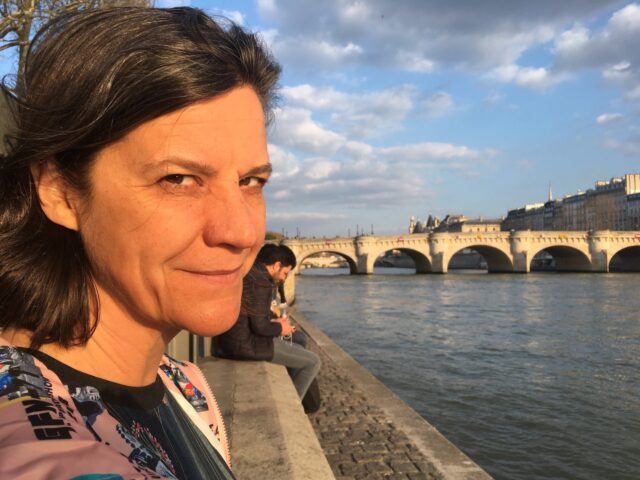
The 28th edition of Ji.hlava hosted a talk with the multi award-winning DOP and director Kirsten Johnson. The US filmmaker is best known for her work on acclaimed documentaries such as Citizenfour, The Oath, and Dick Johnson Is Dead. In her talk, Johnson delved into the emotional impact of her work, the ethics of documentary filmmaking, and the role of images and AI in modern society.
Since the early 1990s, Johnson has filmed over 50 productions, including Kirby Dick and Amy Ziering Kofman’s Derrida, Michael Moore’s Fahrenheit 9/11, and Gini Reticker’s Pray the Devil Back to Hell. Known for her grounded, engaging presence, Johnson turned to directing in 2016 with Cameraperson.
This documentary, a retrospective of her career across current affairs and war zones – including coverage of five genocides -helped her process the traumas she witnessed on the job. “I needed to make that film to help me process,” she reflects.
Dick Johnson Is Dead, her most recent work from 2020, also screened at Ji.hlava to captivated audiences. Produced by Netflix, the film explores her father’s journey with dementia through imagined scenarios of his death. In one memorable scene, he even attends his own funeral. Netflix was particularly drawn to this unique approach, Johnson notes.
These days, Johnson has broader questions on her mind. Since the rise of smartphones, society is experiencing an “incredible proliferation of images,” she observes. She believes it’s time to reconsider what this shift means and underscored how “there’s never just one meaning” behind imagery.
Back in the 1990s, filmmaking was seen as a rare calling, distinct from today’s era, where anyone can claim the title. “In the middle of the 90s, I realised I was part machine, part person,” she says.
Her physical interaction with the camera is a defining trait in Cameraperson. The film, assembled from unused footage shot for other projects, reveals her presence in ways typically concealed. In one scene, a sneeze disrupts the stability of a landscape shot; in another, her shadow appears on the ground, and in a third, she reaches out to pull a weed from the frame, creating a raw authenticity.
Now, she’s less fixated on capturing the “perfect” shot and instead lets the camera roll as she finds her composition. Johnson also contemplates the power dynamics between the camera and its subjects. “These are all of our questions,” she says.
One recurring question involves the roles people play, often differing from what a documentary might aim to depict. Johnson recalls visiting her father in the hospital to find him with a pillowcase on his head. Instead of presenting as a helpless patient, he chose to make light of his situation. “This made me laugh and gave me solace,” she recalls.
Johnson also shares a story of filming a resilient survivor of the Balkan War. Although Johnson had intended to discuss the atrocities endured, the woman avoided recounting her trauma, choosing instead to speak about her sense of style. “She needed to talk about pleasure. She couldn’t talk about the past.”
What many survivors of trauma value most, Johnson finds, is asserting that they have not been defeated. Their statement, she says, is clear: “I lived. I’m myself. I’m not letting you take me down.”
Johnson further remembers a soldier in Fahrenheit 9/11 who spontaneously declared he would not go to Iraq “to kill brown people.” His decision risked court-martial, yet his words, once on screen, led to a policy shift allowing his unit to opt out of service in Iraq.
But the camera can also endanger people, Johnson acknowledges, making them “targets” or tools for self-defence. In today’s hyper-connected world, she observes, “we’re talking to each other across time and space” through shared images, and she suggests “inviting each other to play.”
She has also considered the implications of AI, which she points out now generates more images each second than have been recorded throughout human history. However, she believes AI lacks something vital. “AI doesn’t have a body—but we do.” This distinction, she explains, is essential to understanding how bodies are presented on screen, something humans innately grasp. For example, in conflict zones, the positioning of human bodies often signals when something has gone terribly wrong.
Human bodies, she contends, deserve respect. “Capitalism doesn’t have a body. Tech doesn’t have a body.”
Raised in Seattle and in Wyoming within a Seventh-day Adventist community, Johnson had an early sense of distance from worldly matters. “We are not of the world,” she recalls as a core belief from her upbringing. However, she eventually became captivated by documenting lives through her camera lens. “I want to be in the world. In history,” she sums up, articulating a purpose she still pursues.