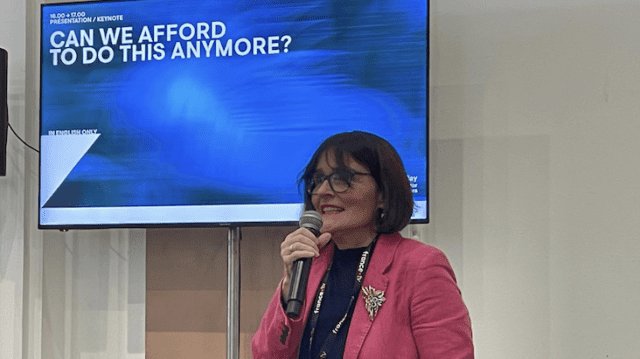
Jane Ray, Artistic Director of UK funding body The Whickers outlined the stark realities of documentary filmmaking in her ‘Can We Afford to Do This Anymore?’ keynote at Fipadoc January 28. Presenting The Cost of Docs, the organisation’s international annual documentary survey, Ray’s keynote explored the emotional and security challenges, as well as the financial struggles, that face filmmakers today.
Key findings from the survey reveal that only 13% of independent documentary filmmakers can take a wage from their production fund, the lowest since the survey began. As a direct result, documentaries are taking longer to complete – two to five years, compared to six months to two years, as revealed in the first survey analysis seven years ago.
Ray commented at the Biarritz event: “I think what comes across very strongly is that nobody’s doing this to get rich. If it was just about finance, then independent international documentary would be dead by now. I think really it all comes back to the resilience of people to carry on regardless. This is something that I find profoundly moving, because there are much easier ways to make a living.”
The challenges are compounded by ever-rising costs across the board, with 71% of respondents citing travel expenses as the most dramatic increase. For the first time ever, music composition was the most-ticked ‘line item’ in documentary budgets (51%), overtaking ‘editor hire’ as the most common item to appear on the budget sheet. This statistic seems to be a positive one, with many docmakers turning to original scores to avoid the high cost of music licensing.
“Filmmakers have found it’s better for them to employ someone to create something unique for their film rather than pay a shed load of money to use 20 seconds of licensed music,” Ray said. “But of course, there are consequences for people who depend on their music license. For them, it’s not such good news, so it’s a double-edged sword.”
There is good news, too, on the wellbeing front. Despite the ongoing cost of living crisis, there has been a 10% drop in respondents reporting the need for mental health support, although 34% of those saying they need support also say that they are unable to afford it.
91% of respondents reported that they felt the doc industry to be a ‘safe space.’ However there is still some work to be done, with 9% citing ‘power imbalance’ as a significant concern.
Whilst this is a positive development, Ray reminds us that, “there is more work to be done to support and encourage people who are dealing with complex post-traumatic stress for working in conflict zones, or constantly getting their funding applications rejected.”
For the first time this year, The Whickers collaborated with Al Jazeera in canvassing more of the Arabic-speaking world on their experiences. Perhaps the most striking differences among these respondents are in attitudes towards mental health and wellbeing. The survey tells us that, when asked about wellbeing, only 19% of Arabic speakers say they feel the need for emotional support, but later in the survey we find that many feel ‘physically unsafe’. Costs differ, too, with ‘kit hire’ being the budget item which has seen the most dramatic price hike, with difficulties in securing travel visas, or gaining permission to travel, constituting major challenges.
Ray also discussed funding applications which, according to the survey, are taking longer to complete than ever. Even when funding is secured, funders are asking for more in return, with 20% now insisting on broadcast rights. However, there are still funders (including The Whickers) who asking for no rights, and that figure has doubled, from 4% in 2023 to 7% today.
Ray tells us: “The funders and commissioners have got less to give. More than a quarter of funding applications completely failed – that’s a lot. Co-production and commissioning is always a marriage where you hope that both sides end up happy, but increasingly we’re finding that the commissioner is more averse to taking risks and they want more things tied down in advance.”
However, it appears that the more you ask for, the more likely you are to get your funding. The findings show that the 9% who applied for funding over £100,000 were proportionally four times (12%) more likely to get what they requested.
Ray rounded off the keynote with an impassioned plea for the continued support and celebration of the sector. “Funders and commissioners need original content. And the one thing that documentary makers have access to is original stories. Being able to walk around for a mile in another person’s shoes is actually fundamental to an engaged and free society. And if we’re talking about free societies, there has never been a time when it was perhaps more important than right now.”
Those wishing to take part in the next Whickers Cost of Docs survey can email info@whickerawards.com to be added to the mailing list and have the chance to win 2 Industry passes for Sheffield DocFest 2025.