As a member of Palestine’s first parkour team, the energetic Ahmed free-runs through the battered buildings of Gaza pre-October 7, 2023. His goal is to create parkour videos that are so impressive that they could be his ticket out. In the meantime, he strikes up an unlikely online friendship with wistful Palestinian-American émigré director Areeb Zuaiter.
Director Areeb Zuaiter has called her film ‘the last glimpse of a pre-October 7th Gaza’. It shows young men, free-running around their neighbourhoods, smiling, laughing and generally being full of life.
Yalla Parkour (‘Yalla!’ meaning ‘Come on!’) is permeated with nostalgia, as Palestinian-American filmmaker Zuaiter, based in Washington D.C., connects online with the young Ahmed, whose smile reminds her, as her voice-over repeatedly tells us, of her mother’s smile whenever she returned to Palestine.
This diasporic framing device turns out to be the least interesting part of the film, which really takes off every time we join Ahmed and his friends from the Gaza Parkour Team (Palestine’s first, and one of the region’s pioneering parkour ensembles) as they run, jump, and flip through the air at various spots around their neighbourhood.
In these images, Zuaiter’s nostalgia seems to be reflected back at her from a broken mirror. Because these energetic, smiling and sun-drenched young men are running through desolate areas dotted with the remnants of past conflicts and relentless oppression. As Zuaiter notes, in her voice-over: “I see experts in turning pain into happiness.”
And so we follow Ahmed and his friends as they run through a bombed-out mall, with death-defying leaps over large holes in the concrete floors, climb the famous fourteenth-century Barquq Castle (which, as no tourists visit anymore, is now full of clotheslines, one of the friends remarks dryly) and explore the unfinished Rafah Airport, where planes neither land nor take off. This country had been broken, bombed and besieged long before October 7th – to start our political discussions at that date is to distort history.
At the beginning and end of the documentary, Zuaiter includes references to the current situation in Gaza. They feel both unavoidable – because we cannot watch this documentary right now without thinking about the genocide taking place – and also somewhat added on, because everything else in the documentary takes place before, with videos recorded between 2015 and September 2023.
The unfinished Rafah airport is a stark symbol of Ahmed’s seemingly unattainable dreams. He may enjoy parkour, but his real reason for practising hard, always improving, and sometimes taking enormous risks isn’t just love of the game. When Zuaiter asks him, a little worried: “All for the sake of adrenaline?”, he replies calmly: “All for the sake of video, Areeb. What else…”
Because those videos could be his ticket out of Palestine. While these images of young Palestinian men running and jumping through the ruins of their cities can rightly be considered a symbol of resilience and unbroken spirits, the real reason behind all Ahmed’s training is his wish to get out of there.
His friend Mohammed Aljakhbir, one of the founders of the Gaza Parkour Team and the first Palestinian free-runner that Zuaiter discovered online, did just that. The online videos of the team’s exploits reached the international parkour community, which resulted, after having overcome all bureaucratic obstacles, in his desired departure to Sweden.
This is where Zuaiter’s framing device works best. The structure is clear: she is an older Palestinian in exile, mourning a lost sense of belonging, Ahmed is her younger counterpart yearning for a way out and a future elsewhere. While she understands his desire to leave, she also knows the realities of life as an emigrant. Her voice-over reflects: “My worry for Ahmed wasn’t if he’d get out, but what part of himself he’d leave behind when he did.”
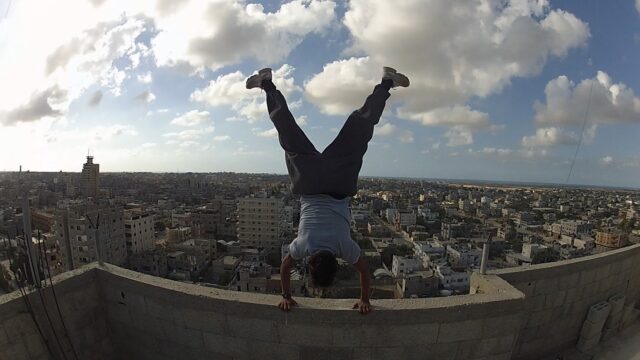
The key image of the documentary, which also ended up on the poster, features a parkour team member doing a handstand on a building’s ledge, eleven storeys up, looking out over the ruined surroundings, maybe even all the way beyond their borders. It’s beautiful, disturbing and exhilarating all at once.
And it’s dangerous – more than once we see Ahmed or one his friends hit the ground at painful angles; a fall from what looks like the eighth floor leaves one of them with fifty broken bones and the urgent need for medical treatment in Israel. Which takes at least a week to organise, because the Israeli occupation and militarised blockade of Gaza was already harsh, humiliating and dehumanising even before the gruesome events of October 7, 2023.
Yalla Parkour won the Grand Jury Prize of the International Competition at DOC NYC, where it had its world premiere. The end credits dedicate the film to five people who died during its production. They are: camera crew members Yaser Murtaja, Roshdi Sarraj and Ibraheem Lafi; sound recordist Marwan Al-Sawaf; and Gaza Parkour Team member Saeed Al Tattari.
Sweden/Qatar/Saudi Arabia/Palestine, 2024, 89 minutes
Director Areeb Zuaiter
Production Kinana Films
Producers Basel Mawlawi
Sales Arthood Entertainment
Script Areeb Zuaiter
International sales Kinana Films
Cinematography Ibrahim Al-Otla (Gaza), Marco Padoan (Sweden), Umit Gulsen (Turkey)
Editing Phil Jandaly
Sound design Yehya Breshe
Sound Marwan Sawwaf, Yehya Breshe
Music Diab Mekari
With Ahmed Matar, Areeb Zuaiter