I wish I’d read the book. Given that Maxie Wander’s 1977 ‘Guten Morgen, du Schöne’ is well-known as one of the most successful books of the GDR, I assume there exists a fair number of people who grew up with it. Women in particular, as it is a groundbreaking collection of interviews with GDR women about their sexuality and love lives. But the love lives of men and other genders are in there as well, as the publication was termed “the first realistic description of life in the GDR.”
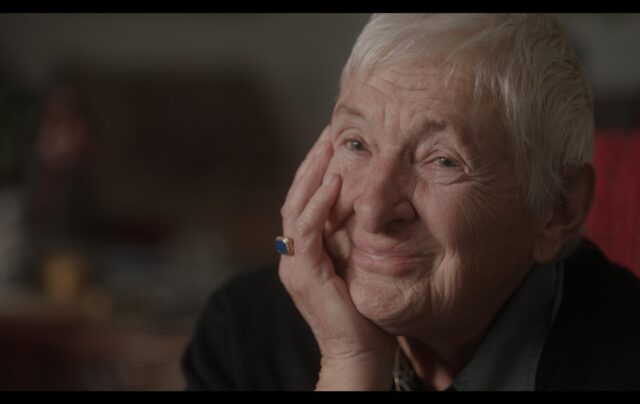
That last quote is from Annerose, one of the women interviewed for the book. She was 41 at the time, and is revisited by filmmaker Ina Borrmann when she is around 90 years of age. She and the other women contributed anonymously (in the book, Annerose appears as ‘Erika’); fifty years later, their names and faces are finally revealed. They reminisce and reflect on their lives before, during, and after the publication – from ‘Guten Morgen, good morning,’ at the beginning of their romantic and sexual lives, to ‘Guten Abend, good evening,’ towards the end.
Imagine being a woman in the GDR in 1977, when the book was originally published, reading for the first time about other women also struggling with their sexuality, struggling with the official propaganda about women, and above all, struggling with men.
And then imagine watching ‘Guten Abend, du Schöne’ now, half a century later, and comparing your own life with the ones depicted in the film. That must be a wondrous and moving, perhaps even deeply confronting experience.
Maybe you’re also alone, by choice. Maybe you also had a terrible marriage, and then found the love of your life. Maybe you also still choke up, recalling how your father left when you were just a little girl. And maybe you too found love in art, and in the arms of another woman.
These examples are of course as varied as the interviewees they describe. But there are also similarities between them, stemming from the political, social and historical circumstances they shared.
Most obvious is the apparent lack (or inadequacy) of sex education, as a result of which women had no idea what to expect from sex with men – who themselves were also completely uneducated in such matters.
And yes – the men. In the words of these women, looking back with the wisdom of the years, men in the GDR were, more or less, useless. They saw themselves as gods, bossed women around, demanded sex, and simply walked out when they no longer received what they desired. According to Annerose, actually writing down and publishing this behaviour amounted to “a small revolution” in 1977, making clear that “we don’t want these men anymore!”
This behaviour is not unique to the GDR, as readers will be aware – but that’s the country we’re discussing. And the Socialist State did have its ideological particularities, which differed from their counterparts in the West. In one of the most interesting passages in the film, it is noted that the official policy of “women being equal to men” (consider how different that sentence would sound if the words ‘men’ and ‘women’ were swapped) made it impossible to criticise structural disadvantages – officially, these simply didn’t exist. As the daughter of one of the women interviewed remarks, “in the GDR, they increasingly talked about women having the same abilities as men – that they are not so different. (…) Which makes any [attempt at] emancipation pointless.”
Alongside contemporary interviews with the women (at home, but also actively out and about), the footage consists mainly of attractive amateur films depicting life in the GDR, as a kind of stream of memory, as well as some historical footage of Nazis and their atrocities, and GDR propaganda events and broadcasting. As the soothing GDR radio voice explains, in one particularly telling, almost absurdist example: “You must understand, dear friend, that outside this Federation everything is only lies and untruths.”
Under such conditions, the truths spoken in the book ‘Guten Morgen, du Schöne’ were indeed little short of revolutionary. Still, much of what the women tell us about their lives, then and today, feels more personal than specifically related to living in the GDR. This does not go against author Wander’s original intentions, as to her, anyone’s life was worth recounting to others. But because in the film each person’s screen time remains limited, the individual storylines can feel a bit slight.
It reminds me of how Michael Apted’s 7Up series (1964-2026) gradually shifted, over the years, from its highly political origins (interviewing young people from lower and higher classes to see how these backgrounds would shape their futures) towards more individual stories, with the initial political framework slowly receding into the background.
Something similar happens here, but due to the shorter run-time it inevitably lacks personal and psychological depth, despite some tantalising glimpses, such as the story of Heide (‘Barbara’ in the book), who still can’t explain how she managed to become an independent freelance artist in the GDR, and who, half a century later, is still drawing beautifully. One could easily imagine an entire documentary solely about her, and the same goes for a number of other participants.
That said, there is much here. These glimpses into lives, echoing one another, collectively evoke a time and place which have now been assigned to history, but continue to live on in minds and hearts. We moved to freedom, one of them explains, but she – as a person educated and indoctrinated in the GDR – could not follow. And when the documentary interviews the children of some interviewees who, like the author herself, are no longer with us, you can still sense the GDR effect rippling through time and generations until this day.
Annerose’s granddaughter says how, at the age of twelve or thirteen, when she first read the book in which her grandmother appeared, “it was hard to read; it made me so angry. The way she speaks of happiness and keeps downplaying it.” She adds that in their family they can still only talk about feelings “sarcastically” – and that this continues to affect her to this day. Tellingly, one daughter of an interview dryly states: “I have little trust, basic trust in men. I got that from her.”
Germany, 2026, 95 minutes
Director Ina Borrmann
Production Shoot from the Hip Filmproduktion
Producers Ina Borrmann, Marc Wächter
Script Ina Borrmann
Cinematography Susanne Schüle
Editing Julia Albrecht
Sound design Adrian Lo
Sound Nic Nagel
Music Adrian Lo
With Annerose Richter, Heide Kathrein Schmiedel, Ulrike Graupner, Sabine Moritz, Katharina Röhl, Kathrin Starkloff, Bert Lindstedt, Luka Handke, Frank Löprich