

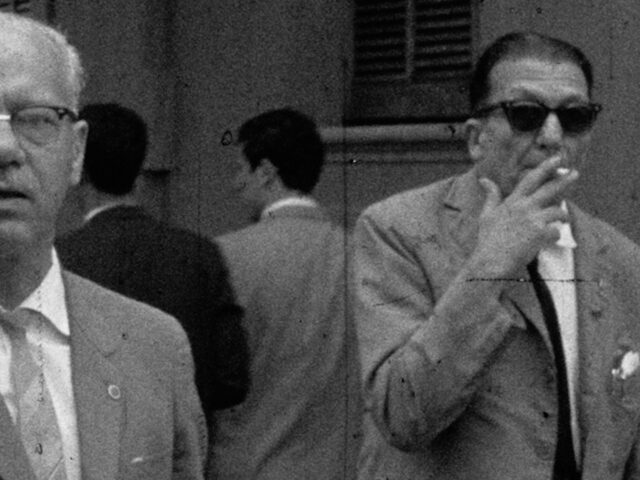
Young Paraguayan director Juanjo Pereira takes an innovative approach to evoking the horrors of the General Alfredo Stroessner dictatorship in his new feature, Under the Flags, the Sun (Bajo las banderas, el sol) sold by Cinephil and a world premiere in Berlin’s Panorama). He doesn’t use voice-over or interviews. Archive material in Paraguay itself is limited to “only a few hours,” he says. His solution is to cast around the rest of the world – and to see how the dictatorship of the Stroessner years was portrayed by foreign media outlets.
He began his search in Argentina (where he had been studying) and Brazil. Then, he began to look further afield, in the UK, France and Spain, “all the countries that have a relationship with Paraguay.”
Pereira was “amazed” by what he turned up. This was footage that “had been lost to the Paraguayan people” but that showed their country in one of its darkest periods.
“I am a child of democracy, in a way, because I was born after the dictatorship,” the director reflects. The Stroessner period had been largely airbrushed out of his young existence.
“We don’t study the dictatorship in school. For me it was OK, who is this guy [Stroessner] and why don’t I know anything about him? I didn’t know anything about that period and I wanted to understand it,” Pereira explains why he first plunged into the archives.
Everything was new to him. Soon, though, the face of General Stroessner became very familiar indeed. The dictator enjoyed a massive personality cult. He featured again and again in newsreel clips, many of which were openly propagandistic.
“The shocking thing for me was what I found in France. In that period, France had this position on human rights. They had done a lot of interviews with people from Paraguay that were against the government. That was different from the other tapes I found. For the first time, I saw the people who were against the government, who were fighting against the dictatorship.”
On French TV, torture victims spoke openly about what they had endured in Stroessner’s jails.
Meanwhile. Life Magazine from the US also exposed the darker side of the regime. Stroessner, who had thought he was taking part in a lifestyle story, was furious. He insisted afterwards in doing interviews only by writing so that the journalists couldn’t set him up.
Stroessner’s supporters in the ‘Colorado’ party wore strident red. This may be confusing for the international audience. In most European countries, red is the colour of socialism. “[But] in Paraguay, we know that red is ‘right’…it is not socialist or communist.”
The dictatorship lasted for 35 years – until Stroessner was toppled in a coup, replaced by another military strongman.
Although the dictator presided over a brutal regime and gave sanctuary to prominent Nazis, there are still parts of the population who revere him.
“It’s sad to say but it was a popular dictatorship,” Pereira notes. Even today, some Paraguayans celebrate the man’s birthday. The coup that toppled him didn’t change that much. “It was not a coup d’état of the people…it was a change of command.”
One poignant image is of Stroessner’s statue being pulled down. This has happened to many other dictators from Stalin to Saddam Hussein.
When the statue was dragged away, it was taken over by a prominent artist who turned into an anti-war monument.
“But the crazy thing is that the feet are still there. No-one knows they are there,” the director explains that the base of the statue has been left intact. It is very high up and you need a drone to see it but the pedestal is still there, 40 years after he was deposed.
One of the fascinations for the filmmakers was to find out just how foreign broadcasters depicted Paraguay. The US TV reports described the country as “bigger than California, smaller than Texas.” The British likened it to the “Birmingham area.” Each country had its own way of looking in at the country through its own very local lens.
“For me, in a way, the film is about two points of view, the point of view of the government and also the camera [view] of people [from the outside] who had their own way of seeing the country.”
Pereira’s bold decision to rely on the footage and not use talking heads or narration was a challenge. He told the editors he wanted to put the film together “like a big puzzle.” Sound was crucial to holding the images together.
“For me, the challenge was to make a movie without my fingerprint.”
The archive producer was Laura Tusi (who had also worked on Asia Kapadia’s celebrated Maradona movie). He met Tusi through a friend. She knew little about Paraguayan history but was immediately fascinated by the project.
Pereira’s hope now is to reach young audiences in Paraguay and to give them insights into a chapter of their own history they may not know. He expects some will react with anger.
“In Paraguay, there will be a great discussion…and maybe a political problem as well. We don’t know yet. It’s the first film to put all this period together, and not in a fiction film. There are documents and you can’t deny it… we want to make a distribution in universities, schools. We want everyone to see this movie in Paraguay.”
This wasn’t a straightforward film to fund.
“It was a long, long trip,” the director sighs of what has been a six-year journey. “At the beginning, I was alone with my editor and my assistant director.” They won a small national arts prize in Paraguay that enabled them to develop the project. Then, three years ago, the project won the RTP Award for Best Project in the Editing or First Cut Stage at DocLisboa, giving it extra momentum.
But there were also problems to address. Pereira and his team were using archive material from all over the world, all with different licensing regulations and fee structures. “We needed to pay these licenses.”
The team applied to funds all over the world. Last year, they were in Hot Docs Forum and Pereira met James Costa of Bird Street Productions. Bird Street championed the film and helped the team push it toward completion. They also won the Aide aux Cinemas du Monde support award in France to add to the backing they received from the IDFA Bertha Fund, Argentine National Film and Audiovisual Institute (INCAA) and elsewhere.
“We had a lot of support because it is not easy to make a movie from Paraguay,” the director says with evident understatement.
The film is produced by Ivana Urízar through Cine Mío, Paula Zyngierman and Leandro Listorti of MaravillaCine, Gabriela Sabaté of Sabaté Films, and Pereira himself. It is co-produced by Bird Street Productions and Lardux Films. Welt Film is the associate producer.





