

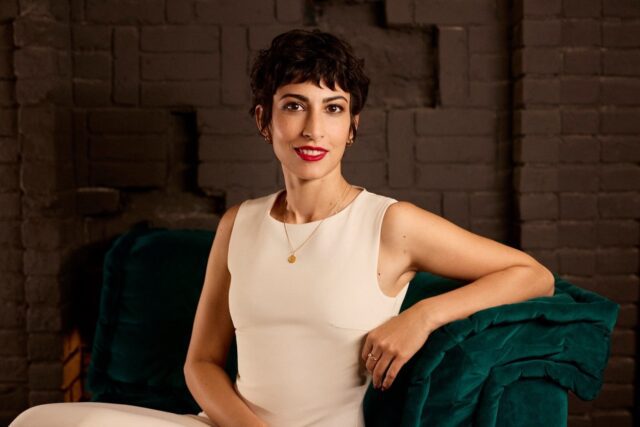
This week has marked the 10th anniversary of German Films’ ‘Face To Face’ initiative. At the event, “outstanding talents from the German film landscape” are presented to international delegates at the Berlinale. The one figure from the documentary world participating this year was Mala Reinhardt.
Last summer, the prolific Reinhardt was at Locarno with her Critics’ Week entry, Familiar Places, in which she followed her friend Akosua, a queer, Ghanaian-German on a three-year journey across Germany and Ghana. What the two friends have in common is a “search for a home and a place where we can arrive,” the director underlined to BDE at Locarno 2024.
Now, she is hard at work preparing for her next project, Mother/Tongue, an ambitious hybrid documentary project that is taking her both to India and Malaysia (this was presented in Berlin as part of Berlin Talents’ Doc Station programme.)
“I want to combine fictional elements with documentary footage but also archival footage and oral history,” she says of a film that will rake over the painful legacy of the British colonial mistreatment of the Tamil people.
“Basically, millions of people were taken from south India as indentured labourers to go and work on the British rubber plantations in the late 19th and early 20th centuries,” Reinhardt sums up one key subject she will be addressing. Today, two million Tamils are living in Malaysia.
This is a story with a personal resonance for Reinhardt. Her family originally comes from south India but went to Malaysia. Her mother was born and brought up on the Malaysian rubber plantations, eventually moving on to Germany (where Mala was born).
On one level, this will be a tough story to tell. Many of the Tamils taken from India were illiterate and there is little direct documentation chronicling their forced migration. Instead, family stories were passed on orally. However, the British left behind exhaustive records of life in the plantations. There are photos and films kept in archives.
Reinhardt is fascinated with what is sacrificed when communities are uprooted and stop speaking their native tongues, “In my case, my great-grandparents stopped speaking Tamil to their children in order to give them a better life in Malaysia. So they spoke Malay. And then my grandparents…were looking for a better life for their children and were always looking to the mother country – and so they spoke English. My mother, growing up speaking English mostly, raised me in German. Now, with my daughter, we are going another step and she is growing up bi-lingually.”
Language is a crucial part of cultural belonging. When you lose access to the tongue your ancestors spoke, you are giving up part of your identity. “Making a film about something as invisible as language is also a challenge…”
The new film, which Reinhardt aims to shoot in 2027 won’t be directly autobiographical, even if the subject matter is deeply personal. “I think it is also a collective story, not specific to my family. It has happened to a lot of people…I want to find narratives that go with my story, add to it and also challenge it.”
She talks of making a “creative documentary that also has dream-like parts where you can play with imagination and what could have been.”
Mother/Tongue is being produced through Berlin-based Seera Film. The project has already received development funding. The filmmakers are currently looking for both Asian and UK co-production partners.
Reinhardt herself has recently returned to Germany from a research trip to south India where she visited several archives. “But I couldn’t find the things I was looking for because they are probably in Britain, not south India.”
The director describes last year’s Familiar Places as “a very, very personal film…I was also in front of the camera. I was not just directing and producing it.” She was recording some of the sound too, and had her young baby on a sling with her as she worked.
On the new movie, she plans to stay out of the frame.
The director strongly believes her background as a cultural anthropologist has helped in her film work. She studied ethnology in Cologne, New Delhi and Kampala before jumping into directing studies at Film University Babelsberg Konrad Wolf.
“I think that speaking about identity and belonging has always been part of my filmmaking,” Reinhardt explains what drives her. “I always find cultural anthropology very close to documentary filmmaking when it comes to how you get into the process of researching and interviewing people. For me, it wasn’t such a huge reorientation to go from cultural anthropology to filmmaking…”
One challenge of shifting from academia to filmmaking was learning how to express herself visually rather than by writing academic papers.
“[But] I think I have always been interested making films, especially behind the camera. It was something I even had a childhood dream {about]. At the same time, I thought it was a very elitist occupation, something you have to have a specific schooling for.”
Her first film Rupa (2015), co-directed with Patrick Lohse, was a short about acid attack survivors in India. This had a warm reception at various smaller festivals and gave her the confidence to continue with her documentary making. Next came The Second Attack (2018), which premiered in German competition at DOK Leipzig. This was a timely polemic about racism and right-wing violence in Germany from the perspective of the people affected.
“We filmed before George Floyd, before Black Lives Matter, and before anyone in Germany officially said there is racism in Germany,” Reinhardt says of the self-funded, self-released doc which continues to be screened, and to spark discussion throughout Germany. (It has been shown this month both in Bremen and Berlin).
Does she now have a visual signature in her work? Reinhardt ponders the question.
“I think I am not set on a specific visual style and I am also still experimenting,” she reflects. Some of her work has featured talking heads and interviews. She has always used animation and fictional elements. “I am still at a stage where I want to try out things.”
Mother Tongue, she adds, will be “completely different” from anything she has done before.
And no, she doesn’t want to give up documentary (“it’s very close to my heart”) but in the long run, she “definitely wants to try out some fictional work…”





