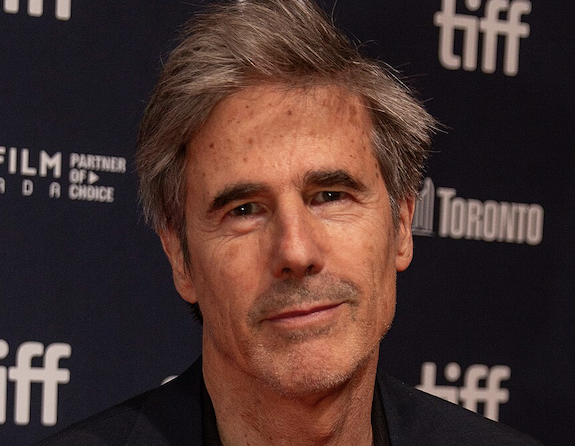
Oscar nominee Walter Salles has revealed further details of his ambitious new four-part documentary series about legendary Brazilian footballer and political activist, Sócrates Brasileiro Sampaio de Souza Vieira de Oliveira, the languid midfielder known to the world simply as Sócrates.
The Brazilian director, whose latest dramatic feature I’m Still Here has three nominations (for Best Picture, Best Actress and Best International Feature) at next week’s Academy Awards, has already shot the series, entitled Sócrates Brasileiro.
Salles himself never met Sócrates but “knows well” his brother Raí, also a Brazilian international footballer.
“He one day shared with me this desire to make a documentary about his brother. In fact, he wanted to know if I could suggest somebody to do it. At that moment, I said I would love to do it because I have the highest admiration for Sócrates in all his complexity,” Salles tells Business Doc Europe.
The director describes the chain-smoking Sócrates as someone who, despite his brilliance on the field, “never ceased to give political opinions even when he was asked not to; who never ceased to think about the world he lived in.”
“It’s a five-hour series, but from it, we will probably also be doing a feature film,” the director explains. “Really, Sócrates deserves that. His experience is so vast and so polyphonic in nature…everything about this character is really extraordinary.”
Sócrates (1954-2011) began his career playing for Botafogo, the team that Salles supports. His career than took him to Corinthians, Fiorentina in Italy, Flamengo, and Santos. He had a bachelor’s degree in medicine (which he studied at the University of São Paulo during his football career) and was a qualified medical doctor.
The Brazilian ace also once famously played for the West Yorkshire team, Garforth Town, in the Northern Counties East League in England. By then, he was already in middle age and far from peak fitness. According to the Planet Football website, he warned up for his appearance with “two bottles of Budweiser and three cigarettes.”
Sócrates’ football career coincided with the military dictatorship (whose devastating effects on a middle-class family in Rio are the subject of I’m Still Here). The midfielder was one of the instigators of the so-called “Corinthians Democracy.”
“They were the first team to put on the back of their shirt, ‘Vote,’” Salles notes.
Corinthians openly challenged the dictatorship and campaigned for democracy, both in the football world and in Brazilian society as a whole.
Sócrates was the son of self-taught parents who came from different parts of Brazil and who each ended up taking jobs in public service. The mother was a teacher in public schools while the father worked for the government, as a revenue supervisor.
“He was the son of parents who believed in public education,” Salles says of his subject (who captained the 1982 Brazilian World Cup team that was knocked out by Italy (3-2) in one of the all-time classic World Cup matches).
During the making of the series, Salles spoke to a former players from a wide variety of different backgrounds. These included figures like Zico and Walter Casagrande Jr.
“They talked not only about their personal journeys when they were part of that team specifically but also about a collectivity – a collectivity meaning the team itself but also the society they lived in. This is something that got lost in the globalisation of football…he lived in the 70s, 80s and 90s and so I got also somehow to do a journey in time.”
Salles, whose other credits include The Motorcycle Diaries and Central Do Brasil, suggested that most of his previous works have been road movies in which characters come in contact with “a human geography that was unknown to them and alters their perception of life. This [the Sócrates film] was another form of odyssey…an odyssey into Sócrates’ different lives, an internal journey in time.”
“I shot it before I’m Still Here and it actually helped me a lot in the fictional project,” Salles notes. “He [Sócrates] is the one man in Brazilian football to understand that sports could be blended with politics to really redefine who we would be.”
The series has been made in collaboration with Videofilmes, Salles’ own company, and Anonymous Content Brazil, and will screen in Brazil on Globoplay.
Alongside his dramatic feature films, Salles has made several previous documentaries, among them Jia Zhangke: A Guy from Fenyang (2014), which screened in the 2015 Berlinale Panorama Documentary section, and the 1995 short Life Somewhere Else, about the correspondence that began between a woman in a Brazilian prison and a famous Brazilian sculptor living in exile.
I’m Still Here itself is based on a true story and adapted from the book ‘Ainda Estou Aqui’ by Marcelo Rubens Paiva. It follows middle-class woman Eunice (the Golden Globe winning and Oscar-nominated Fernanda Torres) in 1970s Rio whose family life is turned upside down after her husband, former congressman Rubens Paiva (Selton Mello), is arrested. He disappears into a captivity from which she fears he will never again emerge.
The film was released in the UK to record breaking box-office last week. UK distributors Altitude reported that its weekend opening of £486,391 was the highest opening for a Latin American film in the UK and Ireland and the top opening Brazilian film since 2003’s City of God.