

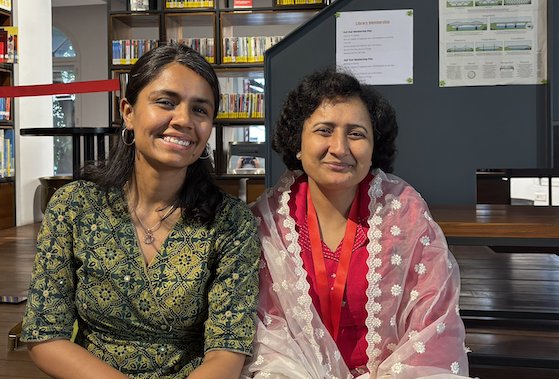
Pushpa Rawat’s upcoming project Sita’s Awakening provides an intimate look at the lives of two sisters fighting against both domestic abuse and an inaccessible legal system. In the process they attempt to rewrite the rules of tradition, justice, and political participation, as well as voice the similar struggles of other women.
The Indian-Nepali production, originally titled Sita Ke Badalte Roop, centres around the community of Uttarakhand migrants in Ghaziabad, Delhi. Rawat originally intended the film to be about her participation, together with her sister Sunita, in the local Ramleela — a dramatic folk re-enactment of the life of Rama according to the ancient Hindu epic Ramayana. But the focus shifted after Sunita suffered a harrowing setback in her personal life, leading her to rediscover her feminist core. Sunita’s husband remarried without seeking a divorce.
“It has been a series of battles, one after the other,” says Rawat of the subsequent legal process. “First it was domestic violence, then it was the process of filing a police complaint which was not as easy. We were also challenged by confronting and dealing with the police. The second challenge was going to court and dealing with the legal system.”
Producer and editor Niharika Popli points out that the sisters’ frustration and lack of progress with their case pushed them to seek legal education – a stepping stone that later brought them into local politics.
“Right now, this film is about the transformative journey of two sisters — who go from being victims of abuse to becoming women who not only recover but also seek to hold positions of power, ensuring an end to this kind of injustice for all,” explains Popli.
In 2019, the project received a grant from Film South Asia Kathmandu under the theme “Challenging the Stereotypes of the Depiction of Violence Against Women,” centring on their participation in the traditional Ramleela.
“Initially, Sunita was sceptical about participating, but once she heard the music, she started getting thrilled about it,” recalls Rawat. “She picked the role of Surpanakha [a demoness known for her fiery personality] and said ‘I want to overcome my fear. Her personality, strength and expressiveness is what I want to embody.’” Rawat herself reinterpreted the character of Sita by rejecting passivity and infusing her with strength and agency.
The filmmakers reaffirm that the story is about finding personal tools to overcome systemic oppression and display resilience, creativity and determination to seek broad justice. Producer Popli underlines that though their project stems from a deeply personal story, it remains a universal narrative.
“I think there’s huge potential for this film to spark conversations about resilience,” she opines. “Across the film, we explore common themes like domestic violence, systemic injustices, oppressive systems and confronting family, law and the police.”
“We could be talking to somebody from Bosnia, Georgia, Sri Lanka, Pakistan or anywhere else in the world, and yet every woman would understand what it means to be able to challenge what has happened. It would speak to others about not just tolerating what you’re going through, but also fighting back.”
Director Rawat emphasises the narrative’s bigger goal of seeking personal redemption and the willingness to voice their struggles for other women. She points out that a third thread of the documentary moves from the sisters’ personal transformation to a quest for greater power and helping others.
“The sisters have started to feel a little bit more confident with their transformation after the Ramleela and their education, and now they want to actually be in a position of power to take stronger decisions,” adds Popli. “That’s how politics came in and they decided to contest in the Municipal Council elections, despite not knowing anything about politics.”
In terms of the film’s visuals, Popli reveals that they worked extensively with archival footage, some of which the sisters began capturing as early as 2014. Rawat points out that much of the footage was initially filmed as legal evidence.
“Earlier on, none of the conversations surrounding a potential film were happening; Pushpa [Rawat] had been recording events just as they were. When the idea of integrating all of this into a film came by, the shooting had already happened,” says Popli. “So the visual language is very candid, has been done using a single hand-held camera in a very intimate way…When we were filming, life went by sometimes on a phone, sometimes on a camera.”
Despite the rawness of their footage, produce, Popli affirms her belief in the production having “immense” potential. She is seeking funds and creative resources to take the film into post-production. The filmmakers expect a 6-month long process to completion once the right financial collaborations are struck.
“DocedgeKolkata has been helpful in connecting us with the right people. Now that we have established contacts with certain agents, we hope they will guide us on how to take this project to the market,” Popli signs off.





