

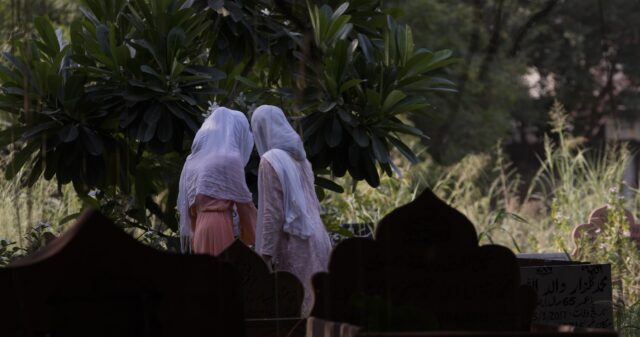
Winner of The Whickers Bursary Award (£3,000) at Docedge 2025, How Love Moves by director Pallavi Paul and producer Aman Mann (All That Breathes) explores the story of 40-year-old grave-keeper Shameem, who has played a paramount role in the burial of over 1000 bodies at the Delhi Gate Cemetery ever since the pandemic reshaped the city.
The production has been following Shameem’s story since August 2023, having dedicated six months of research to seek early stage funding for the film’s development. These grants include the IDFA Bertha Fund for Development and the Asian Cinema Fund from Busan International Film Festival.
The documentary meets Shameem at a perilous moment when he is between efforts to capture a grave vandal – news of the defilement could threaten the sanctity of the 100-year old graveyard. The filmmakers hope to follow his personal journey, with a clear focus on defining the long-term impacts of changes at the graveyard, and on the life of grave-keeper himself.
“Our character and the place where the film is set both look at the modern human sentiments, the relationship between human and the divine, the ritualistic, urban and architectural verticals which create a tight mesh,” director Paul explains the film treatment.
Peering further into the concept of the graveyard, Paul deems it as a “microcosm” for many large events, which in today’s time are extremely vital at a granular level.
“Death is one thread, but there are many more strands running across and alongside them. For example, while the pandemic witnessed huge swarms of dead bodies, the 100-year-old graveyard continues to remain a resting place for freedom fighters. The place has its own mythology and its own patron saints — it houses people from the neighbourhood, their family members and more.”
Her description of the pandemic as a “gash on the collective side of the city,” and the additional acknowledgment of it being a space holding “memories of the partition,” makes the cemetery a microcosmic space for observation and a fertile ground for storytelling.
Producer Mann highlights that the “small, everyday acts of kindness and tenderness” is what brought him and the rest of the crew onboard. “There’s nothing didactic about it, but it is the whole idea that these small moments of generosity make for just a hint of a difference.”
“Often a question is asked about what difference a film or a documentary can make, but I think it is a really heavy burden to place on a film. It eventually comes down to allowing people the privilege to witness an insight into spaces which they will normally never visit,” he adds.
The filmmakers have a very strong perspective of how the graveyard is viewed beyond “a ground of the dead.” Mann shares that continued filming has also enabled them to touch upon themes like universal life, death, love, longing, loss and social tension.
Here, Paul shares a strikingly eerie anecdote, that re-establishes how cemeteries are commonly perceived: “The graveyard staff buries a lot of unclaimed, orphaned bodies. This one time, during the winters, they dug a grave anticipating an unclaimed body. However, the next morning they found a homeless person who had slept in it. While Shameem and the others were really taken aback by this, in the same breath they would say that we understand why in the winter somebody would want to sleep in a grave, as it is so much warmer there than outside. So there’s always this very seamless movement between states of life at the cemetery and the perception of it.”
How Love Moves aims to adopt an observational and vérité style in its cinematic approach, with plans to combine heavily stylised sequences to visualise the protagonist’s relationship with the dead. A dramatic use of seasonal shifts in Delhi is also expected to add to the visual narrative.
Additionally, there is a conscious effort to capture Delhi’s softer elements, in contrast to its reputation for being a bustling city. To try and evoke a sense of time, space, language and energy that the graveyard has, the camera follows a similar rhythm of slow movements and looks around to capture non-human life.
“The graveyard is not a place where any kind of hectic, dramatic activity happens, and yet the richness of life here lends itself to really compelling dramatic moments. Thus, the guiding principle of the filming is to spend time, to observe deeply, to look closely and to look for long enough,” explains Mann.
He also commends Paul’s directorial prowess in being able to “depict elements for which no non-visual materials or archives exist,” and ensure that these moments do not risk being lost to public memory.
Citing the director, he extrapolates: “This is emphatically not a pandemic film, but it aims to bring across the scar that the moment left on the soul of the city. Now that there’s some distance from the memory of the period led by statistics and a lockdown, it is something that Pallavi was very interested in exploring, and she found a way to do that by going to this graveyard and exploring this character.”
In terms of challenges to getting the film to the market, Mann highlights a topical barrier, in addition to securing adequate funding and developing a pitching skillset to gather attention.
He defines the documentary’s ambition is to be “poetic and lyrical,” an approach which can be challenging for the market. However, having faced a similar outlook while seeking promotion and funding for All That Breathes (2022) — which went on to receive an Academy nomination for the Best Feature Documentary — Mann has an optimistic forecast for the opportunities that lay ahead.
“What we’ve realised is that the market keeps shifting. Some years, you can really have an audience. What we have to figure out from our end is to have as many strategies to distribute the film to a wide range of audiences — be it at film festivals, non-governmental or education screenings or other avenues.”
How Love Moves is expected to film continuously through the rest of 2025, and the project is expected to reach completion by August 2026.





