

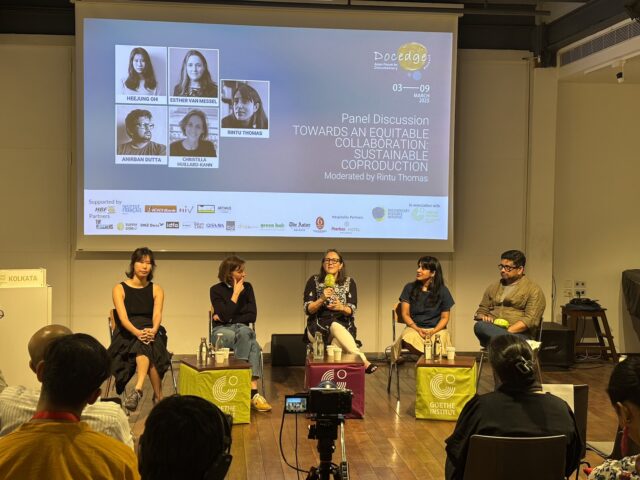
DocedgeKolkata last week hosted a panel titled “Towards an Equitable Collaboration: Sustainable Co-production” moderated by Rintu Thomas, (Writing With Fire). The discussion saw participation of Anirban Dutta (Director and Screenwriter), Esther Van Messel (Founder, First Hand Films), Christilla Huillard-Kann (Producer, ELDA Production; ex-Commissioning Editor, ARTE France) and Heejung Oh (Founder/Producer, Seesaw Pictures).
The panel began with Dutta emphasising the importance for all filmmakers of finding a suitable creative co-producer, terming it as the “most important collaboration.” He highlighted that though there are multiple ways of securing co-production deals, filmmakers need to be “conscious about their rights, and their vision for their creative producer”.
Drawing an example from his Nocturnes (2024), that went on to win a Special Jury Award at the 2024 Sundance Film Festival, Dutta recalls that the project had received a production grant of $100,000 from Sundance. At this juncture, taking on the equity funding route seemed more appropriate to the filmmakers, as they were not willing to compromise on intellectual property and co-production rights through an unsustainable deal.
“Sandbox Films who came in as equity funders took the credit as executive producers and funded over 65% of the film. Their co-production agreement was so good that no matter how much money the film would make, 50% of those profits would go to the director and primary producers — even if they were to cover 80% of the production cost,” he shared.
However, production paperwork differs from country to country. Speaking from the perspective of the Korean documentary industry, both as a filmmaker and producer, Seesaw Pictures’ Heejung Oh pointed out that the “landscape of financing and distribution of films after COVID-19 is changing,” turning the models of collaboration very fluid.
She drew attention to a general norm within the Korean documentary industry of it being rather self-sustainable, and not often seeking co-production deals. However, a long tradition of supporting Asian filmmakers exists, with DMZ Docs, EIDF and Busan International Film Festival opening several doors for artistic and financial collaborations, she added.
In terms of seeking production collaborations of any sort, she recommended “creating a model that serves you [filmmakers] best,”,which includes looking for producers bringing funds, understanding, creative knowledge, access and trust.
In terms of production collaborations with France, ELDA Production’s Christiia Huillard-Kann explained the complexity of applying for CNC funding. As an ex-commissioning leader at ARTE, she explained that her role involved preparing the financial plan and strategically advising the stakeholders.
A collaborating French co-producer — who is the only one eligible to draw grants from the CNC which primarily covers TV distribution —needs to be allocated creative and monetary stakes. For other formats, producers are also eligible to request funds from different French regions, but that requires a certain spend within the same area.
She cites a recent production from last year for which, in order to seek a grant of 40% from a specific French region, the filmmakers needed to spend at least 60% of the total film budget in that area — which included collaborations within France with a local editor and composer, and taking post-production work to the location.
However, in the case of a French producer investing a larger chunk of money, and being listed as the main producer on a project, they could also be responsible for accommodating additional post-production costs based on broadcaster or network requests. “We can say it’s fair on the paper,” Huillard-Kann commented.
“So the first thing to do when you co-produce is to discuss artistic rights,” she recommended. “This includes what you bring in the financial plan, the co-production, creativity or funding. You could also be an associate bringing a network partnership”.
Here, Thomas steered the conversation to the “criticality” of talking to sales agents and distributors right at the beginning. Esther van Messel, a Zurich-based distributor and producer, shared her experience of failed co-production deals, primarily due to conflicts surrounding artistic and production credits.
“It has to be clear that if you want to get something, you have to give something back in a fair way, as it doesn’t work any other way,” van Messel said, pointing towards the requirement for sharing production rights and other creative aspects. “But it’s really important that the filmmaker can convey their vision,” she continued.
“Filmmaking is a team effort, so we need to be able to communicate. What are our dreams? What are our fears? What do we want? What can we do? What can we not do? These questions begin in the creative and end in the legal.”
Thomas pointed out that, for filmmakers from the global south, acting affirmatively on the many themes discussed on the panel becomes a challenge as there are “no structures of financing or producing” locally available.
However, highlighting her experience on the Oscar-nominated Writing with Fire, which brought Norwegian and Finnish minority producers on board, she commented that having an early vision on the shared aspects of production enabled the filmmakers to settle on an equitable form of co-production. The filmmakers were able to secure a sizable amount of money earmarked for post-production in India, and only had to work on the sound mix in Europe.
Dutta then shifted the conversation to structural inequalities that stem from securing late-stage funding and giving up large credits to minority creative contributors. “The reason why these countries have money for documentaries – and other countries don’t – has been a centennial political fight, and it continues to be a fight, as the only way to keep these funds going is to reinvest in these regions,” van Messel agreed.
Having taken all perspectives into account, Thomas urged caution to filmmakers and reiterated the importance of choosing partners wisely. “Bring people into the home of your project who will fight for your film and not fight with you. Instead, choose people who can fight and negotiate with all these structures that we are tapping into.”






