“I just tried mentally and physically to make myself small and invisible,” Norwegian director and photographer Monica Strømdahl tells BDE how she blended into the background when making her debut feature documentary, Flophouse America (in International Competition in CPH:DOX and also screening in Movies That Matter and Visions Du Reel).
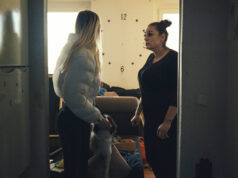
The film is set almost entirely within the tiny, cramped hotel room Mikal shares with his alcoholic parents and where he has lived almost all his life.
It opens with some grim statistics, read on camera by Mikal. The official poverty rate in the US is 11.5%, and that means approximately 34 million people live in extreme financial hardship. Mikal’s family are part of the country’s huge but invisible underclass.
The spark for the movie came after a cheap hotel in which Strømdahl herself had stayed was closed down because of what she calls “gentrification.” She saw then at first hand the devastation caused for families who had been living there. “I set out to document this lifestyle I thought was under pressure everywhere. It turns out that more and more people actually are in need of affordable housing.”
By chance, she had also happened to stay in a hotel where Mikal and his family were living across the hall. Mikal was 11 at the time of the first encounter. “I took an interest in them because I have met so many children in different states who lived in instability in hotels and motels. He was the first one I met who was actually born into the situation…he was raised there. He learned how to walk in those hallways.”
“We stayed in contact throughout the year because I was not able to forget about him. He had such an inner strength,” Strømdahl continues. “He was born with these circumstances – with two parents who suffer from alcohol abuse and they do the best they can for him. They want to provide him with a better childhood than they had…I saw him as a street-smart, very school-smart, strong-minded verbal kid who had learned how to navigate this reality he was born in. It was his strength that made me not forget about him.”
When she first proposed the film, the family eventually agreed to participate. “They were able to put their story in a context that was universal with generational trauma and the crossfire between poverty and parental addiction. They agreed that by shedding a light on those issues, they would feel seen – but others would [also] feel seen and empowered.”
Strømdahl was trying to stay out of the way as she filmed the family’s daily lives. “It was definitely…not easy,” she says. “It was extremely difficult to be there and witness Mikal’s struggles. Many times throughout the process, I thought this would not be a film in the end…there were a lot of ethical questions we had to take step by step.”
She started filming in earnest in 2018 when Mikal was 12 and spent around three years following him and his parents. “Because I am so polite, I wanted to knock on the door each time,” she remembers the early days of shooting, when she would be very cautious about approaching her subjects. The parents told her that she was “part of the family.”
She realised early on that Mikel wasn’t dreaming about having more space or money. What he yearned for most of all was for his parents to change their addictive behaviour.
Strømdahl is a distinguished photographer. Her work has been exhibited in galleries and printed in books and magazines. What do moving images offer that she can’t find in still images?
Her original plan, she explains, was actually to make a book about the family. This is a project she may still return to. “But I had a lot of conversations with people. It made such a big impact on me, talking to people…the experience of being there and meeting people was something that didn’t come across in the photographs, and it was left with me.”
When Strømdahl met Mikal and his family, she felt immediately that photographs on their own wouldn’t be enough to do justice to their story. “I wanted to give them space to speak, space to move.”
The director believes that viewers who “meet the family through the film” get a “more holistic feeling” of their lives than would have been possible through only still images. “I made this film the only way I could because I have never made a film before – so I had to go into it as a photographer,” Strømdahl says. She used a small camera and kept equipment to minimum. Although she talks about giving them space, she was also determined to come as close as possible to her protagonists and to show the claustrophobic nature of their world.
“The family made a huge impression on me and I still feel this deep care for them.”
This wasn’t an easy project to plan. “The learning curve has been steep,” Strømdahl notes. When she first approached producer Beathe Hofseth of Fri Film, she suggested the documentary would take about 10 weeks to make. Inevitably, it took far, far longer than that.
An impact campaign is now being put together in Norway to accompany the film’s release. Strømdahl points out that problems with alcohol, poverty and child neglect exist everywhere – and that includes in the Nordics.
“I am so proud of Mikal. He has finished high school. He did so well in his final tests that he was very close to getting a scholarship,” Strømdahl says of how her subject is turning his life around. He and his father won’t be in Copenhagen for the premiere but may attend future screenings. “I didn’t want to put them in a situation where I didn’t know what it was going to be like. It might be overwhelming both ways – with a lot of attention or a little attention. As much as possible, I want to protect them…”
Flophouse America is selected for the European Film Promotion (EFP) and CPH:DOX EUROPE! On Demand initiative designed to boost the visibility of European documentaries in the North American market.