Inna Shevchenko, the Ukrainian leader of feminist group Femen, gained fame and notoriety a decade ago with a series of topless stunts that led to her being labelled as “a witch, a satan and a daughter of the devil.”
In the new feature documentary Girls & Gods, co-directed by Arash T. Riahi and Verena Soltiz and premiering March 23 in the HUMAN:RIGHTS Award section of CPH:DOX, Shevchenko shows her debating skills as she asks female priests, rabbis, imams and theologians if their beliefs and their feminism can ever be reconciled. She’s respectful but very sharp in her arguments. As she puts it, she is in conflict with monotheistic religions simply “because all their gods are male.” The film is sold CATS&Docs.
Riahi, one of the moving forces behind leading Vienna-based production company Golden Girls Film, met Shevchenko in 2013 when she featured in Everyday Rebellion, his documentary about civil disobedience and non-violent protest.
“We made the film and stayed in contact. Inna was telling me this idea that after all these years of protest, she had met so many women who see themselves as feminists but who want to stay religious – but are not so happy with the patriarchal system in which religions are organised.”
Shevchenko told Riahi that she’d love to make a film about women who don’t reject religion but instead try to re-invent it from within.
There are many doing this but relatively few were ready to go on camera. “We had to travel many miles to find people who were willing to talk to us,” comments co-director Soltiz (whose previous credits include a documentary about footballer Thierry Henry).
At times, for example when shooting inside a synagogue, the filmmakers had to tread very carefully. “It was so difficult because of the recent attacks. Everybody was very afraid. It’s a very delicate topic. People get very easily offended personally when you talk about religion.”
Another challenge was that Shevchenko was such an intellectual “force” when it came to the discussions. It was a struggle to find subjects who could stand up to her. “That made the research even harder,” says Soltiz.
“And some people just reject the other side. If someone like Inna who is outspoken, and who they know is an atheist and against religion, wants to come and talk to them, they think she wants to frame them or make fun of them or to smash them,” Riahi agrees. He points out, though, that the “whole goal of the film was to build bridges,” not to destroy them. “It’s a reflection of our world, of course, that everyone is divided and they are in their own bubble,” he adds.
The filmmakers quickly realised that “90% of people who are religious are very peaceful. They don’t want to fight. They don’t want to convince anyone. They just want to live their religion.”
The downside is they don’t want to speak out. Riahi compares them to people who refuse to vote because they think the system is broken and they won’t be able to change anything. “Our film is about this. It is about waking the silent masses of believers who don’t want violence, who don’t want patriarchy, who don’t want misogyny in their religions and also don’t want war.”
There’s a revealing scene in which Shevchenko expresses her camaraderie with any woman she debates, regardless of their different views on religion and ideology. “I am secretly a friend of hers even though I am fighting her at that very moment.”
Interviewees include Nadya Tolokonnikov, one of the founders of Pussy Riot and who was sentenced to prison in Putin’s Russia for her protests and activism. Tolokonnikov and Shevchenko are two of the most famous feminist activists of their era but this was actually the first time they had met.
“It was really historic in a way. The reason why Inna had to leave her country [Ukraine] was that she cut down that cross in Kyiv in support of Pussy Riot. The whole rest of the life of Inna was influenced by that action – so it was really interesting when they met.”
For once, Shevchenko may even have been a little nervous but the two women very quickly stuck up a close rapport. “It was kind of love at first sight,” Riahi says.
With two strong-willed directors and such a formidable main protagonist, this was a challenging film to structure. “The rule was that if everyone is happy, then we go for that,” Soltiz explains how decisions were made. “We are actually friends. Of course, you have to put your ego somewhere else and think what benefits the project, not what benefits you.”
French cartoonist Coco, a survivor of the Charlie Hebdo attacks, is one constant presence throughout the movie. At several different points, the camera will cut back to her as she draws another of her witty but highly subversive feminist cartoons.
“We knew that we would have a lot of characters…we are dreaming of making a series out of it if someone is out there to get on board,” Riahi says there is enough unused material available to make a five-part series. Girls & Gods, though, is a film aimed at the big screen. It may have a lot of conversation and debate but the directors were determined to make it cinematic.
“We don’t have experts sitting there, in front of books and talking,” Riahi explains the structure. “We get on the journey with Inna and we observe her discussions with other people. No-one is talking into the camera.”
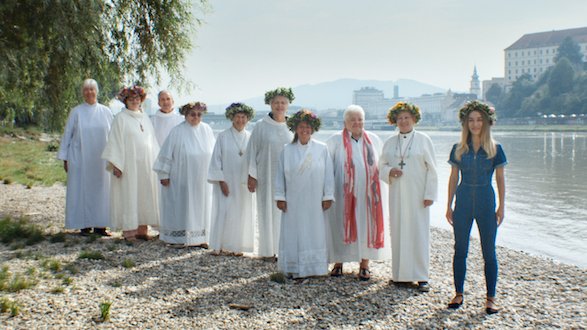
Little bits of observational humour are also sprinkled into the storytelling. For instance, at one stage, when Shevchenko is with female theologians and pastors by the Danube river, an elderly male canoeist rows by and seems utterly confounded by the idea of women priests.
“We hope this film is approachable, entertaining, deep and humorous at the same time…and sensitive and sensual,” Riahi says. “The film is a tool to make the world a little bit better.”
Girls & Gods is selected for the European Film Promotion (EFP) and CPH:DOX EUROPE! On Demand initiative designed to boost the visibility of European documentaries in the North American market.