

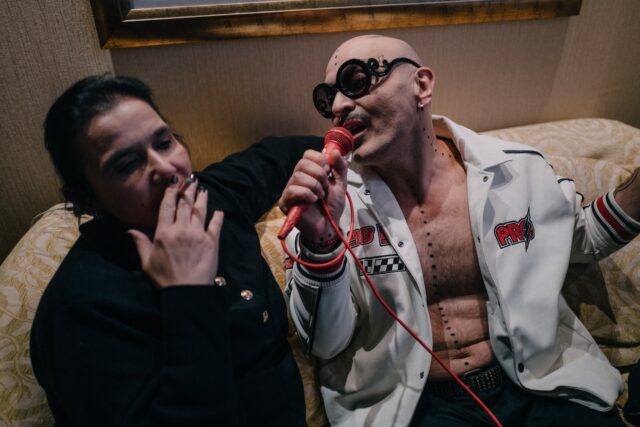
Queer artist Ivo Dimchev is a force of nature, radical and exuberant, promiscuous, bitchy but highly lovable, and with a voice like Elvis. But he harbours a profound bitterness towards his parents who never supported him when he needed it most. His mother never protected him from a violent father, and neither supported him when he came out in his late teens.
As we see in Kristina Nikolova’s In Hell with Ivo, which world-premieres in Munich, her protagonist’s response to the pandemic was to perform more than 400 private concerts in people’s homes in his home country of Bulgaria, as well as in Istanbul, New York, and Los Angeles. Did he compromise on his outrageous tendencies in folks’ homes? Not a bit of it. He continued to sing filthy songs about cocks and clits, prompting one old woman to exclaim afterwards, ‘wow, I just had a great orgasm.’
In his concerts, both in people’s homes and onstage, he offers his audiences a binary choice. In hell with Jesus, or in heaven with Trump? It’s provocative, but it’s not without foundation as Ivo is also a devout Christian, even if he lapses regularly. He has known the hell of HIV and Jesus accompanied him through his ordeal, he explains to an abrasive radio jock.
He also has a phenomenal skill for writing heart-breakingly beautiful songs, sometimes seemingly out of nowhere, as he does with his beloved nephew Alexander, a relationship that is presented in stark contract with the one he has with his parents.
The business of performance and audience-quizzing comes to a logical head when he returns home to his parents’ house In Bulgaria. He sings like an angel for them and his mum is in tears, but when he interviews them, demanding binary answers to highly personal questions about his upbringing and his sexuality, the tone shifts. Whether his parents find the showdown excruciating or cathartic, you’ll have to watch and see for yourselves, but whatever their emotional state at the end, the scene is dynamite for the audience.
At the beginning of the film we see Ivo on stage, goading director Kristina Nikolova to open her film with yet another binary question that he asks, this time about a very specific sexual preference. He ends up deciding that she won’t use it, concluding that she is too conservative to do so. Was this a fair assessment of her?
“I think 99% of people would be considered conservative compared to Ivo,” Nikolova responds. “I definitely lean more towards the middle. I’m married, monogamous, a parent—and naturally that shapes who I am.”
But his outrageousness was something she was nevertheless highly curious about. “In terms of how it influenced the film, I approached it with as much openness as possible. When he’d say, ‘this isn’t what being radically queer looks like,’ I would respond, ‘You’re right—I don’t know what that is. Tell me. Help me understand how to reflect that truth.’”
Such is the cinematic appeal of Ivo, Nikolova would show up to film, confident that whatever may unfold would be usable. But after a while, she began to demand more.
“It began with his home concerts, but I quickly realized that wasn’t enough. I wanted to understand the full picture—his family, his inner world,” she says. “He was hesitant about that, especially regarding his parents. But eventually, he agreed—with conditions. He’d say, ‘Fine, but then you need to include my theatre work, and I’d respond, ‘I’m more interested in your parents.’”
“It was a constant negotiation,” she goes on. “Any time I tried to introduce structure—something more formalized—it didn’t work. He was resistant to it. Over time, he began to understand the kind of documentary I was making, and he started contributing ideas—for instance, the home concert with the parents was his idea, which ended up being one of the most powerful scenes.”
Does the film, or at least the journey that Ivo takes, resonate on a universal level? Nikolova is not so sure. If it does, it is not in a way that would chime with her hero.
“I think it resonates for the very reasons he might dismiss—because of its emotional core,” she opines. “So many people, whether queer or not, understand what it’s like to long for acceptance from a parent. A father who doesn’t accept you, a mother who didn’t protect you—that’s deeply relatable. He might not want to be seen through that lens, but that’s where the emotional resonance lies.”
“And then there’s the sheer awe—people look at him and think, ‘could I ever be that brave? What would it feel like to be that free?’ Not voyeuristically, like looking at an animal at the zoo, but with admiration. He’s an inspiration, even as he provokes and challenges. He is also very funny. And, of course, there’s his music – which makes people cry.”
What did each learn from the other in the making of the film? “I think Ivo learned kindness from me. And I learned courage from him—the courage to take risks and to stop compromising all the time,” Nikolova answers.
“He is uncompromising to his core. I, on the other hand, have always been someone who tries to mediate, to find balance, to make everyone comfortable. That’s not necessarily the mindset of an artist. But it is useful for a documentary filmmaker. I’m able to see multiple perspectives and remain non-judgmental. For example, when filming his parents talk about Trump, I understand why they like him—I understood where they were coming from. Likewise, when Ivo laughed about why he’d follow Jesus over Trump, I understood that too.”
“Balance helps me in my work. But witnessing Ivo’s fearless authenticity reminded me that sometimes you have to take a stand—without apology,” she adds. “I watched him do it again and again, especially with his theatre performances. And that was inspiring, and I think changed something in me, just caring a little less what people think… That part, I learned from him.”
Questions to director Kristina Nikolova posed by Dimitra Kouzi.





