

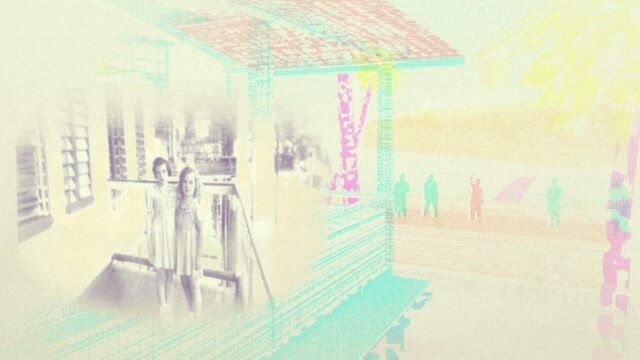
Corine Meijers of Utrecht-based Studio Biarritz is delighted that she was persuaded to come on board as producer of Lacuna by Maartje Wegdam and Nienke Huitenga Broeren, selected for Cannes Immersive Competition 2025.
The subject of the VR is Sonja, an 85-year-old Dutch woman with “keen and twinkling eyes” who was separated from her parents in 1943, an event she has no recollection of. Her parents died in Auschwitz. Sonja consequently grew up in Surinam. But the discovery of three silver napkin rings that once belonged to her parents determines directors Wegdam and Huitenga Broeren to prompt her more about her past, leading her gently through a labyrinth of fractured memories and reimaginings towards the crucial moment of loss and grief during WWII.
Producer Meijers was first contacted about Lacuna by Ilja Kok of Copper Views Film Productions. Kok had already financed a lot of the project but needed Meijers’ know-how in the field of VR. Launched in 2019, Studio Biarritz has (co)produced a slew of award-winning interactive titles, such as Steye Hallema’s The Imaginary Friend; Symbiosis by Marcel van Brakel, Juanita Onzaga’s Floating With Spirits and Polymorf’s Future Botanica.
But Meijers wasn’t sure, at least initially, why Lacuna had to be a VR. As a straight feature documentary, it was an already powerful concept with an excellent script.
When she spoke to director Maartje Wegdam, however, it was clear that an interactive approach would elevate the project into an altogether more personal and sensual realm. (Wegdam told See NL in January how she had been intrigued by the napkin story but Sonja could provide few answers about it. “That was the start of looking into what is not there, the gaps and omissions,” she said.)
“So Maartje’s urge was to really bring people into the memory world of Sonja,” Meijers underlines. “It was really her who pulled me over the line to work on the project.”
But in the same way that Meijers was brought in to apply her VR expertise on the production side, she further recommended that experienced immersive, digital story teller Nienke Huitenga Broeren (Drift, Rozsypne) should be brought in on the creative side. With everybody in place, the four-way team made for a “beautiful combination” that worked closely together to devise prototypes and to determine “the right way to tell Sonja’s story,” says Meijers.
The producer further elaborates on the choice of medium. “We hear someone talk about memories and some memories are clear, other memories are not so clear. Sometimes memories will change when you grow older. And while we viewers are listening to Sonja’s story, we add different layers visually where you enter the imagination. Some images are really clear, some images are vague, and I think that supports very much what the story is about,” Meijers says.
“In the VR you can walk in Sonja’s space and by moving towards specific objects or photos or letters, you will be able to have your own experience that will differ from the experience of someone else who will move differently in that space. So the visuals really support the story, but by being completely immersed in it, the experience is totally unlike what you would see on a 2D screen.”
The story of Sonja was complex and crosses continents, reaching from Amsterdam to Surinam where Sonja went to live with her aunt after her parents’ murder in Auschwitz. “We worked with different visual artists to create those worlds. And there was also the interactivity, how you could move in that space. That was something we had to find out because there’s so many choices you can make in VR. So it took a bit of time to try different things, do prototypes, make choices, talk about it together. And that is the time you really need with projects like this because little by little they become more solid and it all begins to make sense.”
There is always a very personal and emotional undertow to the projects that Meijers takes on, such as The Imaginary Friend, in which a grieving child struggles to separate reality from fantasy and therefore creates YOU – his (imaginary) friend – to fight the monsters in his mind.
“Yeah, they’re beautiful projects and people engage with them. They connect, they inspire people and I think they make the world a bit better.”
Lacuna world-premiered at IFFR to public acclaim, and has screened at EYE Film Museum throughout May, playing a significant part in the WWII memorial and liberation days.
“Sonja is still alive and she saw the piece and she really embraced it as well,” says Meijers. “I was really proud when we presented it in Rotterdam already. The VR will do its job and people will like it and maybe they will have questions, but it’s a powerful piece of work.”
The Cannes selection was a very nice moment, Meijers adds. “We submitted it and they started to ask me questions like, ‘oh, do you have a trailer?’ And they started to reach out a bit without saying anything, and I was like, oh, this feels good – let them reach out. It’s fine. Maybe they’ll select us…and then they did!”





