

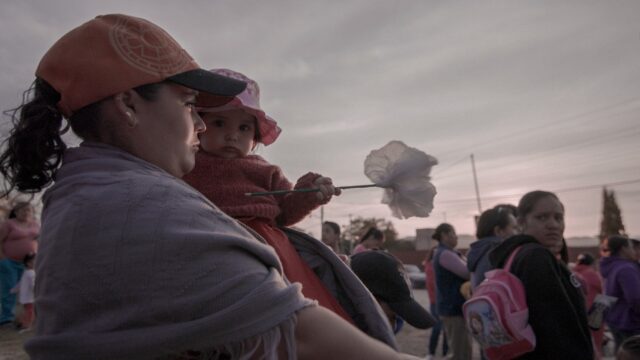
In The Age of Water by Isabel & Alfredo Alcántara, when young mother Nely discovers that the water in the Mexican town of La Cantera is deadly toxic, she decides to fight back, in the process finding herself leading a local resistance movement. Three girls in the local infant school had died of leukaemia, and Nely’s own daughter was moments from death had she not been rushed to hospital. She had an abnormally low platelet count and blood was issuing from her navel. She was in hospital for 21 days.
Together with five other women in the town, Nely forms the protest group MAYOYE, the title formed from the first initials of the three dead girls, Mafer, Yoselyn and Yessica, and enlists an expert in the form of Dr. Marcos Adrián Ortega, a lead researcher at the National Autonomous University of Mexico, UNAM. When they take local water readings, they discover that it contains 300 times the legal levels of radioactivity.
The source of the problem lies in over-extraction of the precious utility. Three per cent of Mexico’s water is on the surface and 97% is to be found in aquifers. But such is the country’s reliance on agriculture exports to the US and Europe, the surface water is not enough to feed the vast amount of vegetables, which means that one billion cubic litres are extracted from the aquifer, the film tells us. But fossil water, as the deep-lying subterranean water is called, is not renewable. It can also be ancient and contain large amounts of lethal chemicals such as arsenic and fluoride (which, despite its use within dental products, can be very dangerous if imbibed in excessive amounts).
Not that the authorities see it this way, especially the Stetson-wearing State Water Commissioner Humberto Navarro who is determined to mollify locals yet retain the status quo in order to keep the multinational food producers happy.
But Nely and her comrades are determined to take matters as far as possible – which includes having local water supplies shut off – even if they are vilified by townsfolk in the process…
Co-director Isabel Alcántara tells how she and her brother Alfredo “fell into the story” while investigating another waste water news item in Mexico. At that point they were introduced to scientist Ortega.
“He said, ‘it is really interesting that you guys are doing a piece about such a small part of the bigger water crisis happening around here,’” remembers Isabel. “Which kind of left us wondering…we were like, what are you talking about? There’s a water crisis? Could you tell us more about this? And he told us about what had been happening nearby. He was like, ‘I’m actually going to go to this community. They’ve asked me to do some water testing, so I’ll be there. Why don’t you come to tomorrow and bring your camera and just shoot?’”
When they arrived the seriousness of the story soon became evident. “We thought that it was this small localized thing, but it was huge. This was such a terrible thing that was happening in the community. We wanted to give them a voice. And then at the same time, we realized that this is just such a wake-up call for everybody dealing with water over-extraction.”
The filmmakers shot between 2015 and 2019 before they began to build the film in the edit, at which point the pandemic struck. That meant, however, they were granted time to better frame the story within the wider context of Mexican food production and agriculture. “We started shooting again in 2022, and we really focused on the big farm conglomerates because the rest of the story – it was pretty much already in the can. But then finishing just took forever. So here we are. We have finally wrapped up, which was, I think, good. It took as long as it needed to take because we wouldn’t have had access to all these places had we not established ourselves within the communities there for so long.”
The characters in the documentary are vibrant, not least the cartoon-like Humberto who is at times authoritative, at other times morally dubious as he tows the party line in defending state interests. The journey of Nely is fascinating, from mum to campaigner to Cassandra whose warnings about the water begin to fall on deaf ears.
Inevitably, other great characters went by the wayside in the telling of the story. “We realized that the [essence] of the film is the death of the three girls. Then we built out a little bit further to give us context and perspective. But to stay true to the story, you really do have to stay true to that essence.”
Alcántara pays tribute to editor Lawrence Jackman as well as story producer Lindsay Pernay. “He did an incredible job, and she was a genius because she had to go through about eight years of footage and say, ‘you guys are making five different documentaries, let’s just focus on one.’”
Funded by a plethora of lead institutions including Chicken & Egg and Women Make Movies, the film further underlines that over-extraction of water isn’t a problem confined to Mexico alone. The states of California, Kansas, Arizona and Colorado have also seen serious cases of water contamination following the dangerous practice.
“Definitely the audience reacts very strongly to the scientific component,” says Isabel. (The film world-premiered at Morelia in Mexico. Doxumentale marks the European premiere.)
“Something that was very gratifying for me as the director was having an audience watch something that’s taking place somewhere that’s pretty remote and immediately taking those circumstances, applying it to their own, and then coming up with questions about their own safety, about their own well-being, about their own position, if their own life is at risk because of things that they’re not necessarily aware of at the moment.”
“I’d say the vast majority of the world is reliant on groundwater extraction, but is unfortunately very unaware of over-extraction because we can’t see it happening. And humans are very visual creatures. So hopefully having the visibility of the film, hopefully showing people some real effects of this, will make an impact that way,” she adds.
From a grass roots Impact perspective, the team is working closely with local communities and organizations that are working to address the water problem.
“They’ve developed a plan to build brain water collection tanks in these communities that can harvest rainwater and filter it and keep it in these large tanks that can serve probably three or four families at a time,” says Isabel. “They figured out that it takes about $5,000 to build one of the tanks. They can build a few in each community, and we want to help them raise that money, develop those plans, and make sure that communities around the region have access to all of that so they can just start caring for themselves that way, since it seems the government is unwilling to provide other sources of water.”





